How to Screen 200 Job Applications Fast Without Losing Quality | GigForge
Organisations
How to Screen 200 Job Applications Without Losing Your Mind
Most hiring teams spend 15-20 hours per role reading CVs manually. Here is a step-by-step framework for screening 200+ applications in under an hour using structured scoring, smart filters, and AI-powered automation.
By Brabyns Yabwetsa21 April 202612 min read
You posted a job on Monday. By Friday, 200 applications have landed in your inbox. Now you are staring at a wall of CVs, cover letters, and LinkedIn profiles wondering how you are supposed to find the right person without losing an entire week to reading.
This is not a hypothetical. The average corporate job posting receives 250 applications. For popular roles at growing companies, that number can hit 500 or more. And most hiring teams — especially small ones without a dedicated recruiter — handle this with the same approach: open each CV, skim it for 30 seconds, make a gut call, move to the next one.
That approach breaks down at scale. It is slow, inconsistent, and almost guaranteed to miss strong candidates buried in the middle of the pile. Here is how to do it properly.
23 Hrs
Average time spent screening CVs per open role
Why Manual Screening Fails at Volume
The fundamental problem with manually reading CVs is not laziness or lack of effort — it is cognitive. Research on hiring decisions shows that recruiter accuracy drops significantly after reviewing more than 20 applications in a single session. By application number 50, you are making faster, more superficial judgements. By 100, you are essentially pattern-matching on surface cues like employer names and university brands rather than evaluating actual fit.
This creates two costly problems. First, you reject qualified candidates because their CV happened to land in the middle of your pile when your attention was lowest. Second, you advance candidates who looked good on a quick skim but do not actually match the role requirements — wasting interview time for both sides.
The real cost is not just time. It is the opportunity cost of the candidates you never saw clearly.
The goal of screening is not to find the perfect candidate. It is to create a shortlist of 10-15 people who are genuinely worth a conversation. Everything in this guide works toward that single objective.
Define Your Scoring Criteria Before You Read a Single CV
This is where most hiring teams go wrong from the start. They post the job, applications arrive, and they begin reading without a clear framework for what they are actually looking for. Every CV gets judged against a vague, shifting idea of "good" that changes based on whatever the last impressive application looked like.
Before you open a single application, write down 5-7 specific criteria that a candidate must meet for this role. Not qualities you hope for. Not nice-to-haves. The actual requirements that determine whether someone can do this job.
For example, if you are hiring a mid-level backend developer, your criteria might look like this:
Minimum 3 years of professional experience in backend development
Proficiency in at least one of: Python, Go, Java, or Node.js
Experience with relational databases (PostgreSQL, MySQL)
Has built or maintained APIs in a production environment
Based in or willing to work in your required timezone
Salary expectation within your budget range
Each criterion gets a weight based on how critical it is. Core technical skills might be weighted at 30%, relevant experience at 25%, specific tool proficiency at 20%, and so on. This weight system ensures you are comparing candidates against the same standard rather than against each other.
Write your criteria BEFORE the applications arrive. If you write them after you have started reading CVs, you will unconsciously anchor to the first few applications you saw, which biases your entire screening.
The Three-Pass Filtering System
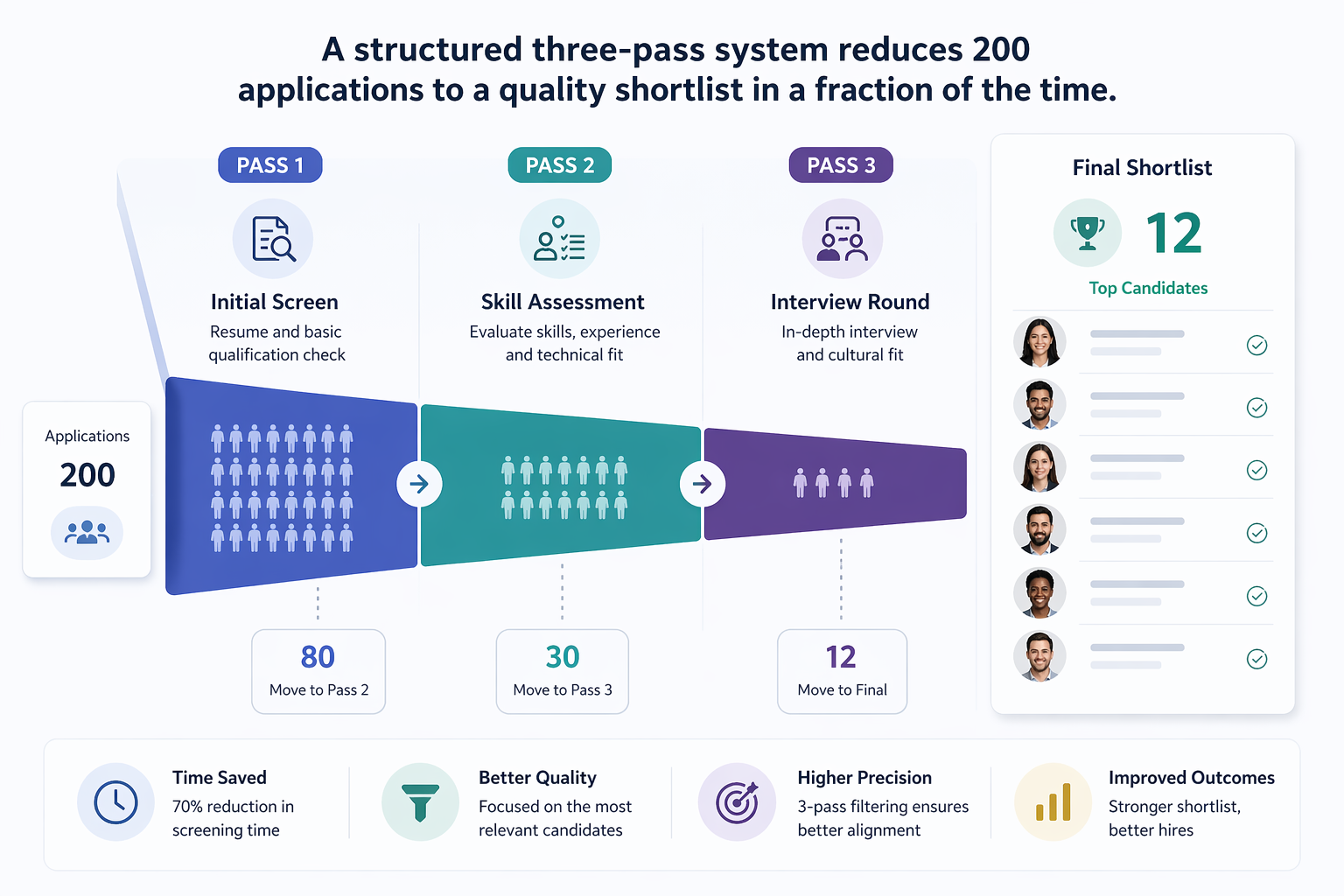
Instead of reading every CV thoroughly, use a three-pass system that progressively narrows the pool. This is how high-volume recruiters at companies processing thousands of applications actually work.
Hard Disqualifiers (2 minutes per application, eliminates 50-60%)
The first pass is purely mechanical. You are not evaluating quality — you are checking whether each application meets the absolute minimum requirements. Does the candidate have the required years of experience? Are they located in or willing to work from the right region? Do they have the core technical skill that is non-negotiable for this role?
You are scanning, not reading. Any application that fails a hard disqualifier goes into the "No" pile immediately. No second-guessing, no "but they seem promising otherwise." If they do not meet the minimum threshold, they cannot do the job as specified. This pass alone typically eliminates 50-60% of applications
Criteria Scoring (3-5 minutes per remaining application, eliminates another 50%)
Now you have roughly 80-100 remaining applications. This is where your weighted criteria come in. For each remaining candidate, score them against your 5-7 criteria. Use a simple 1-3 scale: 1 means they meet the minimum, 2 means they are solid, and 3 means they are exceptional for that criterion.
Multiply each score by the criterion weight, sum the totals, and you have a numerical ranking. This is not about reducing people to numbers — it is about creating a consistent, comparable evaluation that does not depend on which order you happened to read the applications in.
After this pass, take the top 25-30 candidates. Everyone below that line is a clear "not this time."
Deep Review (8-10 minutes per candidate, produces your shortlist)
You are now looking at 25-30 candidates closely. Read their CVs properly. Look at their career progression. Check if their experience descriptions show impact rather than just responsibilities. Look for specific achievements, measurable outcomes, and evidence that they have done work similar to what this role requires.
This is where you also check for red flags: unexplained career gaps that concern you, a pattern of very short tenures, or experience that sounds impressive on the surface but does not hold up under scrutiny.
The output of this pass is your shortlist of 10-15 candidates who are genuinely worth interviewing.
A structured three-pass system reduces 200 applications to a quality shortlist in a fraction of the time.
Use a Scoring Spreadsheet (Not Your Memory)
If you are screening more than 20 applications, you need a system to track your evaluations. Your memory is not reliable across 200 candidates reviewed over multiple days.
Create a simple spreadsheet with these columns: Candidate Name, each of your weighted criteria as separate columns, a Total Score column (auto-calculated), and a Notes column for anything that stood out. As you go through Pass 2, fill in the scores. When you are done, sort by Total Score descending. Your shortlist writes itself.
This has a second benefit: it creates a defensible record of how you evaluated candidates. If a rejected candidate asks for feedback, or if your team disagrees about who to advance, you have objective data rather than "I just had a feeling about them."
Never rely on memory alone when screening more than 20 candidates. Cognitive bias research shows that the first and last candidates you review receive disproportionate attention. A scoring system neutralises this bias.
Automate the First Pass Entirely
Everything described in Pass 1 — checking hard disqualifiers like minimum experience, required skills, and location — is repetitive, mechanical work. It does not require human judgement. It requires pattern matching. And that is exactly what AI does well.
Modern AI screening tools can read every application as it arrives, extract the relevant information, score it against your stated criteria, and present you with a ranked shortlist. The AI handles Pass 1 and most of Pass 2 automatically. You start your process at Pass 3 — the deep review — which is where human judgement actually matters.
This is not about removing humans from hiring. It is about removing humans from the part of hiring where they are slowest, least consistent, and most prone to bias. You still make every interview decision and every hiring decision yourself. The AI just makes sure you are looking at the right candidates.
85%
Reduction in screening time when using structured AI scoring
The teams that are hiring fastest in 2026 are not the ones with the biggest HR departments. They are the ones that automated the mechanical work and redirected their human attention to the decisions that actually require a human.
Let AI handle the first two passes
GigForge's AI screening reads every CV, scores candidates against your criteria, and gives you a ranked shortlist. You skip straight to the candidates worth meeting.
You now have a shortlist of 10-15 candidates. The traditional next step is to schedule 30-60 minute interviews with each one. That is 7-15 hours of interview time for your team — assuming no rescheduling, no no-shows, and no drawn-out coordination.
A faster approach is to add a brief voice screen between the CV shortlist and the full interview. A 10-15 minute structured conversation that covers three things: Can this person communicate clearly? Do they understand the role? Is there an obvious mismatch that their CV did not reveal?
This voice screen eliminates another 30-50% of candidates who looked great on paper but cannot articulate their experience, have unrealistic expectations, or simply are not what you expected. Your team only spends full interview time on the 5-8 candidates who passed both the CV screen and the voice screen.
AI voice interviews take this further. Instead of your team conducting 10-15 voice screens manually, an AI interviewer calls each candidate, asks role-specific questions, scores their responses, and delivers a detailed report with a hire or no-hire recommendation. Your team reviews the reports and decides who gets a full interview.
The combination of AI CV screening plus AI voice interviews means your team only personally interviews 3-5 candidates per role — all of whom have already passed two rounds of structured evaluation. That is the difference between a 20-hour hiring process and a 3-hour one.
The Complete Screening Framework: 200 Applications to Hired
Here is the full process from start to finish:
Before posting: Define 5-7 weighted scoring criteria for the role
Applications arrive: AI screening reads every CV and scores against your criteria automatically (or you do Pass 1 manually if not using AI)
Pass 1 result: 200 applications filtered to approximately 80 qualified candidates
Pass 2 result: Criteria scoring narrows 80 to your top 25-30
Pass 3 result: Deep review of 25-30 produces a shortlist of 10-15
Voice screen: Brief structured conversations (or AI voice interviews) eliminate another 30-50%, leaving 5-8 strong candidates
Full interviews: Your team meets only the candidates who have cleared three rounds of evaluation
Hire: Make the decision with confidence, backed by structured data at every stage
Total time for a hiring manager using this system: approximately 4-6 hours per role. Compare that to the industry average of 23 hours spent on screening alone — before interviews even begin.
What This Looks Like in Practice
A 15-person startup posts a frontend developer role. Within a week, 180 applications arrive. Without a structured system, the CTO would spend the next 10-15 hours reading CVs in the evenings, trying to remember who was good and who was not.
With this framework: AI screening processes all 180 applications overnight and scores each one against the five criteria the CTO defined before posting. The next morning, the CTO opens a ranked list. The top 12 candidates all scored above 80% fit. She spends 2 hours reviewing these 12 in depth, identifies 8 worth a conversation, and sends them AI voice interview links.
Within 48 hours, she has interview reports for all 8 candidates. Three are clearly strong. She schedules full interviews with those three. Total time invested by the CTO: approximately 3 hours across 3 days. She hires her first choice the following week.
This is not theoretical. This is the workflow that GigForge was built for — from job posting to AI screening to AI voice interview to hire recommendation, in a single platform.
Screen 200 applications in the time it takes to read 10
Post your job, define your criteria, and let GigForge's AI screen every applicant and conduct voice interviews. You just review the shortlist and hire.
Even with a good screening system, teams make predictable errors that undermine their results.
The first mistake is changing your criteria mid-process. You defined five criteria before screening, but after seeing 50 applications, you notice many candidates have a skill you had not considered. Resist the urge to add it retroactively. If you change the scoring criteria halfway through, every candidate you already evaluated was scored on a different standard. Finish the current round, then update your criteria for the next hire.
The second mistake is over-indexing on employer brand. A candidate from a well-known company is not automatically better than a candidate from a company you have never heard of. Your scoring system protects against this if you use it honestly. Score what the candidate actually did, not where they did it.
The third mistake is skipping the voice screen. CVs tell you what someone has done. Voice screens tell you how they think, communicate, and present themselves. These are different signals, and both matter. Skipping the voice screen means your first real data point on a candidate's communication ability is the full interview — by which point you have already invested significant time.
Start Screening Smarter Today
You do not need a 50-person HR department to screen 200 applications efficiently. You need a clear set of criteria, a structured scoring system, and a willingness to automate the work that does not require human judgement.
Define your criteria before the applications arrive. Use a three-pass filtering system. Score candidates numerically so you can compare them fairly. Automate the mechanical passes with AI. Add a voice screen before committing to full interviews. And track everything in a system — not your memory.
The result is less time screening, better shortlists, and a hiring process that scales with your growth rather than consuming it.
If you want to see this in action, post a job on GigForge for free. The AI screening and voice interview system handles the first two rounds entirely, and you start your process with a ranked shortlist and interview reports already done.