Why Your Resume Is Being Rejected by ATS — How to Fix It | GigForge
Job Seekers
Your Resume Is Being Rejected by a Robot. Here Is How to Fix It.
75% of resumes are rejected by ATS software before a human reads them. Learn exactly why your resume is being filtered out and the specific fixes that get you past the robots.
By Brabyns Yabwetsa20 April 20267 min read
You have polished your resume, tailored it for the role, and hit submit through the company portal. Two weeks pass. No rejection email. No interview request. Nothing. What happened?
Here is the uncomfortable truth: your resume was almost certainly rejected by an Applicant Tracking System before a human recruiter ever laid eyes on it. This is not a rare edge case. Industry data consistently shows that approximately 75% of resumes are filtered out at this automated stage.
75%
of resumes are rejected before a human reads them
What Is an ATS and Why Should You Care?
An Applicant Tracking System is software that companies use to manage the flood of job applications they receive. When you click "Apply" on a company's career page, your resume enters this system first. The ATS parses your document, extracts your information into structured fields, and scores you against the job description's requirements.
If your score falls below the hiring team's threshold, your application is automatically filtered out. The recruiter never sees your name. Companies like Workday, Greenhouse, Lever, and iCIMS power these systems, and nearly every employer with more than 50 employees uses one.
Key insight: ATS software does not read your resume the way a person does. It scans for specific keywords, checks formatting compatibility, and generates a numerical score. A beautifully designed resume with creative layouts can actually score lower than a simple, clean document — because the ATS cannot parse it correctly.
The 5 Most Common Reasons ATS Rejects Your Resume
1. Your layout confuses the parser
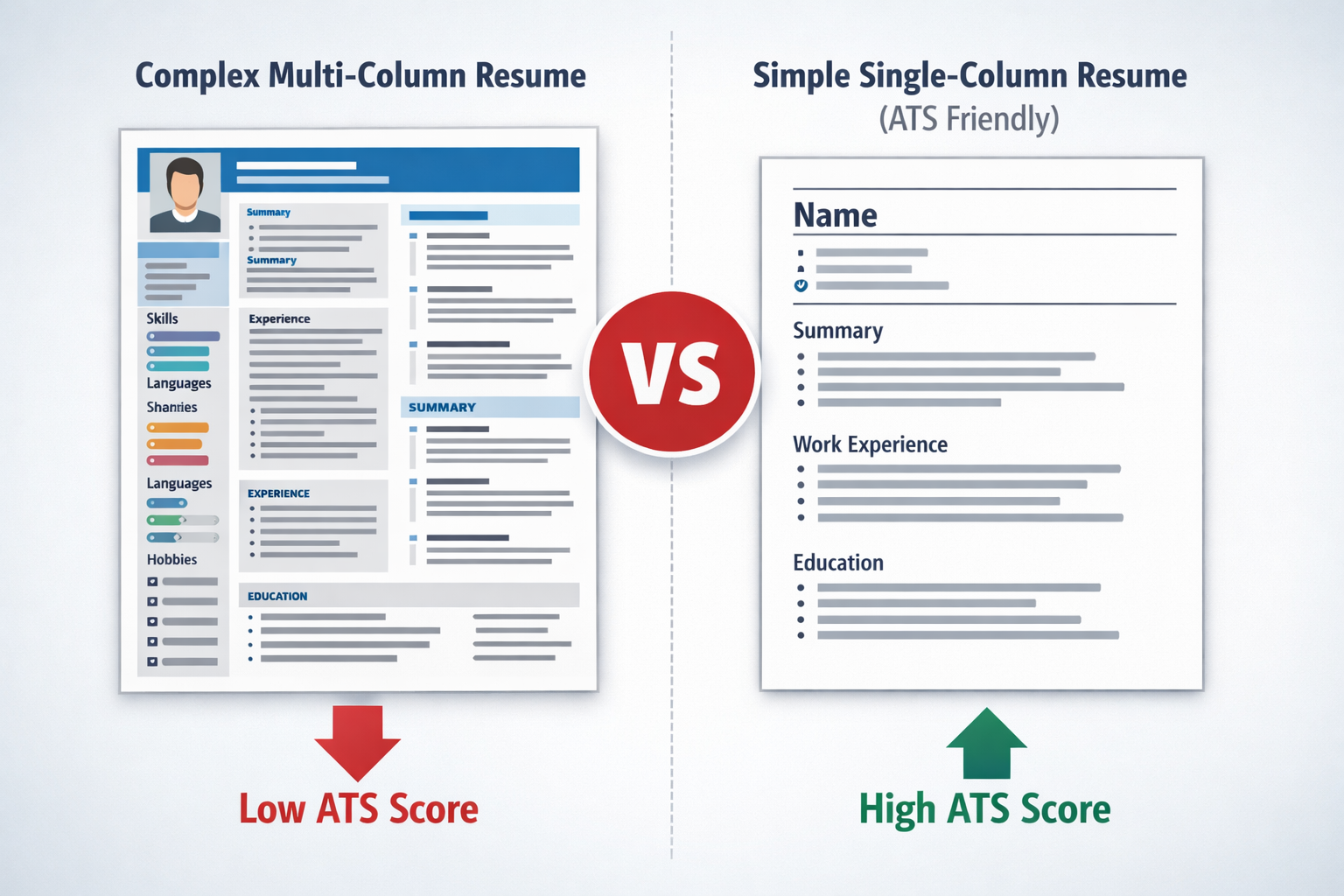
Multi-column layouts, text boxes, headers and footers, tables, and heavy graphics break most ATS parsers. The system either misreads the content order or skips entire sections. That creative two-column resume with the sidebar for skills? The ATS might read it as a jumbled stream of disconnected words. Your carefully crafted layout actually works against you.
Comparison of a complex multi-column resume layout versus a simple single-column ATS-friendly format
2. You are missing keywords from the job description
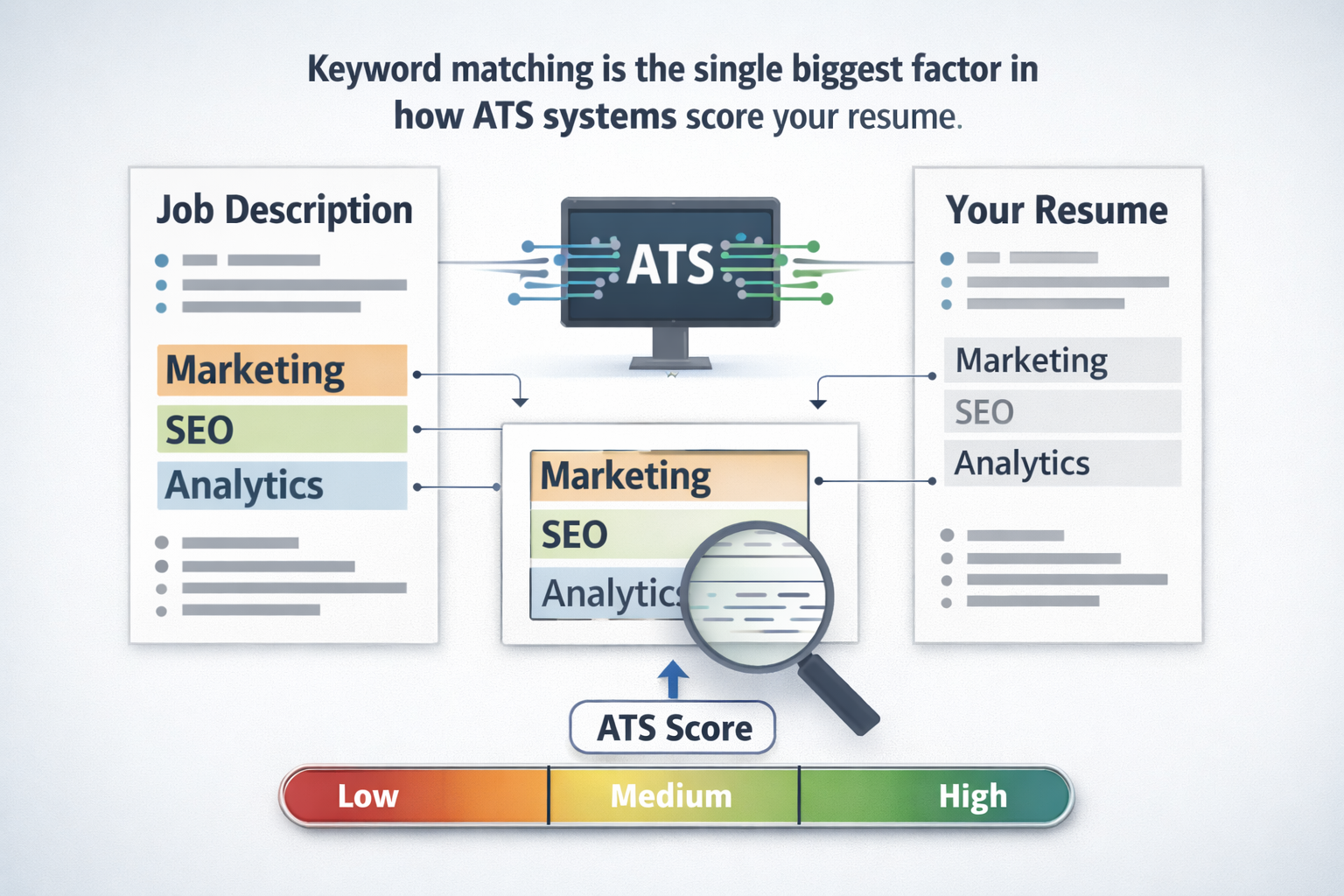
ATS systems match your resume text against the specific language in the job posting. This is not fuzzy matching — it is often literal string comparison. If the posting says "project management" and your resume says "managed projects," some systems will not register the match. If the posting lists "Python, Django, PostgreSQL" and you wrote "programming languages," you have zero keyword matches for three critical skills.
The fix is straightforward but requires discipline: read the job description carefully before every application and mirror its exact language in your resume. Not stuffing keywords randomly — placing them naturally in your experience descriptions where they genuinely apply.
3. Your section headings are too creative
ATS systems look for standard section labels to categorise your information. They expect to find "Work Experience" or "Professional Experience" — not "My Journey." They look for "Education" — not "Where I Learned." They scan for "Skills" — not "What I Bring to the Table."
Creative headings might impress a human reader, but they prevent the ATS from correctly filing your information. If the system cannot identify your work history section, it may score you as having no relevant experience at all.
4. Your achievements lack measurable results
Beyond keyword matching, modern ATS systems increasingly evaluate specificity. "Improved team performance" is vague and scores lower than "Increased quarterly sales by 23% across 4 regional teams over 6 months." Numbers, percentages, timeframes, and concrete outcomes give the ATS — and eventually the recruiter — something tangible to evaluate.
Every bullet point in your experience section should follow the formula: Action + Context + Measurable Result. Not "Responsible for marketing campaigns" but "Designed and executed 12 email marketing campaigns reaching 45,000 subscribers, achieving a 34% average open rate."
5. You are applying at the wrong level
Some ATS configurations score years of experience against the role's stated requirements. If a Senior Developer role specifies 5-7 years of experience and your resume shows 2 years, the system may auto-reject before any human evaluation occurs. This also works in reverse — applying for a junior role with 15 years of experience can trigger an "overqualified" flag.
Check the experience requirements before applying. If you are within one year of the range, apply. If you are significantly outside it, your application is likely wasted effort regardless of your actual capability.
Keyword matching is the single biggest factor in how ATS systems score your resume.
How to Fix Your Resume for ATS (Without Making It Boring)
Optimising for ATS does not mean stripping your resume of all personality. It means making structural and language changes that let the machine read your content correctly — so a human eventually gets the chance to appreciate it.
Here are the specific changes to make:
Use a single-column layout — remove all text boxes, tables, columns, sidebars, and graphics. The ATS reads your content top to bottom, left to right. Anything that disrupts this flow creates parsing errors.
Mirror the job description language exactly — if the posting says "stakeholder management," use that exact phrase in your experience section. Do not paraphrase it as "working with stakeholders" or "managing relationships."
Use standard section headings — Work Experience, Education, Skills, Certifications, Summary. Nothing creative, nothing ambiguous. Save the creativity for your cover letter.
Submit as a clean PDF or .docx — avoid image-based PDFs, scanned documents, or heavily formatted files. Some older ATS still parse .docx more reliably than PDF, so submit both if the portal allows it.
Quantify every achievement — replace vague descriptions with specific numbers. Revenue generated, percentage improvements, team sizes managed, deadlines met, budgets handled. Numbers pass both the ATS keyword check and the recruiter's 6-second scan.
Include a skills section with exact technology and tool names — do not bundle them under vague categories. List "Python, Django, PostgreSQL, Docker, AWS" not "Various programming languages and cloud platforms."
Check your resume's ATS score — free
GigForge's ATS Analyzer scans your resume against real job descriptions and shows you exactly what to fix before you apply.
Getting past ATS is the first gate, not the finish line. Your resume then reaches a human recruiter who spends an average of 6 to 8 seconds on an initial scan. This means the top third of your resume — your name, current title, summary statement, and first two bullet points — must immediately communicate your fit for the role.
This creates a second trap that many candidates fall into: they over-optimise for the machine and produce a resume that reads like a keyword list rather than a career narrative. The best resumes pass ATS scoring and read compellingly to a human skimming quickly. Keywords should be embedded naturally within strong, specific achievement statements — not dumped into a hidden section or repeated unnaturally.
After optimising for ATS, read your entire resume out loud. If it sounds like a keyword-stuffed list rather than a confident narrative of what you have actually accomplished, you need to rewrite. The goal is keywords placed naturally within strong achievement statements. Both the machine and the human should be satisfied.
Stop Getting Filtered Out
Your resume is not being rejected because you are unqualified. It is being rejected because software cannot parse it correctly. Fix the format, match the language, quantify your results, and use standard section headings. These changes take 30 minutes and can be the difference between silence and an interview.
If you want to see exactly how your resume scores right now against a real job description, try GigForge's free ATS Analyzer. Upload your CV, paste the job posting, and get a detailed compatibility score with specific recommendations — in under 30 seconds.
Stop getting rejected by robots
Scan your resume against any job description and get a detailed ATS compatibility score in seconds.