
You've been in your role for a while. You're good at it. Maybe even great at it. But something's off. You keep getting passed over for the promotion. Or you're applying for senior roles and not getting interviews. Or you're watching people with less experience move into positions you thought you were qualified for.
And the frustrating part is nobody tells you why. Your manager says "keep doing great work." The rejection emails say "we decided to go with another candidate." Nobody sits you down and says "here's the specific thing that's standing between you and the next level."
That thing has a name. It's called a skills gap. And until you identify it, you'll keep running into the same invisible wall over and over.
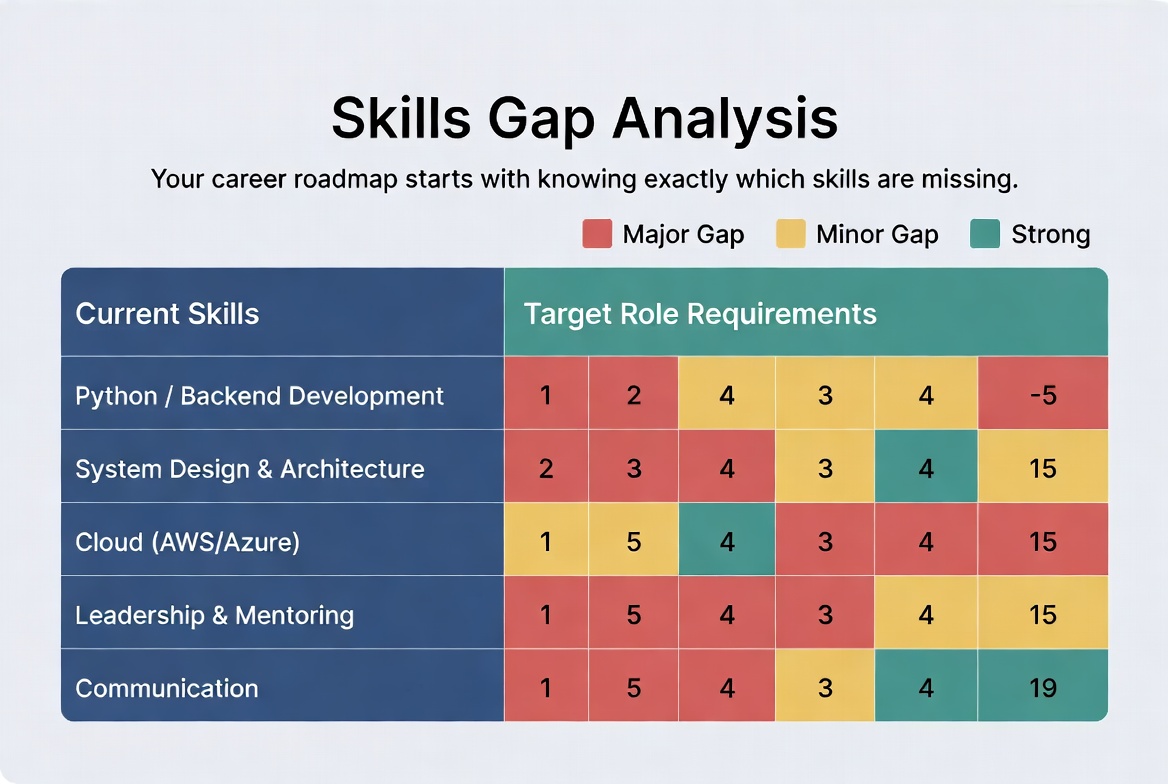
I ran a skills gap analysis on myself when I was trying to figure out my next career move. What surprised me was that the gaps weren't in my technical skills — those were solid. The gaps were in areas I hadn't even thought about: system design thinking, stakeholder communication, and strategic planning. Once I could see the gaps clearly, I knew exactly what to work on instead of just 'trying harder' at things I was already good at.
What a Skills Gap Analysis Actually Is (The Individual Version)
Most "skills gap" content online is written for HR departments doing workforce planning across 500 employees. That's not what you need. You need the individual version — a personal assessment that compares the skills you currently have against the skills required for the specific role you want next.
Think of it like a GPS for your career. You know where you are (your current skills). You know where you want to be (the target role). A skills gap analysis shows you the exact route between them — which skills to build, which to strengthen, and which you can skip because they're already solid.
The output is simple: a list of 3-7 specific skills you need to develop, ranked by how critical each one is for the role you're targeting. That's it. No complicated frameworks. No 50-page assessment. Just a clear, actionable list that tells you exactly where to focus your development time.
How to Do One Yourself in 30 Minutes
You don't need to hire a career coach or take a $500 assessment to do this. Here's the process — grab a notebook or open a spreadsheet.
Step 1: Find 5 job descriptions for your target role (10 minutes)
Go to LinkedIn, Indeed, or any job board and search for the exact role you want next. Not your current role — the next one. If you're a developer who wants to become a tech lead, search "tech lead." If you're a marketing coordinator who wants to be a marketing manager, search "marketing manager."
Find 5 job descriptions from different companies. Copy them into a document. Now read through all 5 and highlight every skill, tool, qualification, and requirement that appears in at least 3 out of 5 postings. Those are the consensus skills — the things the market collectively agrees this role requires.
Ignore anything that only appears in 1 posting. That's company-specific. Focus on the patterns across multiple postings.
Step 2: Rate yourself honestly on each skill (10 minutes)
Take your list of consensus skills and rate yourself on each one using a simple scale:
Strong (3): You could do this confidently in a new job starting tomorrow. You have real experience and results to prove it.
Developing (2): You've done this occasionally or in limited scope. You understand the basics but haven't done it at the level the target role requires.
Gap (1): You haven't done this meaningfully. You might understand the concept but have no practical experience.
Be brutally honest. This assessment is for you, not for an interviewer. Rating yourself "Strong" on something you've only watched a YouTube video about doesn't help you — it just hides the gap.
Step 3: Prioritise the gaps (10 minutes)
You probably have 3-7 skills rated as Gap or Developing. Now rank them by two factors:
How critical is this skill for the target role? Some gaps are dealbreakers — you literally cannot do the job without this skill. Others are nice-to-haves that you could learn on the job. The dealbreakers go to the top of your priority list.
How long will it take to close? Some skills take months of practice (leadership, system design, strategic thinking). Others can be learned in a few weeks (a specific tool, a certification, a framework). Quick wins go first because they build momentum and confidence.
The sweet spot is a gap that's both high-criticality and relatively quick to close. Start there. That's the skill that gives you the biggest career return for the least time invested.
The Gaps Nobody Talks About
Here's something I've noticed that most skills gap content misses entirely. The gaps holding you back are almost never the obvious technical skills. Those are the easy ones to identify and the easy ones to close. The gaps that actually keep people stuck are the invisible ones — the skills nobody mentions in job descriptions but everyone evaluates in interviews and promotions.
Communication at the next level
A developer writes code. A tech lead explains technical decisions to non-technical stakeholders. A marketer runs campaigns. A marketing manager presents strategy to the C-suite. Every career jump requires communicating at a higher level — different audience, higher stakes, more ambiguity. If you're getting "not ready" feedback without clear reasons, this is often the real gap.
Scope of thinking
Individual contributors think about their tasks. Managers think about their team's output. Directors think about their department's strategy. Each level requires widening the lens. If you're still thinking at the task level when the role requires strategic thinking, that's a gap that no certification will close — it requires deliberate practice in thinking bigger.
Dealing with ambiguity
Junior roles have clear instructions. Senior roles have vague problems. The gap between "tell me what to do" and "figure out what needs doing" is enormous, and it's rarely listed in a job description. If you need detailed requirements before you can start working, that's a gap worth addressing.
Ask your manager or a trusted colleague this question: "If you were hiring for the role above mine, what skill would you say I most need to develop?" Their answer might surprise you. People who work with you daily see gaps you can't see yourself. One honest conversation can replace hours of self-assessment.
Closing the Gaps — What Actually Works
Identifying your gaps is the first half. Closing them is the second. And most people get this part wrong because they default to the same approach for every gap: take a course. Courses work for some gaps. They're useless for others.
For technical skill gaps: learn by buildinG
Need to learn React? Don't take a 40-hour course. Build a small project with React. Need to learn data analysis? Take a real dataset from your current job and analyse it. Applied learning beats passive learning every single time. You retain more, you build portfolio evidence, and you can show concrete results in your next interview.
For soft skill gaps: learn by putting yourself in situations
Communication skills don't improve from reading books. They improve from communicating in high-stakes situations. Volunteer to present at team meetings. Ask to lead the next project kickoff. Offer to write the quarterly update email. Each situation is practice that builds the muscle.
For strategic thinking gaps: learn by studying decisions
Read case studies of how companies made strategic decisions. When your company makes a big decision, try to understand the reasoning behind it. Start proposing solutions, not just identifying problems. Strategic thinking isn't a skill you learn in a course — it's a habit you develop by consistently asking "why" and "what's the bigger picture."
Let AI Do the Analysis For You
The manual method I described above works. But it takes time and self-assessment is inherently biased — we all have blind spots about our own abilities.
GigForge's AI career coach does this analysis automatically. It takes your profile data — your skills, experience, projects, education — and compares it against any target role you specify. It identifies the specific gaps, ranks them by importance, and suggests a learning path for each one. Instead of you reading 5 job descriptions and guessing how you measure up, the AI does the comparison objectively using the same data that ATS systems and recruiters evaluate.
It also generates a visual career roadmap showing the steps from where you are to where you want to be, with estimated timelines for closing each gap. Think of it as the GPS metaphor brought to life — your current position, your destination, and the turn-by-turn directions to get there.
Find your skills gaps in 2 minutes
Tell GigForge's AI career coach your target role and it analyses your profile, identifies specific gaps, ranks them by importance, and creates a learning roadmap. No guessing. No self-assessment bias.
Analyse My Skills Gaps →The Career Move That Changes Everything
Most people approach career growth by doing more of what they're already good at. Working harder. Putting in longer hours. Taking on more projects. And then they're confused when it doesn't lead to the next level.
The reason is simple: the next level doesn't need someone who does more of the same thing. It needs someone who does different things. A skills gap analysis shows you exactly what those different things are. Once you can see the gaps, every hour of development time you invest is targeted instead of random. You stop taking courses that make you feel productive but don't actually move you forward. You start building the specific capabilities that the next role requires.
The career ladder isn't about climbing harder. It's about building the right rungs. Find your gaps. Close them deliberately. And if you want to prepare for the interviews that come once you've closed those gaps, make sure you're ready for the 10 most common interview questions — because knowing your skills is only half the battle. Articulating them in an interview is the other half.
Ready for the interview? Practice before it counts.
Once you've closed your skills gaps, practice articulating your growth in mock interviews. AI scoring and feedback on every answer.
Practice Interviews Free →
Make your resume impossible to ignore.
Check your ATS score, rebuild your resume for any job, practice interviews with AI, and track every application — all free.
Try the ATS Analyzer freeNewsletter
Stay one step ahead.
Get the best hiring, career and freelance insights delivered to your inbox. No spam, unsubscribe anytime.
Keep reading

How to Find Remote Jobs in 2026 (Where to Look and How to Stand Out)
Remote job listings get 10x more applications than office roles. That means the competition is brutal — unless you know where to look and how to stand out. Here's the complete playbook for landing remote work in 2026.

How to Negotiate Salary After a Job Offer (Without Losing It)
You got the offer. Now comes the part nobody prepares you for — asking for more money without losing the job. Here's the exact script, the timing, and the mindset that gets you 10-20% more.

75% of Resumes Never Reach a Human — ATS Explained
You applied. You waited. Nothing happened. Not because you weren't qualified — because software rejected your resume before a human opened it. Here's exactly how ATS works and how to make sure your resume gets through.