75% of Resumes Never Reach a Human — ATS Explained (2026 Guide) | GigForge
Job Seekers
75% of Resumes Never Reach a Human — ATS Explained
You applied. You waited. Nothing happened. Not because you weren't qualified — because software rejected your resume before a human opened it. Here's exactly how ATS works and how to make sure your resume gets through.
By Brabyns Yabwetsa5 June 202614 min read
There's a reason you're not getting interviews. And I need you to hear this clearly because most job seekers never find out — they just assume they're not good enough and eventually stop trying. That's not what's happening. What's happening is much more specific, much more fixable, and honestly much more infuriating once you understand it.
Roughly 75% of resumes submitted online are rejected before a human recruiter ever reads them. Not reviewed and rejected. Not considered and passed over. Never seen. Never opened. Filtered out automatically by software that decided — in about 3 seconds — that your application didn't meet a minimum threshold. Your name, your experience, your carefully written cover letter — all of it sitting in a database that nobody will ever look at.
That software is called an ATS — Applicant Tracking System. And if you're applying to jobs online in 2026 and you don't understand how it works, you're essentially applying blindfolded.
ℹ️
I didn't know what ATS was until I started building the employer side of GigForge. When I saw how screening actually works — how the software parses resumes, extracts keywords, and scores candidates — I was genuinely shocked. I immediately understood why talented people I knew personally were getting zero responses. Their resumes were being thrown out by a machine before any human made any decision. That's when I built the ATS analyzer tool — because I think every job seeker deserves to see what the machine sees before they click submit.
What Is ATS? The Simple Version.
An Applicant Tracking System is software that companies use to manage job applications. Think of it like email for recruiters — except instead of an inbox with messages, it's an inbox with resumes. Every mid-size and large company uses one. Many small companies do too. The most common ones are Greenhouse, Lever, Workday, iCIMS, and BambooHR, but there are dozens.
When you click "Apply" on a job listing, your resume doesn't land on someone's desk. It enters the ATS. The software then does three things to your application, and understanding each one is the difference between getting interviews and getting silence.
Step 1: Parsing — The ATS reads your resume
The first thing the ATS does is "parse" your resume. This means it reads your document and tries to extract structured information — your name, email, phone number, work history, education, skills. It converts your beautifully formatted resume into plain data fields in a database.
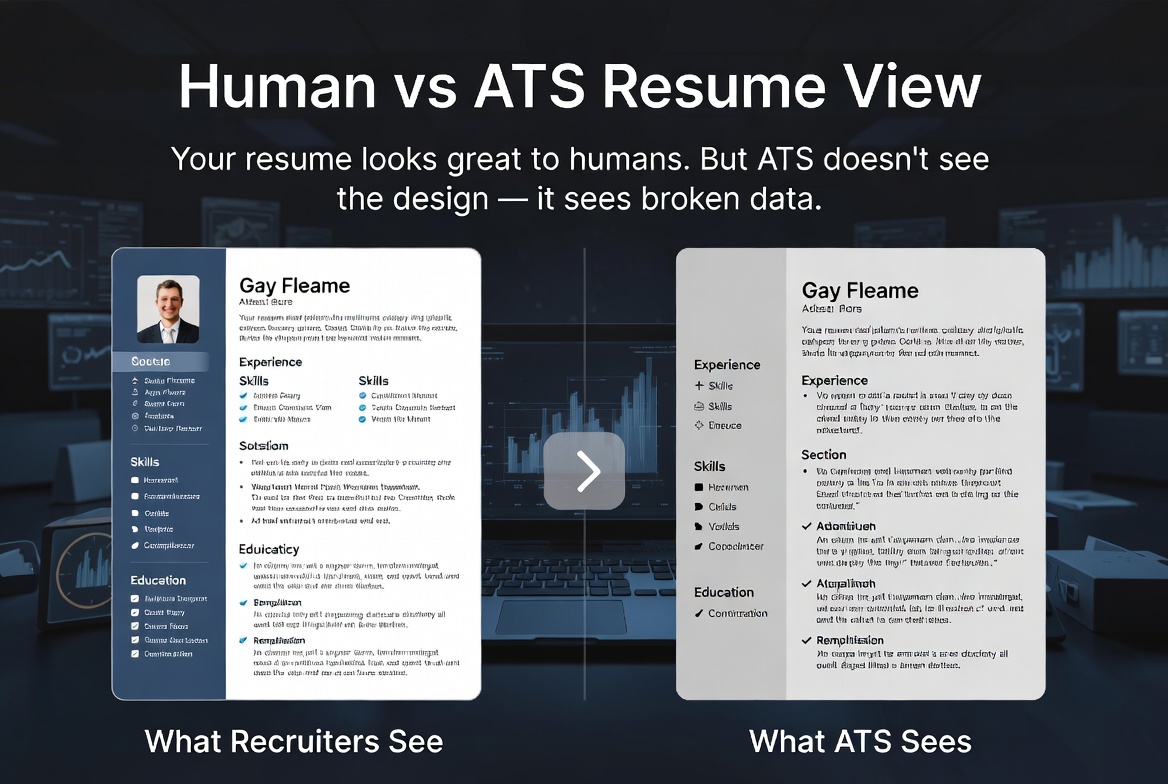
Here's where the first problem starts. The ATS reads your resume top to bottom, left to right, in a single stream of text. It doesn't "see" your resume the way a human does. It doesn't understand two-column layouts. It can't interpret text inside images, graphics, charts, or skill rating bars. If your contact information is in a header or footer, many ATS systems skip it entirely because they only read the main body.
So that gorgeous resume you designed in Canva with the sidebar for skills, the photo in the top right corner, and the creative icons next to each section heading? The ATS sees a garbled mess of text in the wrong order with missing information. Your name might be parsed as a job title. Your skills section might be invisible. Your work experience might be scrambled because the two-column layout confused the left-to-right reading order.
Your resume looks great to humans. But ATS doesn't see the design — it sees broken data.
Step 2: Keyword Matching — The ATS scores your resume
Once the ATS has extracted your information, it compares what it found against the job description. This is primarily keyword matching. The job post says "React.js" — does your resume contain "React.js"? The job requires "project management" — does that exact phrase appear in your resume?
Each keyword match adds to your score. Each missing keyword lowers it. The more your resume's language mirrors the job description's language, the higher you score. The less overlap, the lower you score.
And this is where most qualified candidates get eliminated. Not because they lack the skills — but because they described those skills using different words than the job post used.
The job says "project management." Your resume says "managed multiple projects." Close enough for a human. Not close enough for many ATS systems — they're looking for the exact phrase "project management" as a noun, not "managed projects" as a verb. The job says "React.js." Your resume says "frontend development." You know React — it's your strongest skill. But the ATS doesn't know that because the specific word never appears.
This is not intelligent analysis. This is pattern matching. And your score depends entirely on whether the patterns in your resume match the patterns in the job description.
3 seconds
Average time for ATS to scan, parse, and score your entire resume
Step 3: Filtering — The ATS decides your fate
The final step is the filter. The employer sets a minimum score threshold — often around 60 or 70 out of 100. Every applicant who scores above that threshold gets passed to the recruiter's review queue. Everyone below it gets automatically filtered out.
Filtered out doesn't mean "placed lower on the list." It means invisible. The recruiter's dashboard shows only the candidates who passed the threshold. Your application still exists somewhere in the database, but nobody is looking at it. Nobody will ever look at it. And you won't receive a rejection email because as far as the system is concerned, you were never a real candidate — you were filtered data.
That's how 75% of applications disappear. Not through human judgement. Through automated pattern matching against a threshold that you never knew existed.
⚠️
Here's what makes this especially painful: the ATS doesn't know if you're qualified. It doesn't understand context, nuance, or potential. It's comparing text strings. A candidate with 10 years of perfect experience who formats their resume in two columns and uses different terminology than the job post will score lower than a fresh graduate who used the exact right keywords in a single-column format. The system rewards format compliance, not talent. Which is exactly why you need to understand the rules before you play the game.
Why Companies Use ATS (And Why They're Not Going to Stop)
Before you get angry at ATS — and I think frustration is completely valid — it helps to understand why every company uses one. It's not because recruiters are lazy. It's because the alternative is worse.
A single job posting on LinkedIn can generate 200-500 applications. A popular role at a well-known company can get over 1,000. No human being can read 500 resumes thoroughly. Even spending just 2 minutes per resume, that's over 16 hours of non-stop reading for one job. Recruiters typically manage 15-25 open roles simultaneously. The maths simply doesn't work without automation.
ATS software solves a real problem. The issue isn't that companies use automated screening — they have to. The issue is that most ATS systems are blunt instruments. They use keyword matching when they should use contextual understanding. They penalise formatting when they should be format-agnostic. They filter binary (pass/fail) when they should rank on a spectrum.
That's actually why we built AI-powered CV screening at GigForge to work differently. Instead of simple keyword matching, the AI actually reads and understands the resume content — recognising that "managed projects" means the same thing as "project management," and that 3 years at a fast-growing startup might be more relevant than 5 years at a slow-moving corporation. But that's the employer side of things. On your side — the job seeker side — the reality is that most companies you're applying to are still using traditional keyword-matching ATS. So you need to play by those rules.
The 7 Things That Get Your Resume Thrown Out by ATS
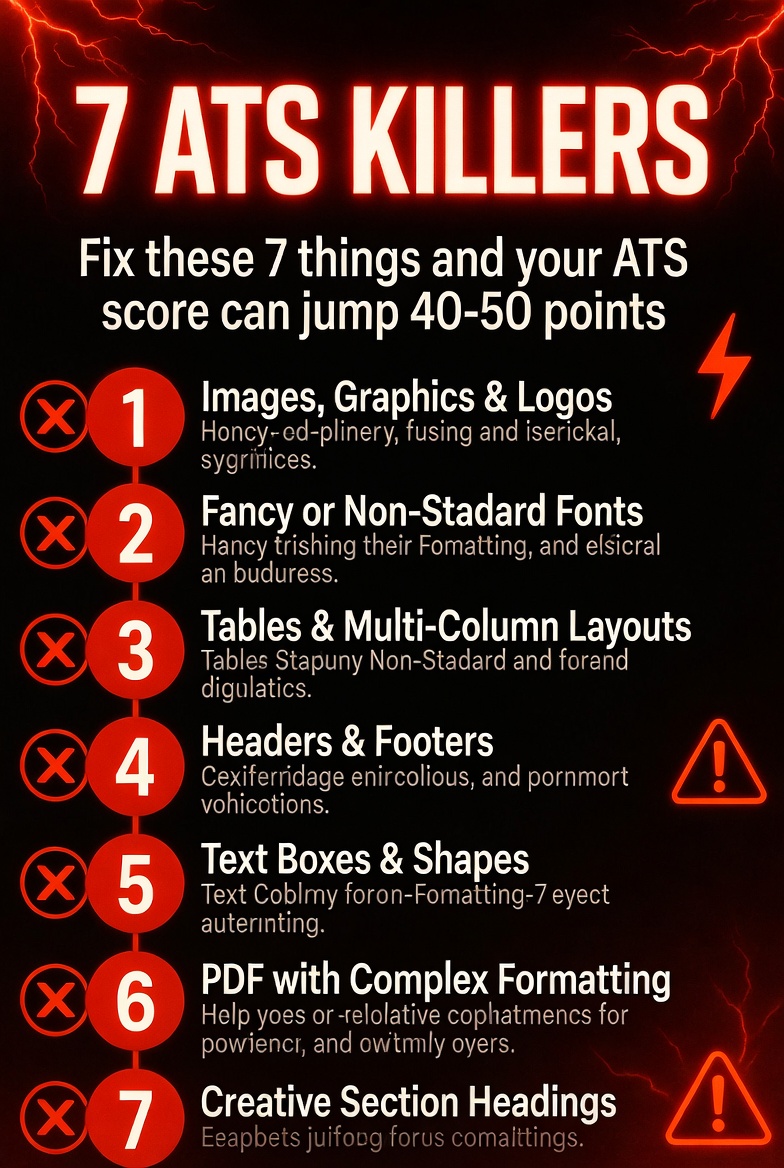
Now that you understand how the system works, here are the specific things that cause qualified resumes to fail. Fix these and your ATS score will jump dramatically — often from below 40 to above 80 with the same content.
1. Multi-column layouts
This is the number one ATS killer and the most common formatting choice on creative resumes. Two columns, sidebars, text boxes — all of these break the top-to-bottom, left-to-right reading order. The ATS might read your left column first, then your right column, jumbling your work experience with your skills section. Or it might only read one column and miss half your resume entirely. Switch to a single column. Always.
2. Graphics, icons, and images
Skill rating bars (those little circles or progress bars showing "JavaScript: 4/5") are completely invisible to ATS. The software cannot read images. Same for icons next to section headings, decorative lines, charts, or your profile photo. Everything in your resume should be selectable text — if you can't highlight it and copy-paste it, the ATS can't read it.
3. Creative section headings
"Where I've Made an Impact" instead of "Work Experience." "My Toolkit" instead of "Skills." "The Journey" instead of "Education." These creative headings might look good, but the ATS is programmed to look for standard headings. When it can't find "Work Experience" or "Employment History," it might miscategorise your content or skip the section entirely. Use the standard headings: Work Experience, Education, Skills, Certifications, Summary.
4. Header and footer content
Many people put their name, phone number, and email in the document header or footer. Many ATS systems do not read headers and footers — they only parse the main document body. If your contact information is in a header, the ATS might have your resume content but no way to contact you. Put your contact information in the main body at the top of the document.
5. Missing keywords from the job description
If the job post mentions "Python" 3 times and your resume doesn't mention "Python" once — even if you've used Python for 5 years — the ATS gives you zero credit for that skill. Read the job description carefully before every application. Highlight the specific skills, tools, technologies, and phrases they use. Then check that your resume contains those exact terms where they honestly apply.
6. File format problems
Some ATS systems struggle with heavily designed PDFs, especially those exported from design tools like Canva, InDesign, or Photoshop. The safest formats are .docx (Microsoft Word) and clean, text-based PDFs exported from a word processor. If you're unsure, submit as .docx — it's the most universally compatible format across all ATS platforms.
7. Tables used for layout
Using invisible tables to create a grid layout (common in Word templates) confuses many ATS parsers. The software reads tables cell by cell, often in the wrong order, scrambling your content. If your resume uses tables for visual layout, replace them with simple paragraphs and line breaks.
Fix these 7 things and your ATS score can jump 40-50 points with the exact same experience.
How to Make Your Resume ATS-Proof (30 Minute Fix)
Here's the good news. Fixing your resume for ATS doesn't mean rewriting your experience or lying about your skills. It means reformatting the same content so the machine can actually read it. This takes about 30 minutes and the improvement is usually dramatic.
The format rules
Single column layout. No sidebars, no text boxes, no columns. Standard section headings: Summary, Work Experience, Education, Skills, Certifications. Contact information in the main body, not the header or footer. No images, graphics, icons, or skill bars. No tables for layout. Save as .docx or a clean text-based PDF.
The keyword strategy
Before each application — not once, but each time — read the job description and identify the 10-15 most important keywords. These are usually skill names, tools, technologies, certifications, and specific phrases they repeat. Then scan your resume and make sure those exact words appear where they truthfully apply. This isn't keyword stuffing. It's using the same vocabulary as the employer to describe skills you genuinely have.
The quantification habit
ATS scoring increasingly considers the quality of your experience descriptions, not just keywords. Bullet points with numbers consistently score higher. "Managed a team" scores lower than "Managed a team of 8 engineers across 3 time zones." "Improved performance" scores lower than "Improved page load time from 4.2 seconds to 1.1 seconds." Numbers prove your claims are specific, not generic.
Check your score before you apply
You wouldn't submit an exam without checking your answers. Don't submit a resume without checking your ATS compatibility score. Upload your resume, paste the job description, and see the actual number — your score out of 100, which keywords matched, which ones are missing, and what formatting issues the system found. This takes 30 seconds with our ATS resume analyzer and it shows you exactly what the machine sees before you click submit.
See what the ATS sees — before you apply
Upload your resume and paste any job description. GigForge shows your ATS compatibility score, matched keywords, missing keywords, and specific formatting fixes. Takes 30 seconds.
I know what you're thinking. "If I remove all the design elements, my resume will look boring." I hear this a lot and I understand the concern. You want your resume to represent you — including your taste and attention to detail.
Here's the truth: your resume has two audiences. First, the ATS (which only reads text). Second, the recruiter (who sees it after the ATS passes it through). You need to satisfy both. That means clean formatting that the ATS can parse, with enough visual polish that the recruiter finds it professional and easy to scan.
This is achievable. A single-column resume with clear section headings, consistent spacing, a professional font, and subtle use of bold and horizontal lines looks polished and clean to a human while being perfectly parseable by any ATS. Some of the best-looking resumes I've seen are also the most ATS-compatible — because clean design and ATS compatibility both reward the same thing: clarity and structure.
GigForge's AI resume builder has an ATS-Clean template that handles all of this automatically. You fill in your information, the template formats it in a way that scores high on ATS while looking professional to recruiters. You can also use the AI to enhance your bullet points — it rewrites them with quantified impact and strong action verbs while keeping the content accurate to your real experience.
💡
I've watched users run their existing resume through our ATS analyzer, see a score of 30-something, then rebuild it using our ATS-Clean template with the exact same information. Score jumps to 85+. Same person, same experience, same skills. The only thing that changed was how the information was structured. It's honestly one of the most satisfying things about building this tool — watching someone go from 'nobody responds to me' to 'I have 3 interviews this week' because of a 30-minute format change.
The Bigger Picture: ATS Is Just the First Gate
ATS is not the enemy. It's a gate. And like any gate, once you know the rules, you walk through it every time. The real challenge starts after — when a human recruiter reads your resume and decides whether to call you. Then when you perform in the interview. Then when you negotiate the offer.
But none of those stages matter if you never get past the gate. And right now, 75% of job seekers are stuck outside it without understanding why.
If you've been applying to jobs and hearing nothing back — if you've sent 20, 30, 50 applications into what feels like a void — I wrote an entire article about what to do when you've applied to 50 jobs and heard nothing. It covers the full action plan beyond just ATS fixes. But start here. Check your ATS score. Fix the format. Match the keywords. Then apply with confidence knowing that this time, a human will actually see your name.
The silence was never about you. It was about a system you didn't know existed. Now you know. Now you fix it.
Stop letting machines reject you
Check your resume's ATS score against any job description. See exactly what's blocking you and fix it in minutes. Then build an ATS-optimised resume that passes every time.