Phone screens have been the default first-round interview for decades. A recruiter calls a shortlisted candidate, spends 15-30 minutes asking basic questions, takes scattered notes, and makes a gut-feel decision about whether the candidate moves forward. Multiply that by 10-20 candidates per role, and your recruitment team is spending 5-10 hours per position on conversations that are mostly repetitive.
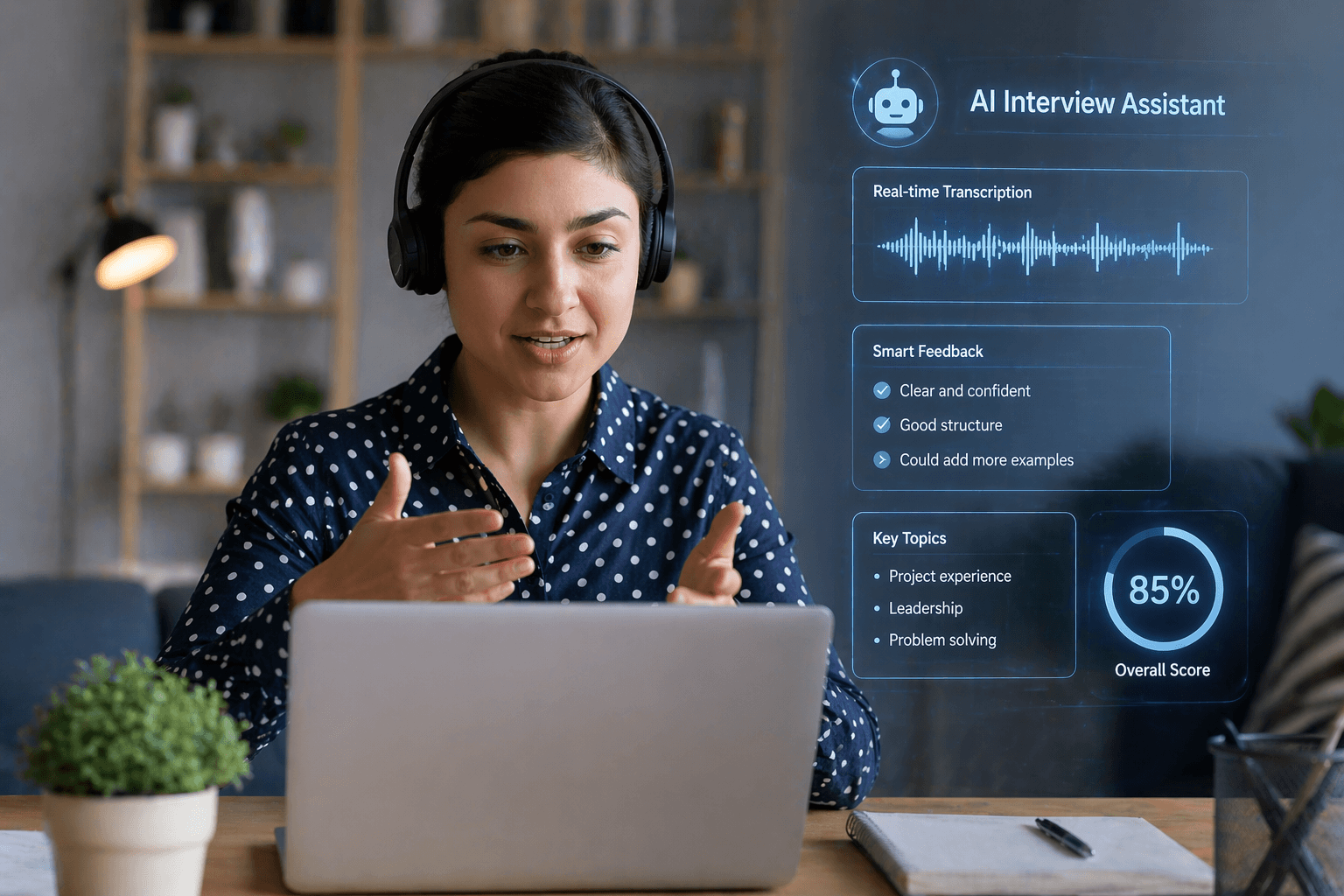
AI voice interviews are replacing this step entirely. Instead of a human making the same phone call 15 times, an AI conducts a structured spoken conversation with each candidate, asks role-specific questions, evaluates the responses in real time, and delivers a detailed report with scores and a hiring recommendation. The recruiter starts their process with a stack of completed interview reports rather than a list of phone calls to schedule.
This is not a chatbot. It is not a one-way video recording. It is a real-time voice conversation where the AI listens, responds, and adapts — and the output is dramatically more useful than anything a rushed phone screen produces.
60%
Reduction in time-to-hire for companies using AI voice interviews
How an AI Voice Interview Actually Works
The process from the hiring team's perspective is straightforward. You post a job, define your screening criteria, and shortlist candidates through either manual review or AI-powered CV screening. Each shortlisted candidate receives a link to complete their AI voice interview. There is nothing to install. The candidate clicks the link, and the interview begins in their browser or on their phone.
From the candidate's side, the experience feels like a structured phone interview with a professional interviewer. The AI introduces itself, explains the process, and begins asking questions. These are not generic questions pulled from a template. They are generated specifically for the role based on the job description, required skills, and the evaluation criteria the hiring team defined.
Here is what happens during the interview, step by step:
The candidate clicks the interview link and enters a waiting room where they can test their microphone and confirm they are ready
The AI interviewer greets them, introduces the role, and explains the structure of the conversation
The AI asks the first question — tailored to the specific position
The candidate answers verbally, speaking naturally as they would in any phone conversation
The AI listens to the complete response, then asks the next question. In some cases it asks a follow-up based on what the candidate said, probing deeper on a relevant point
This continues for 5-10 questions, typically lasting 10-20 minutes depending on the role complexity
The AI thanks the candidate, explains next steps, and ends the session
Within minutes, the hiring team receives a complete interview report
AI voice interviews are asynchronous from the hiring team's perspective. The candidate completes the interview on their own schedule — evenings, weekends, whenever suits them. The hiring team does not need to be present. They simply review the reports when they are ready.
What the Hiring Team Receives
This is where AI voice interviews deliver the most value. Instead of a recruiter's handwritten notes from a phone call — "seemed good, maybe follow up on the database experience" — the hiring team receives a structured, detailed report for every single candidate.
A typical AI voice interview report includes:
Full transcript of the entire conversation — every question asked and every answer given, word for word
Per-question scores — each answer rated on relevance, depth, clarity, and accuracy
Technical competency assessment — how well the candidate demonstrated the specific skills required for the role
Communication score — clarity of expression, ability to articulate ideas, listening comprehension
Culture and role fit assessment — based on how the candidate described their working style, motivations, and career goals
Red flags — any concerning patterns such as vague answers about past roles, inconsistencies, or inability to provide specifics when asked
Overall recommendation — a clear hire, maybe, or no-hire assessment with a summary of the reasoning
Every candidate is evaluated against the same questions, using the same criteria, with the same level of attention. There is no evaluation drift from interviewer fatigue. The fifteenth candidate gets the same quality of assessment as the first.
100%
of candidates evaluated with the same criteria — no interviewer fatigue or bias drift
Why Phone Screens Fail at Scale
Phone screens have worked well enough when companies received 20-30 applications per role. At that volume, a recruiter can call 8-10 candidates in a day and remember meaningful differences between them. The process is manageable even if it is not optimal.
That volume no longer reflects reality. The average job posting now receives over 250 applications. Even after AI or manual CV screening narrows the pool, you are often left with 15-25 candidates who deserve a conversation. Phone screening that many people creates serious problems that most hiring teams recognise but accept as unavoidable.
The scheduling problem
Coordinating 15-20 phone calls between a recruiter's calendar and 15-20 candidates' schedules takes days or weeks. Candidates who are actively job searching often have competing timelines — the slower you move, the more likely your top choices accept offers elsewhere. Every day spent scheduling is a day your best candidates are interviewing with other companies.
The consistency problem
When a recruiter conducts 15 phone screens across three days, the quality of each conversation varies. The first few calls are thorough and engaged. By call number 10, the recruiter is asking shorter questions, taking fewer notes, and making faster judgements. Research on interviewer behaviour consistently shows that evaluation quality degrades after the fifth or sixth interview in a session.
This means candidates who happen to be scheduled later in the process receive a lower quality evaluation than those scheduled first — a factor that has nothing to do with their actual qualifications.
The documentation problem
Phone screen notes are typically brief, subjective, and inconsistent. One recruiter writes three paragraphs. Another writes three bullet points. A third writes nothing and relies on memory. When the hiring manager asks "why did we advance this candidate?" the answer is often a vague impression rather than structured evidence.
This makes it nearly impossible to compare candidates fairly, defend hiring decisions, or identify patterns in what makes a successful hire for your organisation.
The bias problem
Unstructured phone conversations are where unconscious bias has the most room to operate. Factors like accent, speaking pace, vocal tone, small talk rapport, and communication style influence recruiter judgement in ways that have nothing to do with job performance. A candidate who is nervous on the phone but brilliant at the actual work gets scored lower than a candidate who is charming on the phone but mediocre at the job.
Structured AI interviews evaluate what was said rather than how it sounded. The assessment is based on the content and relevance of answers against defined criteria, not on vocal chemistry between two strangers.
This is not about removing human connection from hiring. It is about removing human connection from the stage where it introduces the most bias and adds the least value. Human interviews remain essential for final-round evaluation. AI interviews ensure the humans only spend time on candidates who have already demonstrated baseline competence.
What Candidates Actually Think
The most common concern hiring teams have about AI interviews is candidate experience. Will candidates find it impersonal? Will they refuse to participate? Will it reflect poorly on the company brand?
The evidence so far suggests the opposite. Candidates consistently report three things they prefer about AI voice interviews compared to traditional phone screens.
First, flexibility. Candidates can complete the interview at a time that works for them rather than trying to find a 30-minute window that overlaps with a recruiter's packed calendar. For candidates who are currently employed and interviewing discreetly, this flexibility is significant.
Second, fairness. Candidates know they are being evaluated against the same questions and criteria as every other applicant. There is no advantage to being the first call of the day when the recruiter is fresh versus the last call when they are tired. The playing field is genuinely level.
Third, speed. Candidates receive interview links within hours of being shortlisted rather than waiting days for a recruiter to reach out and schedule a call. In a competitive job market, speed signals that the company respects the candidate's time and is serious about filling the role.
That said, transparency matters. Candidates should always know they are speaking with an AI interviewer, not a human. And the process should always include a human interview at the final stage. AI handles the screening. Humans make the hiring decision.
AI Voice Interviews vs Other Screening Methods
AI voice interviews exist alongside several other screening approaches. Here is how they compare.
vs Phone screens
Phone screens require human time for every candidate, produce inconsistent documentation, and are subject to interviewer fatigue and bias. AI voice interviews eliminate scheduling overhead, produce structured reports, and evaluate every candidate equally. Phone screens do allow for spontaneous rapport-building, which AI interviews do not replicate — but that rapport is more valuable in final-round interviews than in first-round screening.
vs One-way video interviews
One-way video interviews ask candidates to record themselves answering pre-set questions on camera. There is no conversation — the candidate talks to a screen. Completion rates for one-way video interviews are significantly lower than voice interviews because many candidates find the experience uncomfortable and impersonal. AI voice interviews feel more natural because they are actual conversations with real-time interaction.
vs Take-home assessments
Take-home assessments evaluate technical skills but require significant candidate time — often 2-6 hours. Many strong candidates, especially senior ones, refuse to complete lengthy take-home tasks. AI voice interviews take 10-20 minutes and can evaluate both communication skills and technical knowledge through conversational questions.
vs CV screening alone
CV screening tells you what a candidate has done. It does not tell you how they think, communicate, or handle unfamiliar questions. AI voice interviews fill that gap — they evaluate the person behind the CV before you invest in a full interview panel.
See AI voice interviews in action
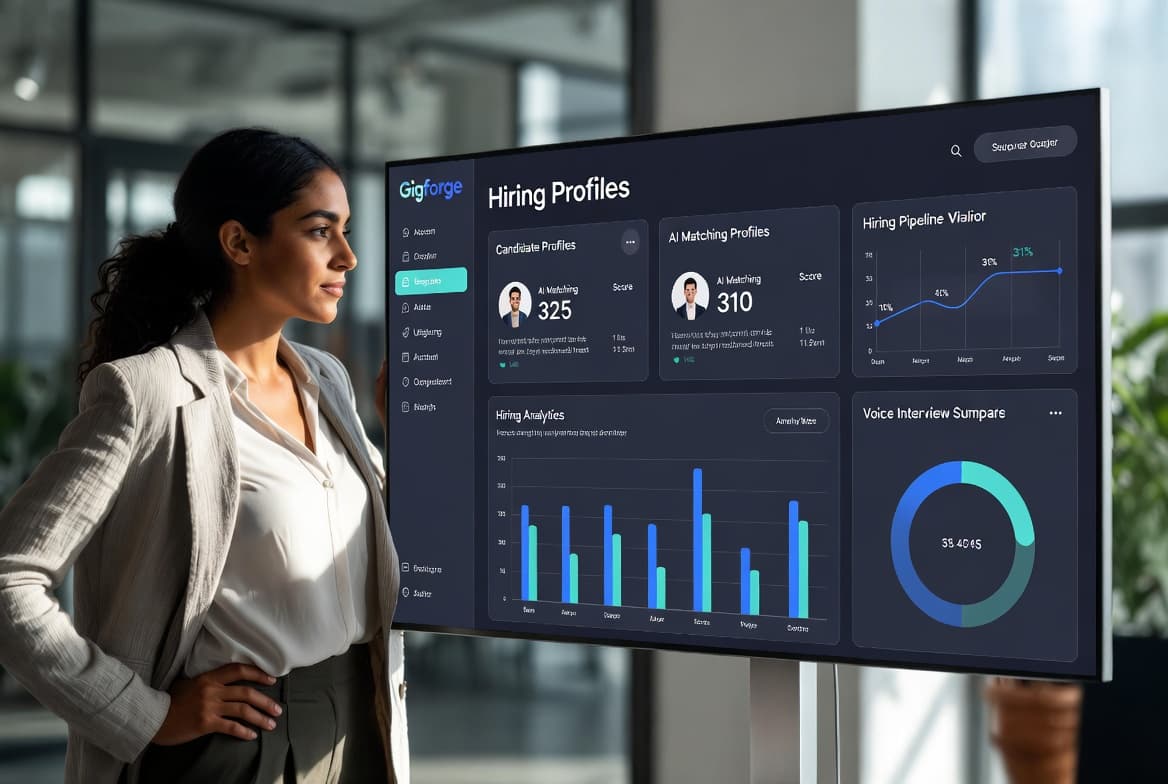
GigForge conducts AI voice interviews for your shortlisted candidates. Each candidate gets role-specific questions, and you get a detailed report with scores and a hiring recommendation.
Start Hiring with AI →When to Use AI Voice Interviews
AI voice interviews are not the right tool for every role. They deliver the most value in specific hiring scenarios.
High-volume hiring is the most obvious use case. When you are hiring for a role that attracts 100 or more applications, AI voice interviews let you evaluate a large shortlist without scaling your recruitment team. A single role can have 20 AI interviews completed in 24 hours — work that would take a recruiter a full week of scheduled calls.
Roles where communication matters are another strong fit. Customer-facing positions, sales roles, account management, support roles, and any position where the person needs to speak clearly and think on their feet. The AI interview reveals communication ability in a way that a CV cannot.
Remote hiring benefits significantly because you are already evaluating candidates without meeting them in person. Adding an AI voice interview before a video call ensures you only invest video interview time in candidates who have demonstrated they can communicate effectively.
Early-career and graduate hiring is increasingly using AI interviews. When all candidates have similar educational backgrounds and limited work experience, the CV tells you very little. The voice interview differentiates candidates based on how they think about problems, articulate their ideas, and respond to role-specific scenarios.
How to Set Up AI Voice Interviews for Your Team
If you are ready to replace phone screens with AI voice interviews, the setup is simpler than you might expect.
Post your job and define the role requirements — the skills, experience, and qualities that matter for this position
Configure your screening criteria — what the AI should evaluate candidates on. This typically includes technical knowledge, communication, problem-solving approach, and role-specific competencies
Shortlist candidates — either manually after reviewing CVs or automatically using AI screening
Send interview invitations — each shortlisted candidate receives a link. They complete the interview at their convenience within a deadline you set
Review the reports — once interviews are complete, you receive a detailed report for each candidate. Sort by overall score, compare specific criteria, and identify your top candidates
Invite your top candidates for a human interview — you are now meeting only candidates who have passed both CV screening and a structured voice evaluation
The entire process from job posting to having interview reports in hand can happen in under a week — compared to the 2-4 weeks that traditional phone screening typically requires.
Set a deadline for candidates to complete their AI voice interview — typically 3-5 days. This creates urgency, keeps your hiring timeline tight, and identifies candidates who are genuinely engaged in the process. Candidates who do not complete the interview within the deadline are self-selecting out.
The Future of First-Round Interviews
The shift from phone screens to AI voice interviews is not speculative. It is happening now. By mid-2026, industry analysts project that the majority of high-volume recruiting will start with an AI-powered voice screen, particularly for early-career and frontline roles. Enterprise companies are already running thousands of AI interviews monthly. Startups and small teams are adopting the technology because it eliminates the bottleneck of having one or two people responsible for every first-round call.
This does not mean human interviews are disappearing. It means human interviews are becoming more valuable because they are focused on candidates who have already been thoroughly evaluated. The recruiter's role shifts from gatekeeper — making pass or fail decisions on basic qualification calls — to talent advisor, spending their time with candidates who are genuinely worth a deeper conversation.
The companies that adopt AI voice interviews now are building a structural advantage. They hire faster, evaluate more candidates per role, produce better documentation, and free their recruiting teams to focus on the work that actually requires human judgement — building relationships, selling the company, and making final hiring decisions.
Replace phone screens with AI voice interviews
Post a job, define your criteria, and let GigForge's AI interview your shortlisted candidates. You get detailed reports with scores and recommendations — without making a single phone call.
Post Your First Job Free →Try It From the Candidate Side
If you are a job seeker reading this, AI voice interviews are becoming part of the hiring process at more companies every month. Practising with an AI interviewer before your real ones gives you a significant advantage — you get comfortable with the format, learn to structure your answers, and receive feedback on how you present yourself verbally.
GigForge's interview practice tool lets you run mock AI voice interviews for any role. Choose your target position, answer real interview questions, and get detailed scoring on every response. When a real AI interview invitation arrives in your inbox, you will already know exactly what to expect.
Practice AI interviews before the real thing
Run mock voice interviews with AI for any role. Get scored on every answer and walk into your real interviews prepared and confident.
Practice Interview →