Fiverr Proposal Tips: How to Stand Out and Get Hired in 2026 | GigForge
Freelancers
Fiverr Proposal Tips: How to Stand Out and Get Hired in 2026
Fiverr proposals aren't Upwork proposals. Different platform, different rules, different buyer psychology. Here's what actually works on Fiverr specifically — from someone who studied the patterns.
By Brabyns Yabwetsa10 June 202611 min read
If you've been using the same proposal style on Fiverr that you use on Upwork, that's probably why you're not getting responses. I see this mistake constantly. Freelancers read one "how to write proposals" article, apply the same template everywhere, and wonder why it works on one platform but fails on another.
Fiverr is a fundamentally different marketplace. The buyers are different. The format is different. The psychology is different. What wins on Upwork — a detailed 400-word proposal with a project plan — will get skimmed and ignored on Fiverr. Fiverr buyers want speed, clarity, and proof. They want to know in 10 seconds: can you do this, have you done it before, and can you start now?
I'm going to break down exactly what works on Fiverr in 2026. Not generic freelance advice — Fiverr-specific tactics that account for how the platform actually works, how buyers actually behave, and what the algorithm actually rewards.
ℹ️
When I was researching how freelancers find work — before building GigForge's proposal generator — I spent time studying what separates winning proposals from losing ones across different platforms. Fiverr was the most interesting because it has its own culture. The proposals that win on Fiverr break rules that other platforms consider essential. Shorter is better. Less formal is better. Speed matters more than depth. This article is what I learned.
How Fiverr Buyer Requests Actually Work
Before we talk about writing proposals, you need to understand how the buyer side works on Fiverr. This changes everything about your approach.
When a buyer posts a request on Fiverr, they typically receive 15-30 proposals within the first hour. Not the first day — the first hour. By the time 24 hours have passed, they might have 50-100. The buyer is usually not a professional hiring manager. They're a small business owner, a startup founder, or someone with a project who needs help. They don't have time or patience to read 50 detailed proposals.
What they actually do: scroll through the list, read the first 1-2 lines of each response, and open the full proposal only if those first lines grabbed them. Then they check the seller's profile, reviews, and portfolio. The decision happens in under 30 seconds per proposal.
This means your entire strategy needs to optimise for two things: the first two lines of your response, and your seller profile. Everything else is secondary.
30
seconds. That's how long a Fiverr buyer spends on your proposal before deciding to read more or move on.
The Fiverr Proposal Structure That Wins
Fiverr responses are short. Maximum about 2,500 characters, but you should aim for 400-600 characters — roughly 80-120 words. That's it. If your Fiverr proposal is longer than what fits on a phone screen without scrolling, it's too long.
Line 1: Their problem, not your introduction
Your first sentence must reference something specific from the buyer's request. Not "Hi, I'm interested in your project." Not "I'm a skilled designer with 5 years of experience." The buyer's problem. Their words. Their situation.
If the buyer wrote "I need a logo for my coffee shop that feels modern but warm," your first line is: "A modern-but-warm logo for a coffee shop — I'd go with warm earth tones with a clean sans-serif wordmark. Something like what Blue Bottle or % Arabica does but unique to your brand."
You just proved three things in one sentence. You read their request. You understand their aesthetic. You have a creative opinion. That's more than 90% of other responses offered.
Line 2-3: Proof — one example, one result
Now show you've done this before. One example. One line. A link if possible.
"I designed a similar brand identity for a café in Nairobi last month — clean, warm, and they said it increased their Instagram engagement by 40% because people started photographing the cups. Here's that project: [portfolio link]"
Specific client. Specific result with a number. A link they can click. In one sentence you've gone from "random freelancer" to "someone who has done exactly this and has proof."
Line 4: Availability and next step
End with something that makes responding easy.
"I can start today and have first concepts to you within 24 hours. Want me to send a couple of rough direction options before we commit?"
Speed matters enormously on Fiverr. Buyers choose sellers who can start immediately over sellers who are "available next week." And offering rough concepts before commitment reduces the buyer's risk — they get to see your thinking before spending money.
The complete example
Putting it all together for a buyer who posted "Need someone to redesign my Shopify product pages — current pages have low conversion":
ℹ️
Low conversion on product pages usually comes from three things — slow images, too much text above the fold, and a buy button that's hard to find on mobile. I rebuilt product pages for a DTC skincare brand on Shopify last quarter and their conversion rate went from 1.8% to 3.4%. Here's that project: [link]. I can audit your current pages today and send you a quick report on what's causing the drop before we start any design work. Available to begin immediately.
That's 85 words. It diagnoses their problem, shows a directly relevant result with specific numbers, offers immediate value (a free audit), and signals availability. On a platform where most responses are "Hi, I can do this. Check my profile," this stands out like a spotlight.
Fiverr vs Upwork: Why Your Upwork Template Fails Here
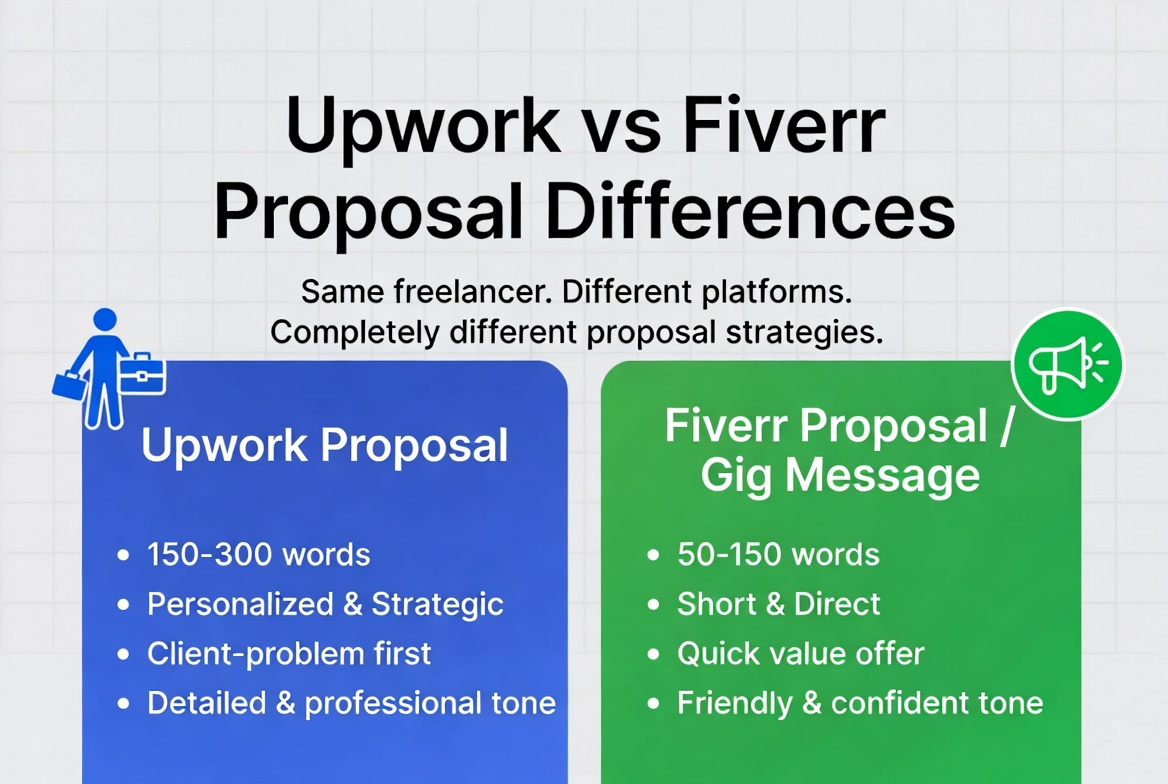
If you've read my guide on writing Upwork proposals that get responses, you might be tempted to use the same approach on Fiverr. Don't. Here's why they're fundamentally different:
Upwork buyers are typically hiring for larger, ongoing projects. They expect detailed proposals (400-600 words), want to see your approach and methodology, and are comfortable with a longer evaluation process. The relationship model is closer to traditional freelance contracting.
Fiverr buyers are typically hiring for smaller, faster projects. They want short responses (80-120 words), care more about speed and immediate availability than methodology, and make decisions within hours, not days. The relationship model is closer to ordering a service.
On Upwork, a detailed project plan in your proposal signals thoroughness. On Fiverr, the same level of detail signals that you're overcomplicating a simple project. Match the platform's energy.
Same freelancer. Different platforms. Completely different proposal strategies.
Your Fiverr Profile Matters More Than Your Proposal
Here's something most Fiverr tip articles won't tell you: on Fiverr, your profile does more selling than your proposal. The proposal gets the buyer to click on your name. Your profile closes the deal. If your proposal is perfect but your profile is empty, you lose.
Your seller bio
Max 600 characters. Start with what the CLIENT gets, not what you do. "I create Shopify stores that convert browsers into buyers" works. "I am a web developer with 5 years of experience" doesn't. Think of your bio as a billboard on a highway — people are driving past at speed. You get one sentence to make them slow down.
Your gig titles
The title format that performs best on Fiverr: "I will [specific deliverable] for [specific audience]." Examples: "I will design a conversion-focused landing page for your SaaS product." "I will write SEO blog articles for health and wellness brands."
The more specific your gig title, the less competition you face. "I will build a website" competes with 50,000 sellers. "I will build a Shopify store for DTC fashion brands" competes with maybe 500. Same skill. 100x less competition.
Your reviews and rating
This is the hardest part for new sellers. Buyers filter by rating and review count, so sellers with zero reviews face an uphill battle. The way to break through: price your first 3-5 gigs lower than your target rate. Not free — that devalues your work. But 30-40% below your eventual rate. Deliver exceptional work. Get 5-star reviews. Then raise your prices. Those first 5 reviews are the most valuable thing on your Fiverr profile. They're worth the temporary discount.
💡
Another way to build credibility fast: if you have a portfolio on GigForge or your own website, link it in your Fiverr profile and in every proposal. Buyers who see an external portfolio with detailed case studies trust you more than sellers who only have Fiverr gig images. Your GigForge freelance portfolio gives you a professional page on your own subdomain — like yourname.gigforge.io — that you can link from every platform you're active on.
The 5 Fiverr Proposal Mistakes That Kill Your Response Rate
1. Copy-pasting the same response to every request
Fiverr buyers can tell instantly. If your first line doesn't reference their specific project, they know it's a template. On a platform where they're reading 30 proposals, the generic ones don't even register. Spend 3 minutes per response customising the first two lines. That's the minimum viable personalisation.
2. Writing too much
If your Fiverr response is 300 words, you've already lost. The buyer stopped reading at word 80. On Fiverr, shorter is always better. Say less. Mean more.
3. Leading with your credentials instead of their problem
"I have 7 years of experience and have completed 200+ projects" — the buyer doesn't care about your history. They care about their problem. Your credentials come AFTER you've shown you understand what they need. Proof comes second. Relevance comes first.
4. Not including a portfolio link
Words are cheap on Fiverr. Everyone claims they're "experienced" and "professional." A link to a relevant project is the fastest way to prove it. Include one in every single response. If you don't have an online portfolio, build one before you send another proposal. GigForge's freelance portfolio builder creates a professional site on your own subdomain in about 5 minutes — that gives you a permanent link to include in every Fiverr response.
5. Ignoring the buyer's budget
If the buyer's budget is $50 and your minimum is $500, don't respond. It wastes both your time and hurts your response rate metrics, which Fiverr tracks. Only respond to requests that match your pricing range. Quality of responses matters more than quantity.
Speed Wins on Fiverr
I want to emphasise this one more time because it's the single most underrated factor on Fiverr. The first 5 sellers to respond to a buyer request get 80% of the work. Not because they're better — because the buyer is making a decision within hours, often within the first hour, and the first strong responses are the ones that get chosen.
Set up notifications for Fiverr buyer requests in your category. When a relevant one appears, respond within 15-30 minutes. Not with a sloppy generic response — with a quick, personalised 80-word response that references their specific request. Speed plus specificity beats a perfect proposal sent 6 hours later.
If writing customised proposals under time pressure sounds stressful, GigForge's AI proposal generator can help with that. Paste the buyer's request, select Fiverr as the platform, and it generates a personalised response using your portfolio data in about 30 seconds. You review it, add a personal touch, and send. The AI handles the structure and platform-specific formatting while you add the specificity and personality.
Generate Fiverr proposals in 30 seconds
Paste the buyer's request and GigForge creates a personalised, Fiverr-formatted proposal using your skills and portfolio. Platform-aware length and structure included.
Fiverr rewards a different kind of freelancer than Upwork does. It rewards speed, brevity, and specificity. It rewards sellers who understand that the buyer is moving fast, choosing fast, and looking for proof — not promises. Adapt to the platform's rhythm, build your reviews from the ground up, and let every response prove that you already understand the buyer's problem before they've even hired you.
Need a portfolio to link in your Fiverr proposals?
Build a professional freelance portfolio on your own subdomain in 5 minutes. No code. Free to start. Link it in every proposal you send.