How to Build a Freelance Portfolio With No Experience (2026 Guide) | GigForge
Freelancers
How to Build a Freelance Portfolio With No Experience (2026 Guide)
"But I don't have any client work to show." You don't need it. Here's how to build a portfolio that wins clients using personal projects, redesigns, and spec work — even if you've never been paid for freelance work in your life.
By Brabyns Yabwetsa22 June 20268 min read
You want to freelance. You have the skills. But every time you go to create a portfolio, you hit the same wall: "I don't have any client work to show." So you don't build the portfolio. And because you don't have a portfolio, you can't get clients. And because you can't get clients, you don't have work to put in the portfolio. It's the most frustrating catch-22 in freelancing and it stops talented people before they even start.
ℹ️
Some of the best portfolios I've seen on GigForge were built by people with zero paid freelance experience. One user — a graphic designer — had three projects in their portfolio: a logo redesign for a local shop they did for free, a brand identity for a fictional coffee company they invented, and a personal project redesigning their favourite app's UI. That portfolio got them their first three paying clients within a month. The work spoke for itself. Nobody asked whether it was paid or not.
The 3 Types of Projects That Replace Client Work
You're going to create 3 portfolio pieces. Each one uses a different approach so your portfolio shows range, not repetition.
Project 1: The personal project — build something real for yourself
This is the easiest starting point because you already have the brief: yourself. Build something you actually need or want.
If you're a web developer: build your own portfolio website. Yes, the portfolio IS a portfolio piece. A well-built personal site demonstrates your skills while also giving you somewhere to showcase them. Meta? Sure. Effective? Absolutely.
If you're a designer: create your own brand identity. Logo, colour palette, business cards, social media templates. You're designing for yourself as the client.
If you're a writer: write a case study about something you know well. Break down a process, explain a concept, tell a story. Publish it on Medium or your own blog.
If you're a marketer: create a social media strategy for a local business you admire. Don't ask them for permission — just do the work as an exercise, document it, and include it as a strategic case study.
The personal project shows potential clients that you can take initiative, scope your own work, and deliver a finished product without someone holding your hand. Those are exactly the qualities clients look for in freelancers.
Project 2: The redesign — improve something that already exists
Pick a website, app, or brand that you think could be better. Redesign it. Document why you made each decision.
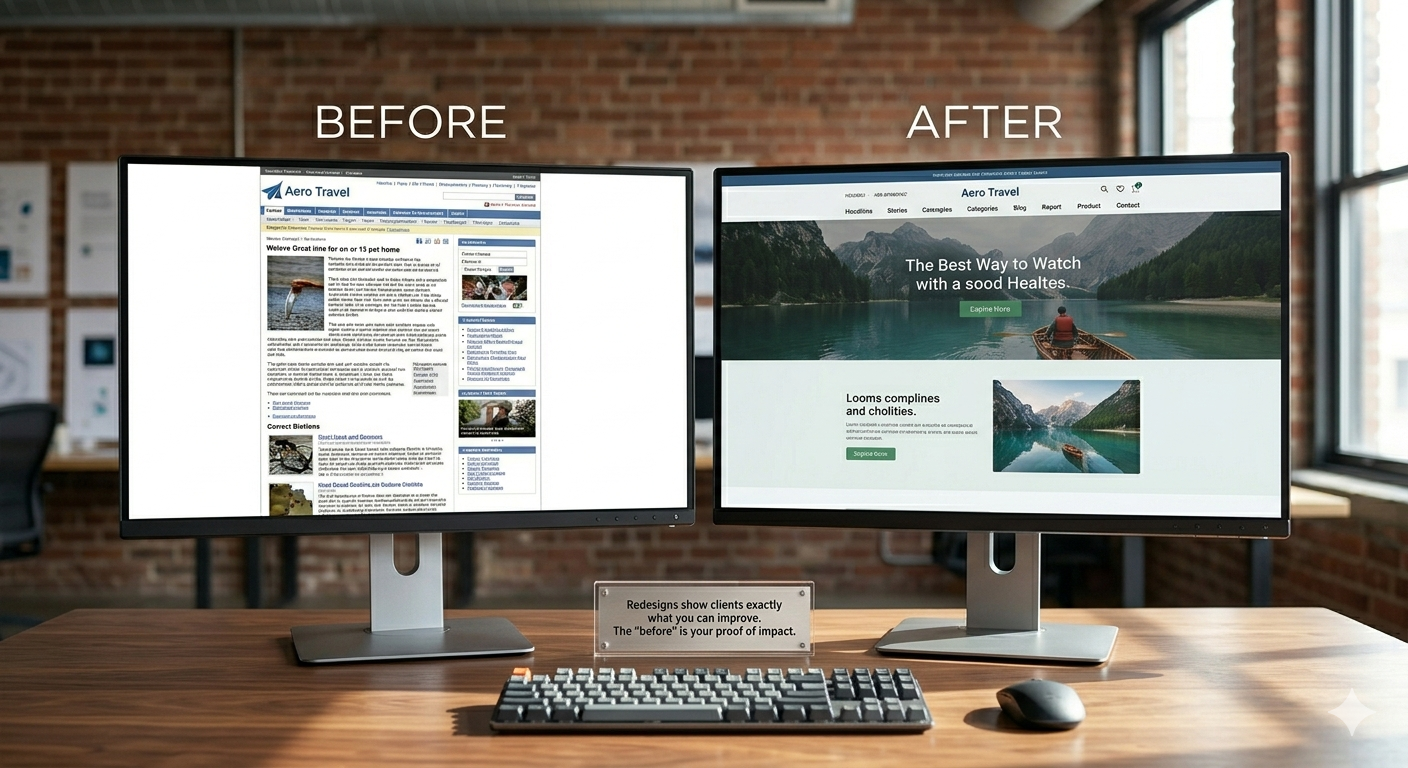
This is incredibly powerful for three reasons. First, the "before" already exists — so clients can immediately see the improvement you made. Second, it shows critical thinking — you identified problems and solved them. Third, it demonstrates that you can work within constraints, because you're improving something real rather than starting from a blank canvas.
Some rules for redesigns. Always credit the original — "Redesign concept for [Brand]. Not affiliated." Never claim it's real client work. And focus on explaining your reasoning: "I moved the CTA above the fold because their analytics likely show most users don't scroll past the hero section." The reasoning is what separates a redesign from a random mockup.
Good redesign targets: a local restaurant's outdated website, a popular app's onboarding flow, a small brand's inconsistent social media templates, a nonprofit's cluttered homepage.
Redesigns show clients exactly what you can improve. The "before" is your proof of impact.
Project 3: The spec project — brief yourself for a fictional client
Create a fictional company. Give it a name, an industry, and a problem. Then solve that problem as if they hired you.
"BeanTrail: A subscription coffee company targeting remote workers. They need a landing page that converts visitors into subscribers." Now build that landing page. Design the brand. Write the copy. Create the social media launch campaign. Whatever your skill set covers.
The key to making spec work feel professional rather than amateur: document it like a real project. Write a brief. Describe the problem. Explain your approach. Show the deliverables. Include the result (even if the "result" is hypothetical: "Designed to achieve a 3% conversion rate based on industry benchmarks").
Spec projects let you show work in specific industries without needing a client in that industry. Want to work with fintech companies? Create a spec project for a fictional fintech startup. Want to design for restaurants? Invent one and build their whole brand. Clients who work in that industry will see your spec project and think "this person already understands our space."
💡
The secret that experienced freelancers know: clients rarely ask whether a portfolio piece was a paid project or a personal one. They're looking at the quality of the work, whether it's relevant to their needs, and whether you can clearly explain your process. A beautifully executed spec project beats a mediocre real client project every time.
How to Present Your Projects Like a Professional
Having 3 projects isn't enough if they're just screenshots in a folder. How you present them matters almost as much as the work itself.
Write a case study for each project
Every portfolio project needs context. Not just "here's what I made" — but "here's the problem, here's my approach, here's the result." This is what separates a professional portfolio from a student portfolio.
Structure each case study in 4 parts. The brief: what was the problem or goal? (2-3 sentences) The process: how did you approach it? What decisions did you make and why? (3-5 sentences) The deliverables: the actual work — screenshots, mockups, links, files. The outcome: what was the result or projected impact? (1-2 sentences)
Even for spec projects, you can write a compelling outcome: "The landing page was designed to optimise for above-the-fold conversion, targeting a 3.5% signup rate based on SaaS industry benchmarks."
Show process, not just output
Include behind-the-scenes elements. Early sketches. Wireframes. Color palette explorations. Before-and-after comparisons. Screenshots of your design tool or code editor. These artifacts prove you have a real process — you didn't just stumble into a final product.
Clients hiring freelancers are often nervous about whether you can handle their project professionally. Showing your process reduces that anxiety because they can see exactly how you work.
Publish it somewhere permanent
A portfolio on your own subdomain is worth 10x more than a Google Drive link or a PDF attachment. Having a real URL — like yourname.gigforge.io — signals professionalism. It gives clients something they can bookmark, share with their team, and revisit later. It shows up in Google search results. And it provides a permanent link you can include in every proposal, every email, and every social media bio.
GigForge's freelance portfolio builder creates a professional portfolio site on your own subdomain in about 5 minutes. You add your projects with descriptions, images, and case studies. Pick a template. Publish. That's your portfolio — live, shareable, and ready to link in every single proposal you send. Our detailed guide on how to build a freelance portfolio that wins clients covers the full strategy for established freelancers, but if you're starting from zero, the 3 projects in this article plus a published portfolio page is all you need to begin.
Build your portfolio in 5 minutes — even with zero client work
GigForge gives you a professional portfolio on your own subdomain. Add your personal projects, redesigns, and spec work. Pick a template. Publish. Start sending the link in proposals today.
Add your portfolio URL to your LinkedIn headline. Put it in your Upwork profile overview. Include it in your Fiverr bio. Add it to your Twitter/X bio. Email signature. Everywhere. Every platform where a potential client might discover you should have one click to your portfolio.
Include it in every proposal
When you write Upwork proposals or Fiverr responses, always include a link to a relevant portfolio piece. Not your whole portfolio — the specific project most relevant to the client's job. "I built a similar landing page for a subscription company — here's the case study: [link]." If you want to write proposals that actually get responses, I broke down the exact Upwork proposal template that gets responses and Fiverr-specific proposal tips in separate guides.
Keep adding to it
Your first 3 projects get you started. But every piece of work you do from now on — paid or personal — should be documented and added to your portfolio. The portfolio grows as your experience grows. Within 6 months, those original spec projects will be replaced by real client work. That's the progression: spec work gets you the first client, the first client gets you the second, and within a year nobody remembers or cares that you started with zero experience.
Ready to start landing clients? Write proposals that get responses.
Paste the client's job description and GigForge generates a personalised, platform-specific proposal using your portfolio and skills.