Upwork Proposal Template That Actually Gets Responses
95% of Upwork proposals get ignored in the first two lines. Not because the freelancer isn't talented — because they open with "Dear Sir/Madam, I have 5 years of experience." Here's the template that actually gets responses.
By Brabyns Yabwetsa27 May 202615 min read
I need to tell you something that's going to sound harsh but might save your freelance career. Your Upwork proposals are probably terrible. Not because you're a bad writer or an unqualified freelancer — but because you're writing them the way everyone else does, and the way everyone else does it doesn't work.
Here's what I mean. The average Upwork job post gets 20-50 proposals. Some get over 100. The client — who is usually busy, overwhelmed, and skeptical — opens each proposal and reads the first two lines. Two lines. If those two lines sound like every other proposal they've received, they close yours and move to the next one. Your portfolio, your hourly rate, your 5-star reviews — none of it matters if the client never gets past line two.
I've spent a lot of time studying what separates proposals that get responses from proposals that get ignored. And the pattern is so consistent it's almost boring. The winning proposals all do the same thing in the first sentence. And the losing proposals all make the same mistake in the first sentence. Once you see it, you'll never write a proposal the same way again.
ℹ️
Before building GigForge, I freelanced for a while and went through the exact frustration of sending proposals into the void. I remember one stretch where I sent 15 proposals in a week and got zero responses. When I finally started landing clients consistently, it wasn't because I got better at my craft — it was because I completely changed how I wrote the first two sentences of every proposal. That experience is a big reason we built the AI proposal generator at GigForge.
The Mistake 95% of Freelancers Make in Line One
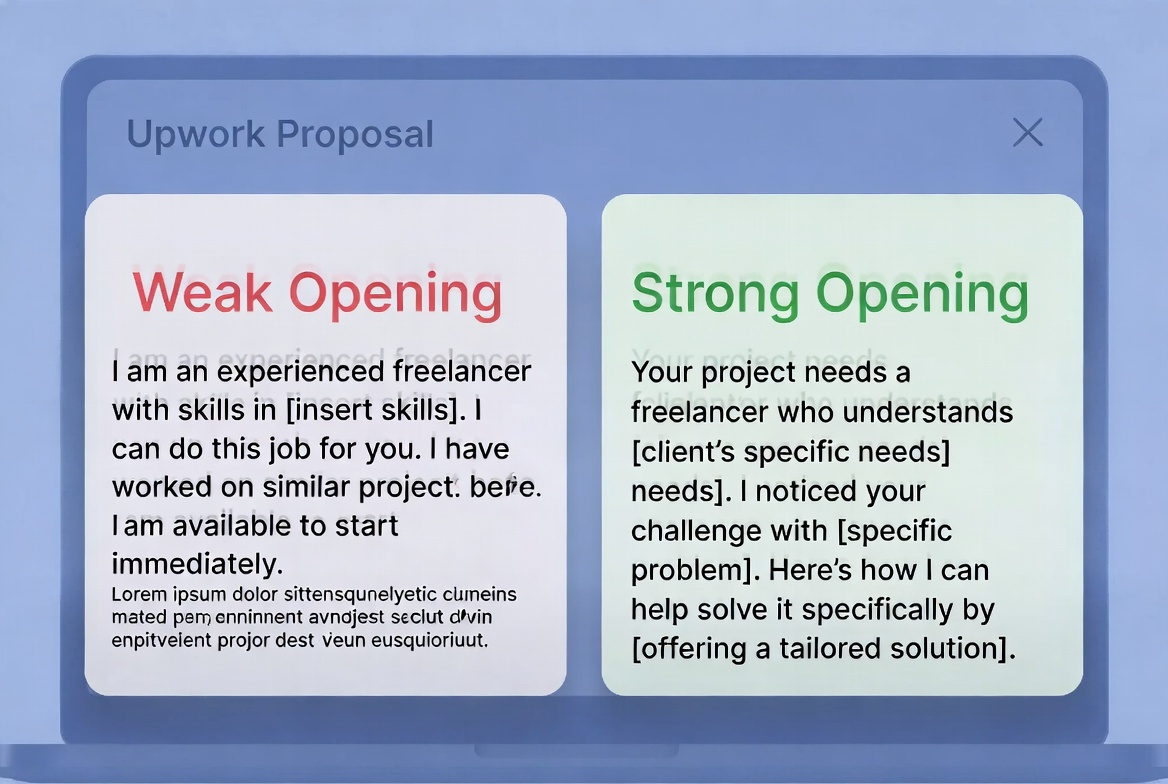
Open your Upwork sent proposals right now. I'll bet the first line of most of them looks something like this:
"Dear Hiring Manager, I am a highly skilled web developer with over 5 years of experience in React, Node.js, and Python. I am confident I can deliver excellent results for your project."
Or this:
"Hello, I read your job posting with great interest. I have extensive experience in the field and I believe I would be a great fit for this opportunity."
Or the absolute worst one:
"Hi, I can do this project. Check my profile for my portfolio and reviews."
Every single one of these opens with the same thing: ME. I am skilled. I have experience. I can do this. I am great. Me, me, me.
The client doesn't care about you yet. They care about their problem. They posted a job because something is broken, something needs building, something is urgent. They're looking for someone who understands THEIR situation — not someone who wants to talk about themselves.
That's the mistake. Leading with yourself instead of leading with them.
The client reads 50 proposals that start with "I." Yours should start with "you."
The Proposal Structure That Wins
Here's the template. It's 5 sections. The entire proposal should be 150-200 words on Upwork — shorter than you think. Clients don't want to read essays. They want to know three things fast: do you understand my problem, have you done this before, and can you start soon?
Section 1: The Hook — Reference their specific problem (1-2 sentences)
Your first sentence should prove you actually read the job post. Not "I read your job posting with great interest" — that's a lie every client can see through. Instead, reference a specific detail from THEIR description.
Bad: "I am interested in your web development project."
Good: "You mentioned your checkout page is losing 40% of users before payment — that's almost always a loading speed issue combined with too many form fields."
Feel the difference? The first one could be copy-pasted to any job. The second one could only have been written by someone who read this specific post and immediately understood the problem. The client reads that and thinks "this person gets it." That's the entire goal of line one.
Where do you find these specific details? The job post itself. Clients usually describe their problem in plain language. They say "my website is slow" or "I need a logo that feels modern but not too corporate" or "our app crashes when more than 50 users are online." Use their exact words back to them with your professional interpretation of what's causing it.
Section 2: The Proof — One relevant example (2-3 sentences)
Now — and only now — talk about yourself. But not your general experience. One specific example that directly relates to what they need.
Bad: "I have 5 years of experience building websites and have worked with many satisfied clients."
Good: "I rebuilt a similar checkout flow for a Nairobi-based e-commerce company last quarter. Their completion rate went from 58% to 84% after I reduced the form to 3 fields and added M-Pesa as a payment option. Here's the case study: [link]"
One project. One result. One number. That's more convincing than five paragraphs of "I have extensive experience." The client can verify it. They can see the result. They can click the link. Specificity builds trust instantly.
What if you don't have a directly relevant example? Use the closest thing you have and bridge the gap. "I haven't built a checkout flow specifically, but I rebuilt a 7-step signup form into a 3-step flow for a SaaS client and their conversion rate doubled. Same UX principles apply."
💡
Always include a link to a relevant portfolio piece or case study. Clients are 3x more likely to respond to proposals that include a clickable example of your work. If you don't have an online portfolio yet, you can build a professional one on your own subdomain using GigForge's freelance portfolio builder — it takes about 5 minutes and gives you a permanent link to share in every proposal.
Section 3: The Approach — How you'd tackle this project (2-3 sentences)
This is where you separate yourself from 90% of other freelancers. Most proposals say "I can do this project." Winning proposals say "here's HOW I would do it."
"For your checkout redesign, I'd start by auditing the current page speed (I suspect the image assets aren't optimised). Then I'd simplify the form to the 3 essential fields and add a progress indicator. I'd implement lazy loading for the payment gateway and A/B test the new flow against the old one for a week before fully switching."
You just gave the client a mini project plan for free. They can see you've thought about their problem specifically. You're not guessing — you have a method. This builds confidence that you'll actually deliver, not just promise.
Keep it short though. 2-3 sentences maximum. You're showing your thinking, not writing a full specification. If they want the detailed plan, that comes after they hire you.
Section 4: The Differentiator — Why you specifically (1 sentence)
One line that addresses something the client cares about beyond just the work itself. This could be timezone compatibility, language fluency, industry experience, or availability.
"I'm based in East Africa (GMT+3) so I overlap with European business hours, and I can start this week."
Or: "I've built 4 e-commerce checkouts in the last year so I won't be learning on your project — I'll be applying patterns I already know work."
Or: "I specialise in mobile-first design which matters here because your analytics probably show 60%+ of your traffic is on phones."
This sentence answers the question the client is thinking but hasn't asked: "Why this freelancer instead of the other 30 who applied?"
Section 5: The Close — Clear next step (1 sentence)
End with a specific, low-pressure ask. Not "I hope to hear from you" — that's passive. Not "Please hire me" — that's desperate. A question that's easy to say yes to.
"Want me to record a quick 2-minute Loom video walking through exactly how I'd approach this?"
Or: "Happy to jump on a 10-minute call this week to discuss your timeline and any questions — what works for you?"
Or simply: "Can I share a more detailed plan once I understand your current tech stack?"
The close should make it easy for the client to respond with one word: "yes." That's it. Conversation started. Proposal worked.
150-200
words. The ideal Upwork proposal length. Anything longer gets skimmed.
The Complete Template (Copy and Adapt This)
Here's the full template with everything in one place. I'm going to show you a real example for a fictional but realistic Upwork job post, so you can see how all 5 sections work together.
Imagine the job post says: "Need a freelance designer to redesign our mobile app's onboarding screens. Current onboarding has a 70% drop-off rate. We're a fintech startup based in Lagos. Budget: $1,500-2,000."
ℹ️
"A 70% drop-off in onboarding is painful but very fixable — it usually means too many screens before the user sees value. I redesigned the onboarding flow for a mobile banking app in Nairobi last year and cut their drop-off from 65% to 22% by reducing the flow from 8 screens to 3 and showing the account dashboard preview on screen 2 instead of screen 8. Here's that project: [portfolio link]. My approach for your app would be to map where users are actually dropping off (I'd need access to your analytics), then redesign those specific screens rather than rebuilding everything from scratch. I specialise in African fintech UI and I'm in the same timezone as your Lagos team, so collaboration would be seamless. Want me to do a quick audit of your current onboarding and share my findings before we commit to anything?"
That's 148 words. It took about 8 minutes to write. And it would outperform 90% of the proposals that job post receives, because it references their specific problem (70% drop-off), includes a directly relevant result (65% to 22%), proposes a specific approach (map drop-offs then redesign those screens), addresses a practical concern (same timezone), and closes with a low-commitment ask (free audit).
Platform-Specific Rules You Need to Know
The template above works across all freelancing platforms, but each platform has specific constraints that change how you format.
Upwork
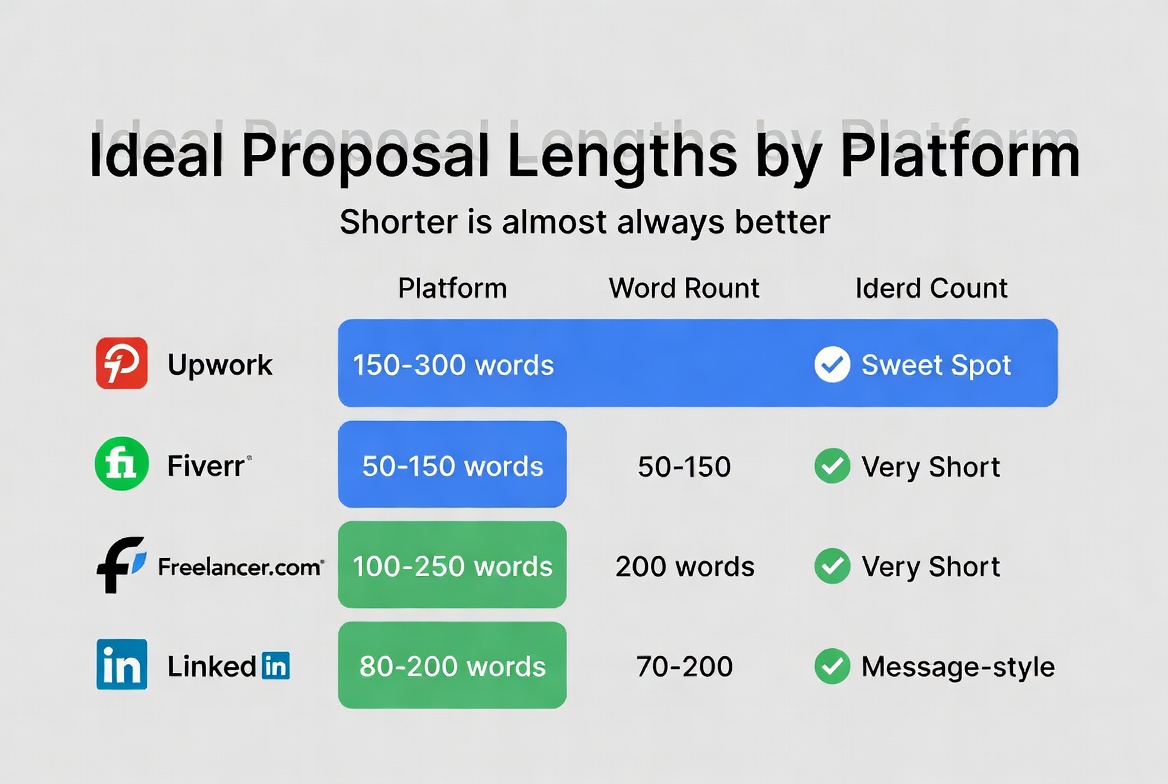
Maximum proposal length is about 5,000 characters but you should never come close to that. Aim for 600-800 characters — roughly 150-200 words. Upwork shows the first 2 lines as a preview before the client clicks "read more." Those first 2 lines ARE your proposal. If the hook isn't there, nothing else matters.
Upwork also shows your profile photo, hourly rate, job success score, and number of hours worked right next to your proposal. If your profile is empty or your job success score is low, even a great proposal faces an uphill battle. Make sure your Upwork profile is complete before you focus on proposals.
Fiverr
Fiverr buyer requests are even shorter — maximum about 2,500 characters. Keep proposals under 150 words. No formatting, no bold, no links in many cases. Your response needs to be pure text that hooks in the first sentence. Fiverr is also much more competitive on price, so your differentiator section matters even more. Lead with specialisation, not generalist skills.
Similar to Upwork but allows slightly longer proposals — up to about 3,000 characters. The platform is more competitive on price than Upwork, so emphasise value and specific outcomes over your hourly rate. Include a portfolio link in every proposal — Freelancer makes it easy for clients to click through.
LinkedIn
When responding to LinkedIn project posts or reaching out to potential clients directly, the "proposal" is actually a message. Keep it under 100 words. LinkedIn messages that read like formal proposals get ignored. Write like you're messaging a professional contact, not submitting a bid. "Hey — saw your post about the checkout redesign. I just finished a similar project for [company] that took conversion from 58% to 84%. Happy to share how I approached it if you're interested."
Every platform has a different sweet spot. Shorter is almost always better.
The 6 Proposal Killers (Avoid These at All Costs)
1. Copy-pasted generic proposals
If your proposal could be sent to any job post without changing a word, it's not a proposal — it's spam. Clients can tell instantly. The first sentence should contain something that only applies to THIS specific project. If it doesn't, don't send it.
2. Starting with your credentials instead of their problem
"I am a certified full-stack developer with 7 years of experience and a degree in Computer Science." Great. The client still doesn't know if you understand their checkout problem. Lead with their problem. Your credentials come in Section 2 as proof, not Section 1 as introduction.
3. Writing an essay
If your Upwork proposal is 500 words, the client will skim it. If it's 800 words, they won't read it at all. Respect their time. 150-200 words is the sweet spot. Every word should earn its place. If a sentence doesn't make the client more likely to respond, delete it.
4. Undercutting on price without adding value
"I can do this for $200" when the budget is $1,500 doesn't make you look competitive — it makes you look like you don't understand the scope. Competing on price alone is a race to the bottom. Compete on understanding, relevance, and specific results instead. Clients pay premium rates for freelancers who clearly understand their problem.
5. No portfolio link or example
Words are cheap. Evidence is expensive. When you say "I've built similar projects" but don't include a link, the client has no way to verify your claim. Always include one relevant portfolio link. Always. If you don't have an online portfolio, that's the first thing to fix — build one before sending another proposal. GigForge's freelance portfolio builder creates a professional portfolio on your own subdomain in about 5 minutes with no code required. That gives you a permanent link to include in every single proposal.
6. No clear call to action
"I look forward to hearing from you" is not a call to action. It's a passive hope. End with a specific, easy-to-answer question. "Want me to send a quick audit?" or "Free for a 10-minute call Thursday?" Give the client something to say yes to.
⚠️
The single biggest ROI activity for freelancers is not learning a new skill, not lowering your rate, and not applying to more jobs. It's fixing your proposal. A great proposal sent to 10 relevant projects will outperform a mediocre proposal sent to 100 random ones. Quality over volume. Every single time.
What to Do When You Get a Response
Your proposal worked. The client responded. Now don't blow it by being slow.
Respond within 2 hours if possible. Freelance clients often message 3-5 freelancers at the same time. The first person to respond with a thoughtful, specific reply usually wins the project — not because speed matters inherently, but because it signals reliability. If you take 2 days to respond to an initial message, the client assumes you'll take 2 days to respond during the project too.
In your response, do three things. Answer any questions they asked. Ask one clarifying question about the project scope or timeline. And suggest a concrete next step — a call, a shared document, or a brief project outline. Move the conversation forward. Don't let it sit.
Proposals Are a Skill You Build — Not a Talent You're Born With
I want to end with something encouraging. If you've been sending proposals and getting silence, it doesn't mean you're a bad freelancer. It means you haven't learned proposal writing as its own skill yet. And it is a skill — separate from your actual craft.
You can be an incredible designer who writes terrible proposals. You can be an average developer who writes brilliant proposals. The second person gets more clients. That might feel unfair, but it's how platforms work. The proposal is your first impression, and on Upwork, you don't get a second one.
Start with the template in this article. Adapt it. Practice it. Track which proposals get responses and which don't. Over time you'll develop a sense for what works with different types of clients and projects. That sense is worth more than any certification or course.
And if you want a head start — GigForge's AI proposal generator creates platform-specific proposals based on the client's job post and your freelance portfolio. It gives you a tailored first draft in 30 seconds that you can then personalise with the specific details that make it yours. Think of it like having a proposal coach who handles the structure while you add the expertise and personality.
Stop sending proposals that get ignored
Paste the client's job post and GigForge generates a personalised proposal using your portfolio, skills, and experience. Platform-specific formatting for Upwork, Fiverr, and Freelancer. Customise and send in minutes.
One more thing. If you don't have a freelance portfolio to link in your proposals yet, start there. A professional portfolio with your best projects, testimonials, and a clear description of your services transforms you from "anonymous freelancer #47" to "specialist with proof." GigForge's freelance portfolio builder gives you a portfolio on your own subdomain — like yourname.gigforge.io — in about 5 minutes. No code. The first portfolio is free. Build it once, link it in every proposal forever.
Build the portfolio that wins clients
Create a professional freelance portfolio on your own subdomain. Add projects, testimonials, services with pricing, and share one link in every proposal.