How to Write a Cover Letter That Gets Responses in 2026 | GigForge
Job Seekers
How to Write a Cover Letter That Gets Responses in 2026
Most cover letters get skipped in 3 seconds. Not because recruiters don't care — because the first line tells them everything they need to know. Here's the format that actually gets responses in 2026.
By Brabyns Yabwetsa13 May 202613 min read
I'm going to be honest with you. I used to think cover letters were dead. Seriously. I thought they were a formality that nobody reads — a box you tick before hitting submit, knowing full well the recruiter is going straight to your CV.
I was wrong.
I changed my mind after talking to over a dozen recruiters and hiring managers while building GigForge. Almost every single one said the same thing: "I don't read bad cover letters. But when someone writes a good one, it jumps off the screen and that person gets an interview."
The problem isn't that recruiters don't read cover letters. The problem is that 95% of cover letters are so generic, so templated, and so painfully boring that they deserve to be skipped. And honestly? I get it. Because most cover letter advice out there is terrible.
So let me show you what actually works in 2026. No fluff. No "Dear Sir/Madam." No five-paragraph essay about your life story. Just the format that gets responses.
I tested this format myself when I was applying for freelance contracts before building GigForge. I went from zero responses to a 40% reply rate just by changing my opening line. The rest of this article is based on what I learned from that experience and from watching how employers on our platform respond to applications.
Why Most Cover Letters Fail in the First 3 Seconds
Here's what happens when a recruiter opens your cover letter. They glance at the first two lines. Not read — glance. In about 3 seconds, they decide whether this is worth reading or whether they should move to the next application. Three seconds. That's it.
And what do most cover letters open with?
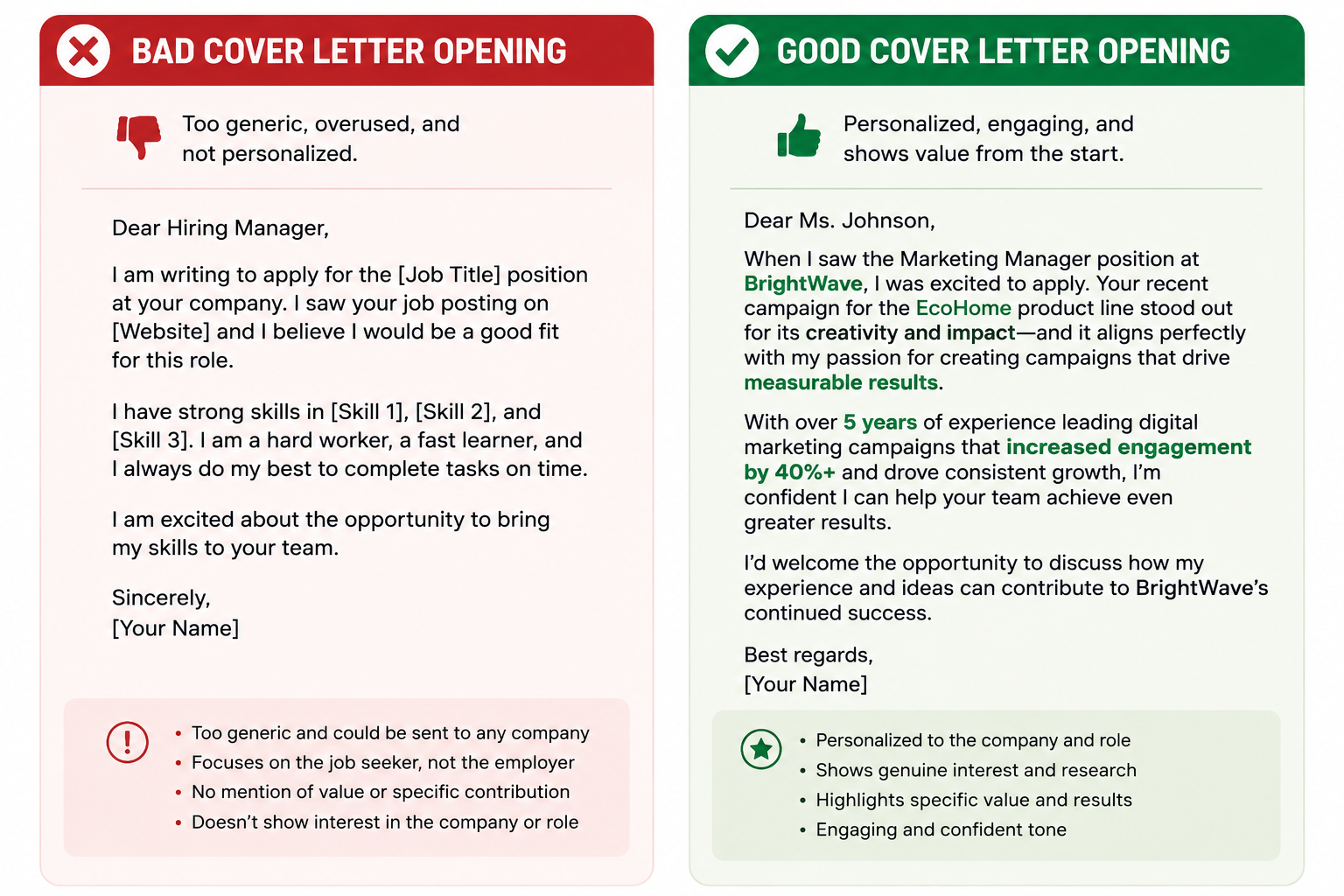
"Dear Sir/Madam, I am writing to express my interest in the Software Developer position at your esteemed organisation. With over 3 years of experience in the field, I believe I would be a valuable addition to your team."
I genuinely fell asleep typing that. And I'm the one writing this article.
That opening fails because it says absolutely nothing specific. It could be sent to any company, for any role, by any person. The recruiter knows — because they've seen this exact opening 200 times this week — that this person did not write this for them. They copied a template off the internet, changed the job title, and hit submit. Why would anyone respond to that?
The difference between getting ignored and getting read comes down to the first two lines.
The Opening Line That Changes Everything
The first line of your cover letter should do one thing: prove that you actually read the job description and understand what this company needs. Not what YOU want. What THEY need.
Here's the formula. Your first sentence should reference a specific problem, project, or goal that the company has — and connect it to something you've actually done.
Bad opening: "I am excited to apply for the Marketing Manager role at TechCorp."
Good opening: "I noticed TechCorp is expanding into the East African market this quarter — I led a similar regional expansion at my last company that grew our user base from 5,000 to 40,000 in 8 months."
Feel the difference? The second opening tells the recruiter three things in one sentence: you researched the company, you've done similar work before, and you have a specific result to show for it. That's a cover letter they finish reading. That's a cover letter that gets a response.
Where do you find this information? The job description itself usually tells you. Company blog posts, LinkedIn updates, recent press coverage, their social media — spend 5 minutes researching before you write. That 5-minute investment is the difference between your application landing in the "read later" pile and the "interview" pile.
When I was applying for gigs, I'd spend 5 minutes on the company's LinkedIn page before writing anything. I'd find one recent post or announcement and reference it in my opening line. It felt almost too simple to work. But it worked every single time because it showed I cared enough to look.
The 4-Line Cover Letter Structure
I'm about to give you a cover letter framework that fits on your phone screen. Not because short is always better, but because every word in a cover letter needs to earn its place. If a sentence doesn't make the recruiter more interested in talking to you, delete it.
Line 1: The hook — reference their specific need
Connect the company's situation to your experience. Show you understand what they're dealing with.
"Your job post mentions scaling the customer support team from 3 to 15 people this year — I built and managed a support team through exactly this kind of rapid growth at my previous company."
Line 2: The proof — your most relevant achievement with a number
Back up your hook with one concrete result. One. Not three. Not five. The single most impressive thing you've done that directly relates to what they need.
"During that scaling phase, I reduced average response time from 18 hours to under 2 hours while maintaining a 94% customer satisfaction score across 12,000 monthly tickets."
Notice the numbers. 18 hours to 2 hours. 94% satisfaction. 12,000 tickets. Numbers are not optional. A recruiter reading "I improved response times" feels nothing. A recruiter reading "18 hours to under 2 hours" leans forward in their chair. Numbers make claims real.
Line 3: The connection — why THIS company, not just any company
This is where most people fumble even when the rest of their cover letter is decent. They write something generic like "I admire your company's mission" or "I'm passionate about your industry." That is meaningless. The recruiter knows you applied to 20 other companies this week.
Instead, name something specific about the company that genuinely interests you and connect it to your work.
"I've been following your product since the beta launch, and the way you've approached customer onboarding with in-app guides rather than email drip campaigns is exactly the philosophy I built our support team around."
This tells the recruiter: you know the product. You use it or follow it. Your values align with theirs. That is not something you can copy-paste from a template.
Line 4: The ask — clear, confident, no begging
End with a direct ask. Not "I hope to hear from you" — that's passive and weak. Not "I would be grateful for the opportunity" — that's begging. Instead:
"I'd welcome a conversation about how I can help your support team scale without losing the quality your users clearly love. I'm available this week if that works."
That's it. Four lines. Hook, proof, connection, ask. The entire cover letter is under 200 words. The recruiter can read it in 45 seconds. And every sentence gives them a reason to want to talk to you.
200
words. That's all your cover letter needs.
A Complete Example (That You Can Adapt)
Let me put it all together. Imagine you're applying for a Product Manager role at a fintech startup that just raised a Series A.
"Your team is about to scale product development after the Series A — I've been through this exact phase before. At my last company, I led the product roadmap through our post-seed growth stage, shipping 4 major features in 6 months that increased user retention by 28%. I've been using your app since January and the payment flow redesign you launched last month is one of the cleanest I've seen in the East African fintech space. I'd love to talk about how I can help your product team move fast without breaking things. Free any day this week."
Read that again. It's 4 sentences and 95 words. But it tells the hiring manager: you've scaled product before, you shipped measurable results, you actually use their product and noticed specific details, and you're ready to talk immediately. That is a cover letter that gets a response.
The 7 Mistakes That Kill Cover Letters Instantly
Now that you know what works, here's what to avoid. I've seen all of these hundreds of times, and every single one will get your application ignored.
1. "Dear Sir/Madam" or "To Whom It May Concern"
Nothing says "I sent this to 50 companies" louder than a generic greeting. Find the hiring manager's name on LinkedIn, the job post, or the company team page. If you genuinely cannot find a name, use "Hi [Company Name] team" — it's casual, modern, and shows you at least know where you're applying.
2. Repeating your entire CV in paragraph form
Your cover letter is not a prose version of your resume. The recruiter already has your CV — they don't need you to restate it in sentences. Your cover letter adds what the CV cannot: context, motivation, personality, and a direct connection between your experience and their specific needs.
3. Talking about what YOU want instead of what THEY need
"I am looking for a challenging role where I can grow my skills and advance my career." Cool. But the company doesn't exist to grow your skills. They exist to solve a problem, and they're hiring someone to help. Frame everything around what you bring to them, not what they give to you.
4. Being vague about your achievements
"I have extensive experience in project management and have successfully delivered many projects." How many? What size? What was the outcome? "I managed 8 concurrent projects totalling $2.3M in budget and delivered all of them within 5% of timeline" — that's the same experience, but now it's real.
5. Writing more than one page
If your cover letter is longer than 250 words, it's too long. Recruiters spend 30-60 seconds on cover letters. Anything past 250 words is writing for yourself, not for the reader. Cut everything that doesn't directly answer: "Why should we interview this person?"
6. Using buzzwords and corporate speak
"Leveraging synergies to drive stakeholder alignment across cross-functional teams." I have no idea what that person actually does. And neither does the recruiter. Write like you're explaining your work to a friend. Simple, clear, direct. If a sentence sounds like it came from a corporate mission statement, rewrite it until it sounds like a human being.
7. Not customising for each application
This is the big one. The entire point of a cover letter is to show the recruiter why you're right for THIS role at THIS company. If your cover letter could be sent to any company without changing a word, it's not a cover letter — it's spam.
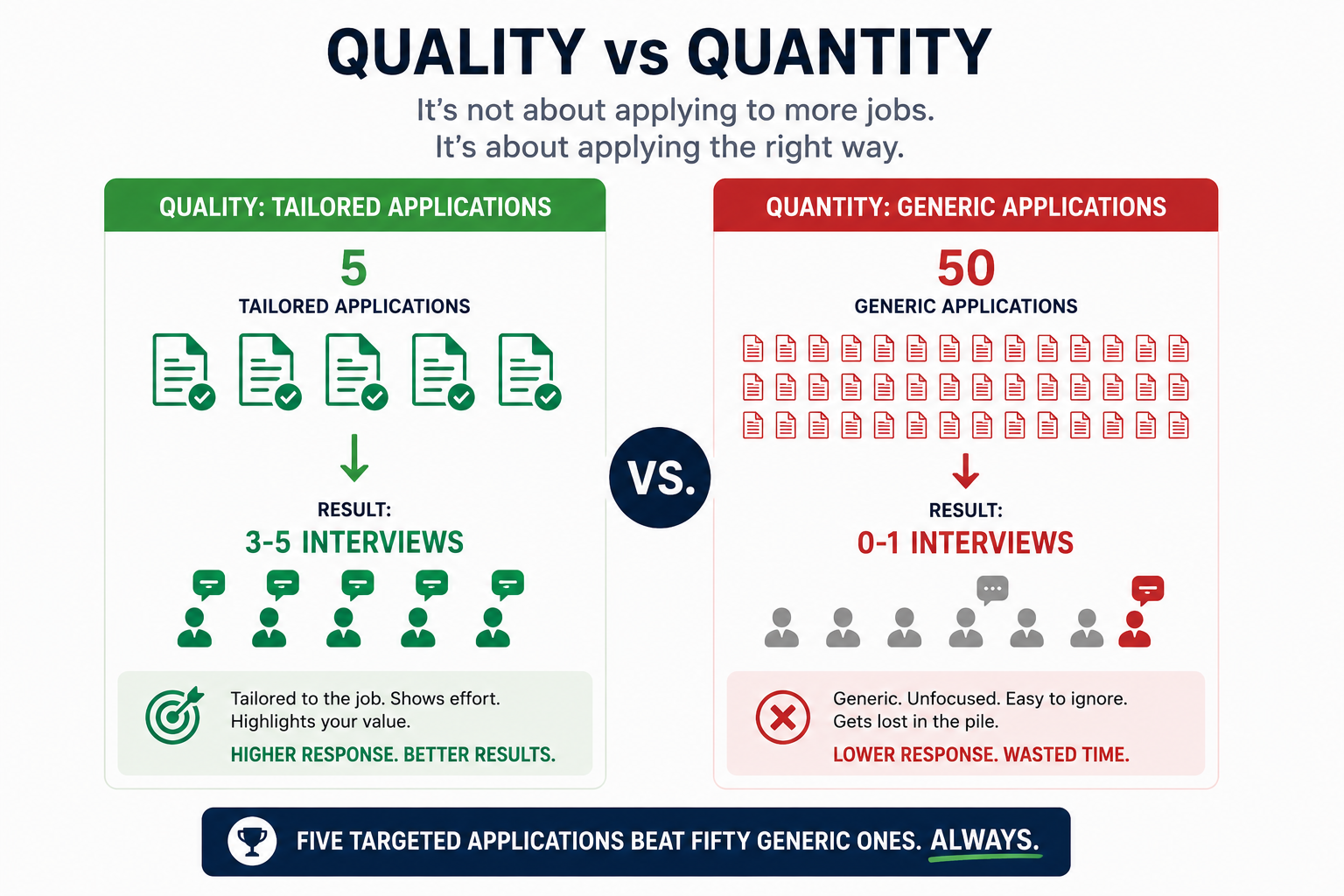
Yes, customising takes time. About 15-20 minutes per application if you follow the 4-line structure. But here's the truth: 5 customised applications will generate more interviews than 50 generic ones. Quality over volume. Every time.
Five targeted applications beat fifty generic ones. Always.
Cover Letters in the Age of AI
Let's talk about the elephant in the room. Should you use AI to write your cover letter?
Here's my honest take. Using AI to generate a first draft that you then personalise and refine? Smart. It saves you time on structure and phrasing so you can focus on adding the specific details that make the letter genuine — the company research, the relevant achievement, the personal connection.
Using AI to generate a cover letter and sending it without changing anything? That's worse than not sending one at all. Recruiters in 2026 can spot untouched AI writing instantly. It has a particular rhythm — smooth, balanced, generic. No personality. No specifics. No evidence that a human being actually thought about this application.
The best approach is somewhere in the middle. Let AI handle the blank page problem — getting from zero to a solid structure with the right tone and length. Then add the 3 things AI cannot know: what specifically about this company interests you, which of your achievements is most relevant to their situation, and why you want this particular role.
This is actually why we built the cover letter generator at GigForge. It gives you a solid starting draft tailored to the job, but we always tell users: don't send the first draft as-is. Read it, add your personal details, and make it yours. AI writes the structure. You add the soul.
Get your first draft in 30 seconds
GigForge's AI cover letter generator creates a personalised draft based on the job description and your profile. Choose your tone — professional, friendly, or technical — and your length. Then make it yours.
The Cover Letter Checklist (Use Before Every Application)
Before you hit send on your next application, run through this. It takes 60 seconds and catches the mistakes that get cover letters thrown out.
Does the opening line reference something specific about this company or role? Not a generic statement — something that proves you researched them.
Have you included at least one quantified achievement? A number, a percentage, a timeframe — something measurable.
Is the entire letter under 250 words? If not, cut. Be ruthless.
Does it explain why THIS company, not just any company? Name something specific you know about them.
Is the closing a direct ask, not a passive hope? "I'd welcome a conversation" not "I hope to hear from you."
Did you address a specific person by name? If not, at least "Hi [Company] team."
Did you proofread? One typo in a cover letter can end your application. Read it out loud before sending.
Is it a fresh write for this application? If you could send this same letter to another company without changing anything, start over.
What Happens After You Send It
A good cover letter gets you one thing: attention. The recruiter finishes reading and thinks "this person gets it — I want to talk to them." That's the entire goal. Not to get hired from the cover letter. Not to summarise your career. Just to earn a conversation.
Once you have that conversation, the cover letter did its job. But if you're sending applications and hearing nothing, the cover letter is where to look first. Not your CV. Not your experience. The cover letter is the front door, and right now, most people's front doors are locked with a "Dear Sir/Madam" sign that tells every recruiter to keep walking.
Open that door properly. Four lines. One specific hook. One proven result. One genuine connection. One clear ask. That's all it takes.
And if you want a head start, GigForge's cover letter tool gives you a tailored first draft based on the job description in 30 seconds. You add the personal details, the specific research, and the human touch — and you've got a cover letter that gets responses.
Stop sending cover letters that get ignored
Generate a personalised cover letter draft for any job in 30 seconds. Choose your tone, customise with your personal details, and apply with confidence.