The Real Cost of a Bad Hire in 2026 (And How to Avoid It) | GigForge
Organisations
The Real Cost of a Bad Hire (And How to Avoid It)
A bad hire costs your company far more than their salary. The real damage includes lost productivity, team morale, rehiring costs, and months of lost momentum. Here is what a bad hire actually costs and how to prevent it with structured screening.
By Brabyns Yabwetsa11 May 202611 min read
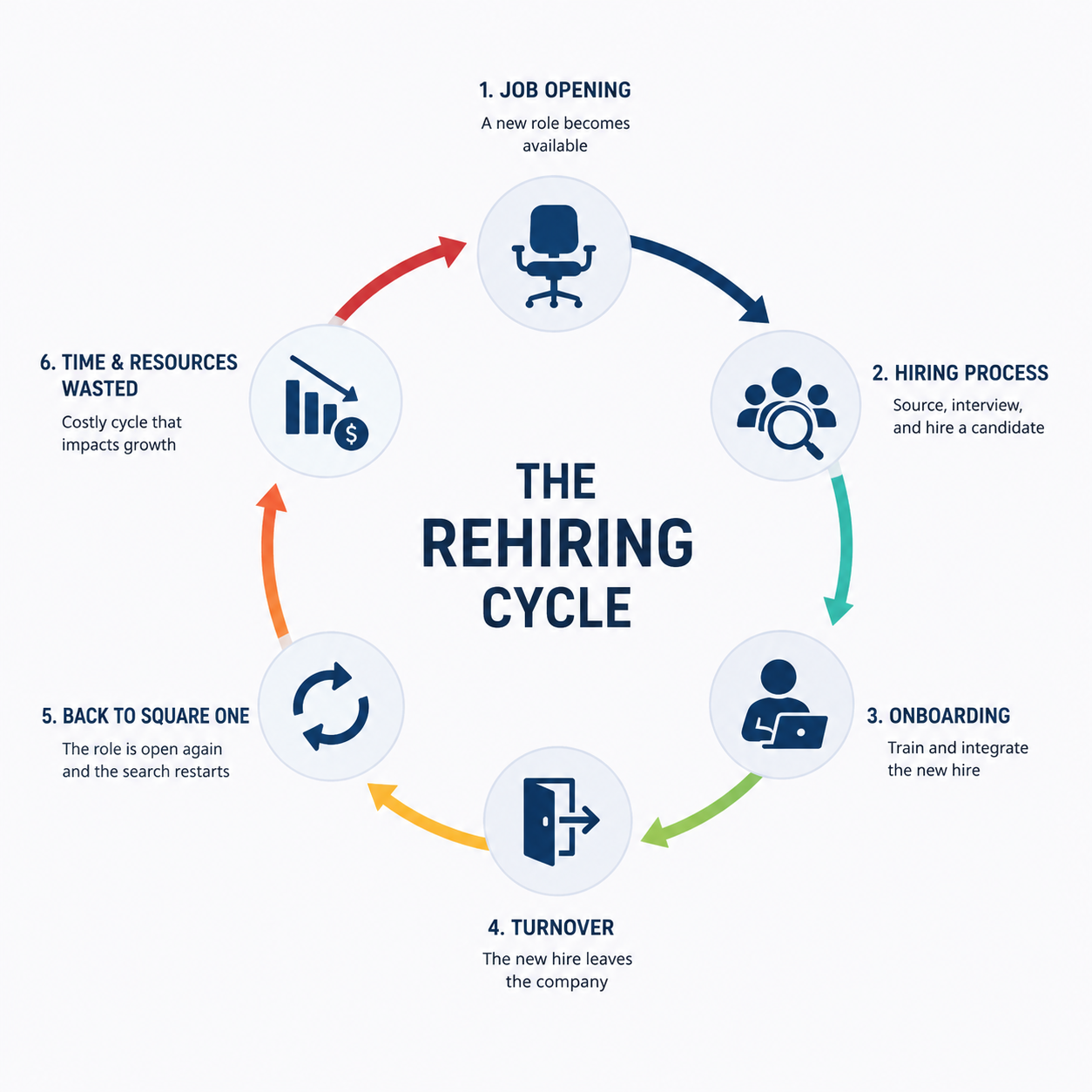
You posted the job, screened a few candidates quickly, picked the one who interviewed best, and extended the offer. Three months later, the new hire is underperforming. Six months later, you are having difficult conversations about fit. Nine months later, they are gone — either they quit or you let them go. And now you are right back where you started, except thousands of dollars poorer and months behind schedule.
This story plays out in companies of every size, in every industry, every single day. And most leaders dramatically underestimate how much it costs them. The salary you paid during those wasted months is the smallest part of the bill. The real cost of a bad hire lives in the things you cannot see on a spreadsheet.
$17,000
Average cost of a single bad hire (U.S. Department of Labor estimate)
The Costs You Can See
The visible costs of a bad hire are straightforward to calculate but painful to add up.
Salary and benefits paid during their tenure
Every month a bad hire remains on your payroll, you are paying full salary and benefits for someone not delivering the value the role requires. If a mid-level employee earns $60,000 per year and stays for six months before the situation resolves, that is $30,000 in direct compensation for substandard work. Add employer-side costs — health insurance, pension contributions, equipment, software licenses — and the figure climbs to $35,000-$40,000 easily.
Recruitment costs to fill the role again
You already spent money filling this role the first time. Job board fees, recruiter time, background checks, onboarding setup. Now you spend all of that again. If you used an external recruiter, their fee is typically 15-25% of the annual salary — paid twice because the first placement failed. Internal recruiting costs add up too: every hour your HR team spent sourcing, screening, and interviewing is an hour they now repeat from scratch.
Each bad hire restarts the entire recruitment cycle — doubling the time and cost.
Training and onboarding investment — wasted
Every new employee requires training. Someone on your team spent days or weeks bringing the new hire up to speed — explaining systems, introducing clients, transferring knowledge, reviewing their early work. All of that investment walked out the door when the hire left. The person who trained them now has to do it all over again for the replacement, meaning their own productivity suffers twice.
36%
Productivity drop across a team when one member is a bad hire
The Hidden Costs That Actually Hurt More
The visible costs are bad enough. But the hidden costs are where the real damage lives. These are harder to put a number on, but companies that track them consistently find they cost more than the salary and recruitment expenses combined.
Your best employees start leaving
When strong performers watch a bad hire coast by with poor work — or worse, create extra work that everyone else has to clean up — resentment builds quietly. They start questioning leadership's judgement. They wonder why they are working evenings and weekends while the new hire misses deadlines without consequences. If the situation drags on for months without resolution, your best people start updating their own resumes. The cruelest irony of a bad hire is that the people most likely to leave because of it are your strongest performers — the ones with the most options elsewhere.
Team productivity collapses
A bad hire does not just underperform individually. They drag down everyone around them. Team members spend extra hours compensating for the weak link, fixing their mistakes, redoing their work, and covering their responsibilities. Managers spend time in coaching sessions, performance documentation, and HR conversations instead of focusing on growth. One underperforming person in a team of six does not reduce output by one-sixth — research on team dynamics shows it reduces the entire team's output by 30-40%.
Client relationships get damaged
If the bad hire was in a client-facing role — sales, account management, customer support, project delivery — the damage extends beyond your company. Clients who received poor service during those months may not complain. They will simply not renew. Relationships that took years to build can deteriorate in weeks of dropped balls and missed commitments. And the replacement hire inherits those damaged relationships, starting at a disadvantage through no fault of their own.
Months of momentum — gone
This is the cost companies almost never calculate, and it is usually the largest. While you were managing a bad hire — coaching, documenting, having difficult conversations, eventually terminating, then recruiting again, then onboarding again — your competitors moved forward. That product feature did not ship. That market did not get entered. That sales target did not get hit. Not because of a strategic failure, but because one role was filled with the wrong person and it consumed everyone's bandwidth for six months.
The average time to identify a bad hire is 3-6 months. The average time to resolve the situation (performance plans, termination, re-hiring) adds another 2-4 months. Total disruption: 5-10 months of compromised team performance from a single hiring mistake.
Why Bad Hires Happen
Bad hires are rarely the result of carelessness. They are usually the result of a broken process that looks functional on the surface.
Rushing to fill the seat
When a role has been open for weeks and the team is struggling, the pressure to hire someone — anyone — becomes intense. This leads to lowering the bar, skipping screening steps, or making offers based on "good enough" rather than "genuinely qualified." The urgency of filling the role today creates a much bigger problem three months from now.
Over-valuing interview performance
Some people are exceptional interviewers and mediocre workers. They present well, tell compelling stories, and create a strong impression in a 45-minute conversation. But a structured interview only tests one skill: the ability to interview. It tells you very little about how someone performs under real work conditions, handles ambiguity, collaborates with a team, or delivers under pressure over months. Hiring decisions weighted too heavily on interview charisma are hiring decisions based on performance art rather than evidence.
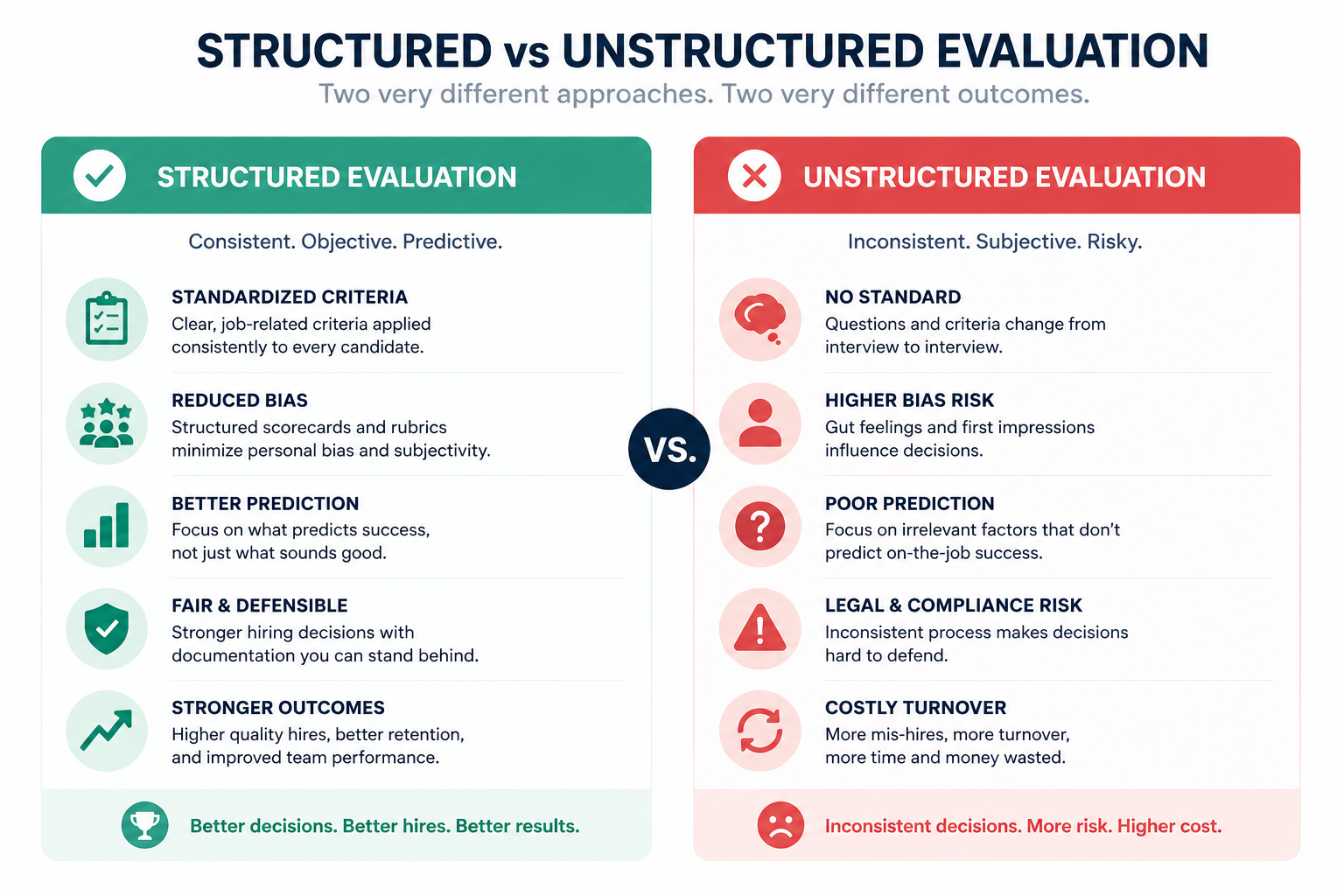
Gut feeling instead of structured evaluation
"I just had a good feeling about them" is the most common and most dangerous hiring rationale. Gut feeling is pattern recognition based on biases you may not even be aware of — similarity bias, halo effect, recency bias. Without a structured scoring framework that evaluates every candidate against the same criteria, your hiring decisions are only as reliable as your subconscious assumptions. And your subconscious is not as objective as it thinks it is.
Structured scoring catches what gut feeling misses.
Not testing for the actual role
Most interviews ask candidates to talk about their past experience. Very few test whether the candidate can actually do the work this role requires. A developer who describes previous projects impressively may struggle with your specific tech stack. A marketer who talks about past campaigns confidently may not be able to write a single piece of copy that matches your brand voice. The gap between "talks about work well" and "does the work well" is where bad hires live.
How to Prevent Bad Hires
Preventing bad hires is not about being more cautious or interviewing longer. It is about adding structure and evidence to a process that most companies run on intuition and time pressure.
Define scoring criteria before you start
Before you review a single application, write down the 5-7 specific, measurable criteria that determine success in this role. Not "good communicator" — that is unmeasurable. Instead: "Can clearly explain technical concepts to non-technical stakeholders in writing." Not "team player" — instead: "Has led or contributed to cross-functional projects involving 3+ teams." Each criterion gets a weight based on how critical it is. Technical skills might be 40%, relevant experience 25%, and cultural alignment 15%. This framework becomes your objective evaluation tool.
Screen with data, not with skimming
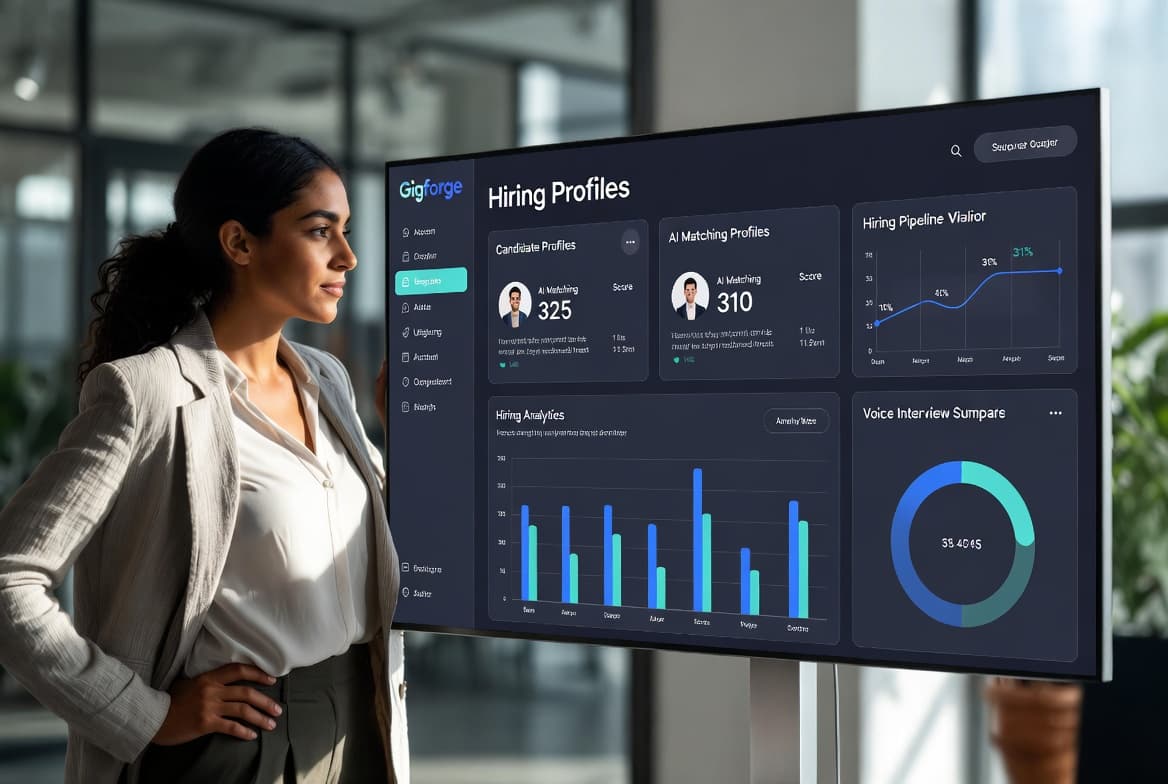
Reading 200 CVs by skimming each one for 30 seconds is not screening — it is guessing. Structured screening scores each application against your predefined criteria systematically. AI-powered screening does this automatically: it reads the full resume, evaluates skills matches, experience relevance, and qualification alignment, and produces a numerical score for every applicant. The hiring team starts their review with a ranked list rather than a random pile, and every candidate is evaluated against the same standard.
The single most effective way to reduce bad hires is to define your scoring criteria before you see any applications. Once you start reading CVs, your criteria unconsciously shift toward the first few candidates you liked — biasing every evaluation that follows.
Add a structured voice screen before the full interview
Between the CV screen and the full interview, add a structured voice conversation that evaluates three things: Can this person communicate clearly? Do they understand what the role involves? Is there an obvious mismatch that their CV did not reveal? This 10-15 minute voice screen eliminates 30-50% of candidates who looked strong on paper but cannot articulate their experience, have misaligned expectations, or simply are not what you assumed from reading their application.
AI voice interviews take this further. Instead of your team conducting 15 phone calls, an AI interviewer speaks with each candidate, asks role-specific questions, and delivers a detailed report with scores, transcripts, and a hiring recommendation. Your team reads the reports and decides who earns a full interview — investing human time only in candidates who have already been objectively evaluated twice
Stop guessing. Start screening with data.
GigForge's AI reads every CV, scores candidates against your criteria, and conducts voice interviews with your shortlist. You get ranked candidates with detailed reports — no gut feeling required.
Scenario A: Traditional approach. You skim 150 CVs in 12 hours, shortlist 15 based on gut feeling, phone screen 10 in another 8 hours, interview 5 in 6 hours. You hire based on interview impression. Three months later, the hire is underperforming. Six months later, you start over. Total time invested before you have a productive employee: 10+ months. Total cost including salary, recruitment, training, lost productivity, and rehiring: $40,000-$80,000.
Scenario B: Structured approach with AI. AI screens 150 CVs in minutes and produces a ranked shortlist. AI voice interviews the top 15 candidates and delivers detailed reports. You personally interview only the top 3-5 candidates who have passed two rounds of objective evaluation. You hire with evidence, not impression. The hire performs because they were evaluated for what they can actually do, not how they interview. Total time invested: approximately 4 hours. Cost of the AI tools: under $200.
The difference is not marginal. It is an order of magnitude. And the most important number is not the money — it is the months of team momentum you preserve by getting the hire right the first time.
80%
Reduction in bad hires when using structured AI screening vs traditional interviews
One Bad Hire Is Expensive. Two Is a Pattern.
Every company makes a bad hire occasionally. It is unavoidable. But when bad hires happen repeatedly — when every second or third placement does not work out — that is not bad luck. That is a process problem. And process problems are the easiest kind to fix because you do not need different people or more budget. You need a different system.
The system is straightforward. Define what success looks like before you start. Score every candidate against those definitions consistently. Add an objective evaluation step between the CV and the interview. Use the interview for what it is actually good at — assessing culture fit, motivation, and interpersonal chemistry — not for determining basic competence. That is what the screening and voice interview data already told you.
The companies that hire well do not have better intuition. They have better process. And in 2026, the best processes are the ones that let AI handle the mechanical evaluation while humans focus on the decisions that actually require human judgement.