
I need to start this article by saying something that might sound strange coming from someone who builds hiring technology: the silence is not your fault. At least, probably not in the way you think.
If you've sent out 30, 40, 50 applications and gotten zero responses — not even a rejection email — you're not alone. You're not unemployable. You're not doing something fundamentally wrong with your career. What you are doing, almost certainly, is hitting a wall that most job seekers don't even know exists. And once you see it, you can't unsee it.
Let me explain what's actually happening to your applications after you click submit. Because the answer is probably going to make you angry. And then it's going to help you fix it.
I know this feeling personally. Before I started building GigForge, I went through a stretch where I applied to over 30 freelance gigs in two weeks and heard back from exactly one. ONE. It wasn't until I started researching how recruitment actually works on the employer side that I understood what was happening — and it completely changed how I approached applications."
Here's What Actually Happens After You Click "Apply"
You spend an hour tailoring your CV. You write a cover letter. You double-check everything. You click submit and feel a little rush of hope. Then you wait.
Here's what happens on the other side.
Your application enters an Applicant Tracking System — ATS for short. This is software that every mid-size to large company uses to manage the flood of applications they receive. The ATS does not put your resume on someone's desk. It scans it. It extracts your information. It scores you against the job description. And if your score falls below a threshold that the employer set — sometimes as low as 60 out of 100 — your application is automatically filtered out.
The recruiter never sees your name. Your carefully written cover letter never gets opened. Your resume sits in a database marked "does not meet minimum criteria." And you receive... nothing. No rejection email. No acknowledgement. Just silence.
This is not a bug. This is how the system is designed. And it happens to roughly 75% of all applications.
Let that number sink in. Three out of every four applications you send are probably being discarded by software before a human being makes any decision about you. The silence isn't personal. It's algorithmic.
"But My Resume Is Good" — It Probably Is. That's Not the Problem.
This is the part that makes people angry, and I think they have every right to be.
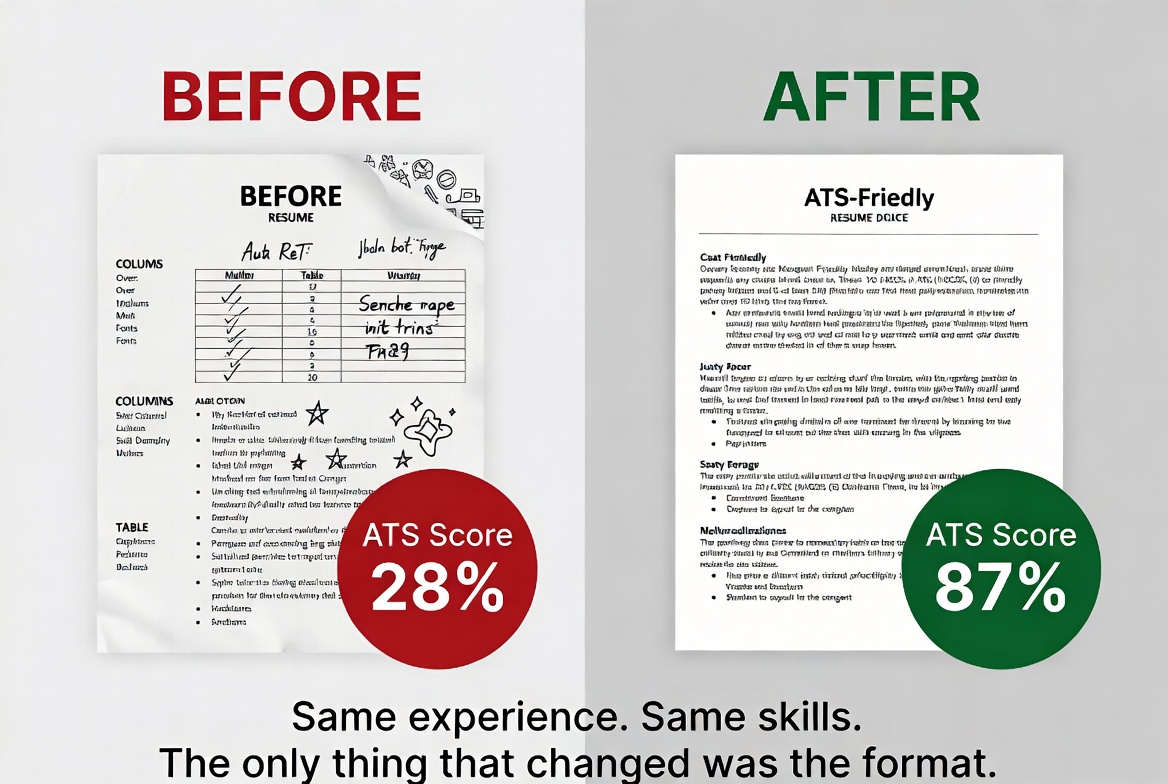
You can have 10 years of perfect experience, a degree from a great university, and a resume that any human recruiter would love. But if your resume is formatted in two columns, or uses creative section headings, or is saved as a design-heavy PDF — the ATS can't read it properly. It scrambles your information, misses your keywords, and scores you at 30 out of 100. Qualified candidate. Zero response.
I've seen this happen over and over. A friend of mine — experienced software developer, solid portfolio, great references — applied to 40+ jobs in Nairobi and Kampala over six weeks. Nothing. Not a single interview. When I ran his resume through an ATS scoring tool, it scored 28 out of 100. The problem? His resume used a Canva template with two columns, icons for skills, and a sidebar for contact info. Beautiful to look at. Completely invisible to the software.
We reformatted it in 20 minutes. Single column. Standard headings. Same content, just restructured. His next 5 applications got him 3 interviews. Same person. Same experience. Different format.
The 5 Reasons You're Getting Ghosted (And It's Not Your Experience)
If you've been applying and hearing nothing, at least one of these five things is happening. Probably more than one
1. Your resume format is breaking the ATS
This is the number one reason and the easiest to fix. Multi-column layouts, text boxes, tables used for design, headers and footers with contact info, graphics, icons, skill rating bars, profile photos — all of these confuse ATS parsers. The software reads your document top to bottom, left to right, in a single stream. Anything that disrupts that flow gets scrambled or skipped.
The fix takes 15 minutes. Strip your resume to a single column. Put your contact info in the main body, not a header. Use standard section headings: Work Experience, Education, Skills. Save as .docx or a clean text-based PDF. That's it. Your content stays the same — you're just making it readable by the machine that decides whether a human ever sees it
2. You're not using the same language as the job description
ATS scoring is largely keyword matching. If the job post says "project management" and your resume says "managed projects," many systems won't register the match. If they ask for "React.js" and you wrote "frontend frameworks," you get zero credit for a skill you actually have.
This one takes 10-15 minutes per application but makes an enormous difference. Read the job description carefully before each application. Highlight the specific skills, tools, and phrases they use. Then check your resume — does it contain those exact phrases? If not, add them where they honestly apply. Not keyword stuffing. Just using their language to describe your genuine experience.
I tell everyone who uses GigForge's ATS analyzer the same thing: run the analysis before EVERY application, not just once. Each job description has different keywords and priorities. A resume that scores 90 for one role might score 45 for another. The 10 minutes you spend tailoring per application is worth more than 10 generic applications sent in the same time.
3. You're applying for the wrong level
Some ATS configurations automatically reject applications where the candidate's years of experience don't match the role's requirements. If a Senior Developer role asks for 5-7 years and your resume shows 2, the system may auto-reject before the AI or human evaluation even begins. This also works in reverse — applying for a junior role with 15 years of experience can trigger an "overqualified" filter.
Check the experience requirements before applying. If you're within a year of the range, apply. If you're significantly outside it, your application is almost certainly going to be filtered out regardless of how strong your skills are.
4. You're not applying to enough of the RIGHT jobs
Here's an uncomfortable truth. Applying to 50 jobs sounds like a lot, but if those 50 applications were scattered across different industries, roles, and seniority levels with the same generic resume, the quantity doesn't help you. Hiring managers can tell when someone is shotgunning applications versus targeting specific roles.
A better approach: identify 10-15 roles that genuinely match your skills and experience. For each one, tailor your resume to match the job description keywords. Write a cover letter that references something specific about the company. Apply with quality, not volume. Fifteen targeted applications will outperform fifty generic ones every time. I know that's hard to hear when you're desperate and frustrated, but it's true.
5. Your online presence is working against you
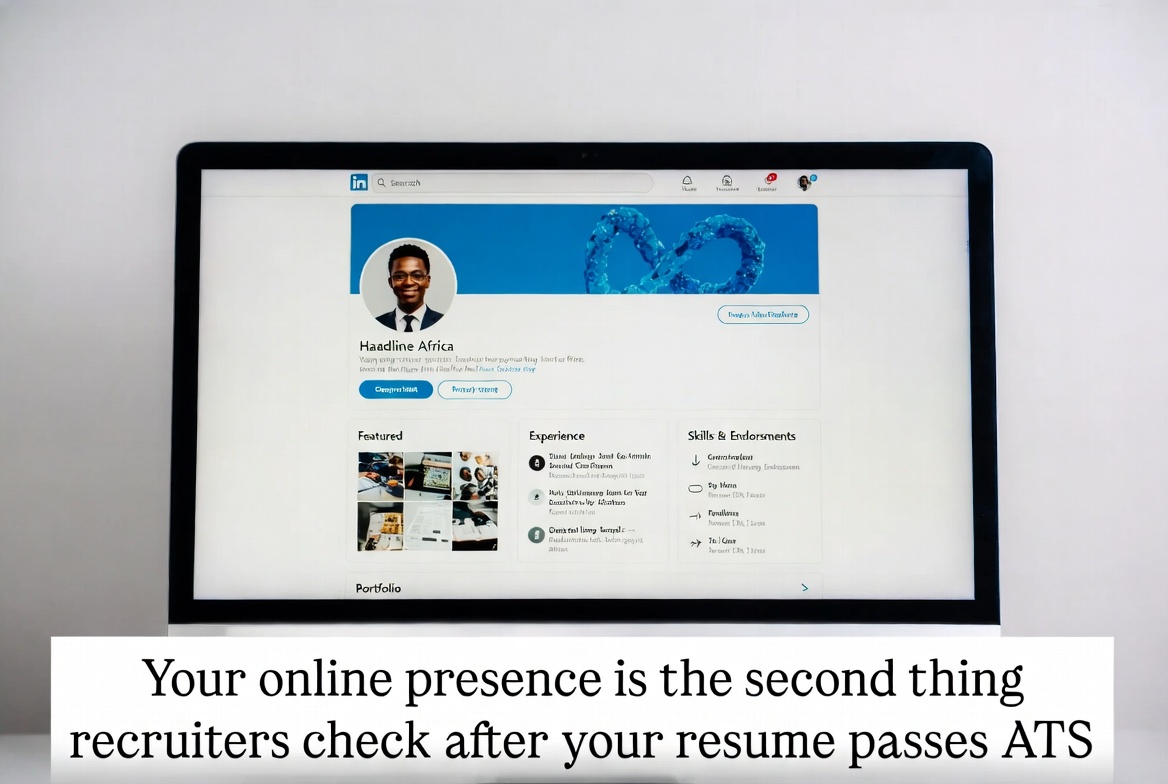
After the ATS passes your resume to a recruiter, many of them will Google you or check your LinkedIn before deciding to reach out. If your LinkedIn profile is empty, outdated, or tells a different story than your resume, that creates doubt. If you have no online presence at all, you're at a disadvantage compared to candidates who do.
You don't need to become a LinkedIn influencer. Just make sure your profile is complete, your headline matches the roles you're targeting, and your experience section aligns with your resume. If you're a freelancer or creative, having a portfolio link in your profile gives you a significant edge.
The Action Plan — What to Do This Week
Enough diagnosis. Here's exactly what to do, in order, starting today. The entire process takes about 2-3 hours and will fundamentally change your response rate.
Step 1: Check your ATS score right now (10 minutes)
Take your current resume and the job description for a role you recently applied to. Run them through an ATS compatibility checker. You need to see the actual score — a number out of 100. If you're below 70, the formatting and keyword issues I described above are exactly what's happening to your applications. Don't guess. See the score.
See your actual ATS score in 30 seconds
Upload your resume, paste the job description, and GigForge shows you your compatibility score with specific keywords matched, keywords missing, and formatting issues to fix.
Check My ATS Score Free →Step 2: Reformat your resume for ATS (30 minutes)
If your score was below 70, reformat your resume following the rules from step 1. Single column layout, standard headings, contact info in the body not the header, no graphics or icons, clean .docx or PDF. If you need help, our resume builder has an ATS-Clean template that handles all of this automatically.
Step 3: Tailor and reapply to your top 5 roles (1-2 hours)
Pick the 5 jobs you're most qualified for and most excited about from your recent applications. For each one, tailor your resume keywords to match that specific job description. Write a 4-line cover letter that references something specific about the company. Reapply if the posting is still open. These 5 tailored applications are worth more than the 50 generic ones you already sent.
Step 4: Update your LinkedIn profile (30 minutes)
Make sure your LinkedIn headline matches the roles you're targeting. Fill in your experience with the same keyword-rich descriptions you used in your resume. Add a professional photo if you don't have one. Set your profile to "Open to Work" if you're comfortable with that. Connect with people at companies you're targeting.
Step 5: Practice your interview skills (ongoing)
Once the interviews start coming — and they will once your resume passes ATS — you want to be ready. Practice with mock interviews so you're not walking into your first real interview cold. AI interview practice lets you rehearse with role-specific questions and get scored on your answers before the real thing.
The goal of this action plan is not to apply to MORE jobs. It's to apply BETTER to FEWER jobs. Five applications that score 85+ on ATS with tailored cover letters will generate more interviews than fifty applications scoring 30 with generic cover letters. Change the quality, not the quantity.
What If You've Done All of This and STILL Hear Nothing?
Sometimes the market is genuinely tough. Industries go through hiring freezes. Companies post roles they're not actively filling. Budgets get cut after the job was listed. These things happen and they're completely outside your control.
But here's how you know the difference between "the market is slow" and "my applications aren't getting through." If you're applying with an ATS-optimised resume, tailored keywords, and targeted cover letters — and you're getting interviews for some roles but not others — the market is just being selective. That's normal. Keep going.
If you're getting zero responses from zero applications across all roles and companies, the problem is almost certainly still in your application materials. Go back to Step 1 and check your ATS score again. The answer is almost always there.
The Silence Ends When You Understand the System
Look — I know how demoralising it is to apply and hear nothing. It feels personal even when it isn't. It makes you question your skills, your experience, your worth. I've been there. Most people who've ever job searched have been there.
But the system isn't broken in a mysterious way. It's broken in a very specific, fixable way. Software is filtering you out before a human sees you. That software has rules. And once you learn the rules, you can play by them — without changing who you are or what you've accomplished. You just change how you present it.
Check your score. Fix the format. Match the keywords. Apply with intention. The interviews will come.
End the silence today
Check your resume's ATS compatibility score against any job description. See exactly what's blocking your applications and fix it in minutes.
Check My Score Free →
Make your resume impossible to ignore.
Check your ATS score, rebuild your resume for any job, practice interviews with AI, and track every application — all free.
Try the ATS Analyzer freeNewsletter
Stay one step ahead.
Get the best hiring, career and freelance insights delivered to your inbox. No spam, unsubscribe anytime.
Keep reading

How to Find Remote Jobs in 2026 (Where to Look and How to Stand Out)
Remote job listings get 10x more applications than office roles. That means the competition is brutal — unless you know where to look and how to stand out. Here's the complete playbook for landing remote work in 2026.

Skills Gap Analysis: How to Find Out What's Holding Your Career Back
You're stuck. Not because you lack talent — because there's a gap between the skills you have and the skills the next level requires. Here's how to find that gap and close it fast.

How to Negotiate Salary After a Job Offer (Without Losing It)
You got the offer. Now comes the part nobody prepares you for — asking for more money without losing the job. Here's the exact script, the timing, and the mindset that gets you 10-20% more.