How to Follow Up After an Interview Without Being Annoying
The interview went great. You walked out feeling confident. And now you're staring at your phone wondering if you should text them, email them, call them, or just sit in silence and hope for the best. Here's exactly what to do and when.
By Brabyns Yabwetsa1 June 202615 min read
You walked out of the interview feeling good. Maybe even great. You answered every question, you connected with the interviewer, you hit that one answer about the cross-functional project out of the park. For about 45 minutes after leaving, you're riding high.
Then the waiting starts.
Day 1: "They said they'd be in touch. I'll give them space." Day 2: "Should I have sent an email by now?" Day 3: "I'm checking my inbox every 20 minutes and I hate myself for it." Day 5: "It's been almost a week. Did I say something wrong? Did they already hire someone else? Should I call? Would that be weird? It would be weird. But what if they forgot about me?"
If this sounds familiar, you're not alone. The post-interview silence is genuinely one of the most anxiety-inducing parts of job searching. And the reason it's so stressful is that nobody teaches you the rules. When exactly should you follow up? What should you say? How many times before you become annoying? What if it was an AI interview — do you still follow up with a human?
I'm going to answer all of those questions right now. With exact timelines, exact email templates, and the specific mistakes that make hiring managers cringe.
ℹ️
I've seen follow-up from both sides. As someone who applied for gigs before building GigForge, I know the anxiety of waiting and wondering if I should reach out. And now, running a platform where companies screen and interview candidates, I see what follow-up messages actually land in the hiring team's inbox and which ones get eye-rolls. The advice in this article comes from both perspectives.
The 24-Hour Rule: Send a Thank-You Email (Not a Text, Not a LinkedIn Message)
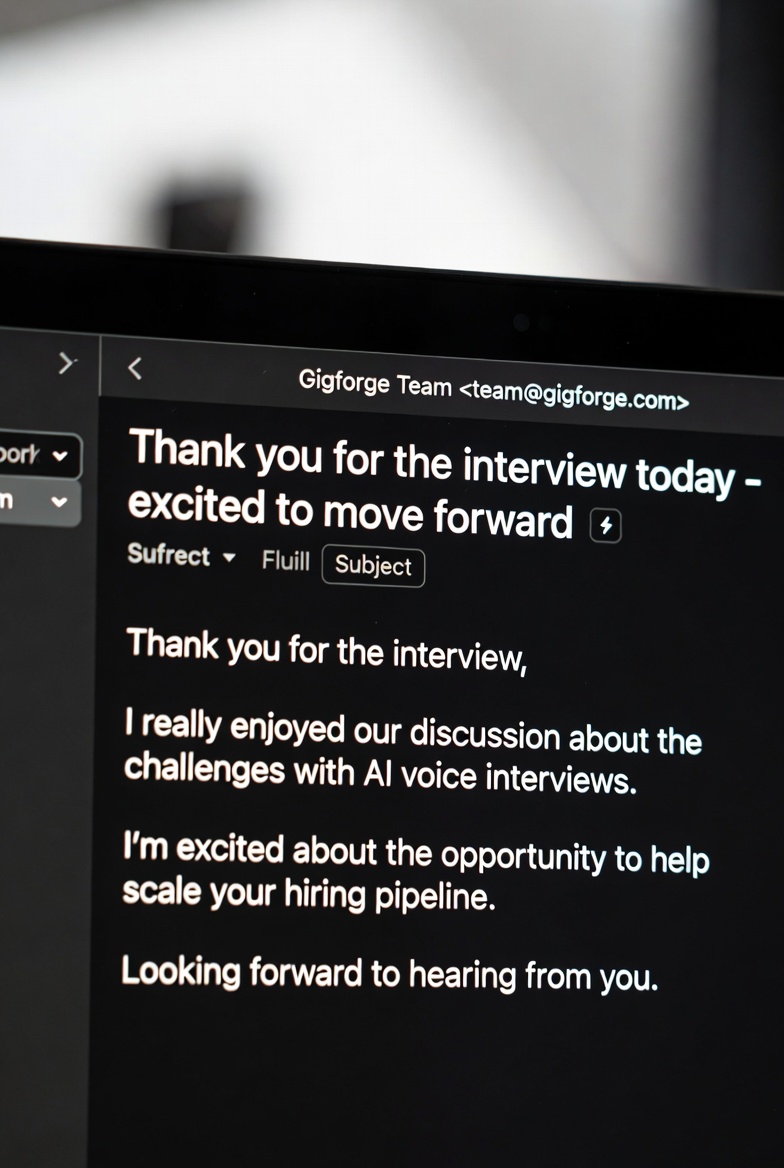
Within 24 hours of your interview, send a thank-you email. Not a text message. Not a LinkedIn DM. Not a WhatsApp voice note. An email. To the person who interviewed you.
Why email specifically? Because email is professional, searchable, and doesn't put the interviewer on the spot. A text feels too casual for someone you just met in a professional context. A LinkedIn message gets buried in a sea of recruiter spam and connection requests. A phone call — absolutely not. Nobody wants an unexpected phone call in 2026. Email is the medium where professional follow-up lives.
Why 24 hours? Because it shows eagerness without desperation. Same-day emails feel rushed — like you ran to your car and started typing before the engine was on. Waiting 3 days feels like you forgot or didn't care. The sweet spot is the morning after your interview, between 8-10am in the interviewer's timezone. They open their inbox, see your name, and remember the conversation while it's still fresh.
The follow-up email template that works
This is the exact structure. Four sentences. Under 100 words. That's it.
Subject line: "Thank you — [Job Title] conversation"
"Hi [Name],
Thank you for taking the time to speak with me yesterday about the [Job Title] role. I especially enjoyed our conversation about [ONE specific thing you discussed — a project, a challenge, a company goal]. It reinforced my excitement about the role, particularly the opportunity to [ONE specific way you'd contribute based on what you discussed].
I'm looking forward to hearing about next steps. Please don't hesitate to reach out if you need any additional information from me.
Best,
[Your name]"
That's 80 words. It takes 3 minutes to write. And it does 4 things that generic thank-you emails don't.
First, it references a SPECIFIC conversation topic — not "I enjoyed learning about the company" but the actual thing you talked about. The interviewer reads this and thinks "they were actually paying attention." It also helps them remember you specifically among however many candidates they spoke with this week.
Second, it connects that topic to how you'd contribute. This isn't a thank-you card — it's a subtle reinforcement of your value. You're reminding them why you're the right choice without saying "please hire me."
Third, it's short. Hiring managers are busy. They don't want to read a 300-word essay about how grateful you are. Respect their time and they'll respect your candidacy.
Fourth, it ends with an action enabler — "don't hesitate to reach out" — which makes it easy for them to reply if they need a reference, a portfolio link, or anything else.
Four sentences. Under 100 words. That's all a follow-up email needs.
What If It Was an AI Interview?
This is the 2026 twist that no follow-up guide written before last year covers. More and more companies are using AI voice interviews as a first-round screen before you ever speak to a human. If your first interview was with an AI — which is increasingly common — the follow-up rules change.
You don't send a thank-you email to the AI. Obviously. But you also shouldn't assume that no follow-up is needed. Here's what to do.
If the AI interview platform tells you what happens next — "a recruiter will review your results and contact you within 5 business days" — wait for that timeline to pass before following up. The recruiter is reviewing an evaluation report, not a personal conversation, so your follow-up needs to be different. Instead of "I enjoyed our conversation about X," write something like:
"Hi [Recruiter name], I completed the initial interview for the [Job Title] role on [date] and wanted to follow up on next steps. I'm very interested in the position and happy to provide any additional information or schedule a conversation at your convenience."
Short, professional, no reference to AI (the recruiter knows what system they use). If you don't know the recruiter's name, check the job listing, the company's careers page, or LinkedIn. If you truly can't find a name, reply to whatever email sent you the AI interview link.
If your first round was an AI interview and then you had a human interview after, send the thank-you email to the human interviewer using the standard template above. The AI round doesn't change how you follow up with the person.
💡
If you know your upcoming interview will be an AI voice interview, prepare for it the same way you'd prepare for a human interview. AI interviewers ask role-specific questions and score your answers on communication, technical knowledge, and relevance. Practicing beforehand makes a real difference. GigForge's AI interview practice lets you do mock interviews with AI scoring and feedback so you know exactly what to expect. The candidates who practice before AI interviews consistently score higher than those who go in cold.
The Waiting Game: What to Do Between Days 2 and 7
You sent the thank-you email. You got a brief reply — "Thanks for your time too, we'll be in touch" — or no reply at all. Now what?
Now you wait. And I know waiting is the worst part. But here's what you need to understand about what's happening on the other side during this period.
The interviewer is probably not thinking about you. That sounds harsh, but it's not personal. They're interviewing other candidates. They're doing their actual job. They're in meetings. They're waiting for other team members to share their feedback. They're coordinating schedules for next rounds. The hiring process moves slowly from the inside, even when it feels urgent from the outside.
During this waiting period — days 2 through 7 after the interview — do three things.
1. Don't check your email every 10 minutes
Seriously. Set a rule for yourself: check email twice a day for responses, morning and evening. Every time you open your inbox hoping for a response and see nothing, your anxiety spikes and your confidence drops. That emotional rollercoaster doesn't help you. Turn off email notifications for a few days if you need to. The email will be there whether you check at 10:03am or 6:00pm.
2. Keep applying to other roles
The single best antidote to post-interview anxiety is having other options in motion. If this is the only job you're waiting to hear from, the stakes feel impossibly high. If you have 3-4 other applications active, this becomes one of several possibilities instead of your entire future hinging on one email. Keep your application tracker updated with every role you've applied to so you don't lose track of where things stand across multiple companies.
3. Prepare for the next round
If they do invite you back for round two, you want to be ready — not scrambling. Use the waiting period to research the company deeper. Read their recent blog posts, press coverage, and LinkedIn updates. Prepare answers for the 10 most common interview questions if you haven't already. Think about questions you want to ask THEM in the next round. This preparation turns anxious waiting into productive waiting.
The Second Follow-Up: When Silence Goes Past 7 Days
Seven business days have passed since your interview. You sent the thank-you email. You got no response, or you got a brief acknowledgement but no update on next steps. Now you have two options.
Option A: They gave you a timeline
If the interviewer said "we'll have a decision by end of next week" or "you'll hear from us within 10 days," wait until that specific deadline passes. Not the day before. The actual day after. Then send a brief follow-up.
"Hi [Name], I wanted to check in on the [Job Title] role. You mentioned a decision by [date] — I'm still very interested and happy to answer any additional questions. Looking forward to hearing from you."
That's it. 35 words. No pressure, no guilt-tripping, no "I haven't heard from you and I'm anxious." Just a polite, professional check-in that references their own timeline.
Option B: They gave you no timeline
If there was no specific timeline mentioned, wait 7 business days after the interview, then send this:
"Hi [Name], I hope your week is going well. I wanted to follow up on our conversation about the [Job Title] role from [date]. I remain very enthusiastic about the position and would love to learn about any updates on the process. Please let me know if there's anything I can provide from my side."
Again — short, warm, professional. You're expressing continued interest without demanding a response. The tone should feel like a colleague checking in, not a salesperson chasing a lead.
7
business days. The minimum wait before your second follow-up.
The Third Follow-Up: The Final One
You've sent the thank-you email. You've sent one follow-up a week later. Another 7-10 business days have passed. Still nothing.
You get one more email. After this, you stop. Three total messages is the absolute maximum. Anything beyond three crosses the line from "persistent and interested" to "not reading social cues."
"Hi [Name], I know how busy things get during a hiring cycle, so I'll keep this brief. I'm still very interested in the [Job Title] role and wanted to check in one final time. If the position has been filled or the timeline has shifted, I completely understand — I'd just appreciate knowing so I can plan accordingly. Either way, I genuinely enjoyed our conversation and hope our paths cross again."
This email does something important: it gives the interviewer an easy out. "If the timeline has shifted, I completely understand" removes the pressure of delivering bad news. Many recruiters ghost candidates not because they're rude, but because they don't want to send a rejection. Giving them permission to say "we went with someone else" makes it more likely you'll get a response — even if that response isn't what you hoped for.
After this third message, stop emailing. If they want to move forward, they have your contact information three times over. If they don't respond after three professional, well-spaced messages, the answer is no — they just didn't say it.
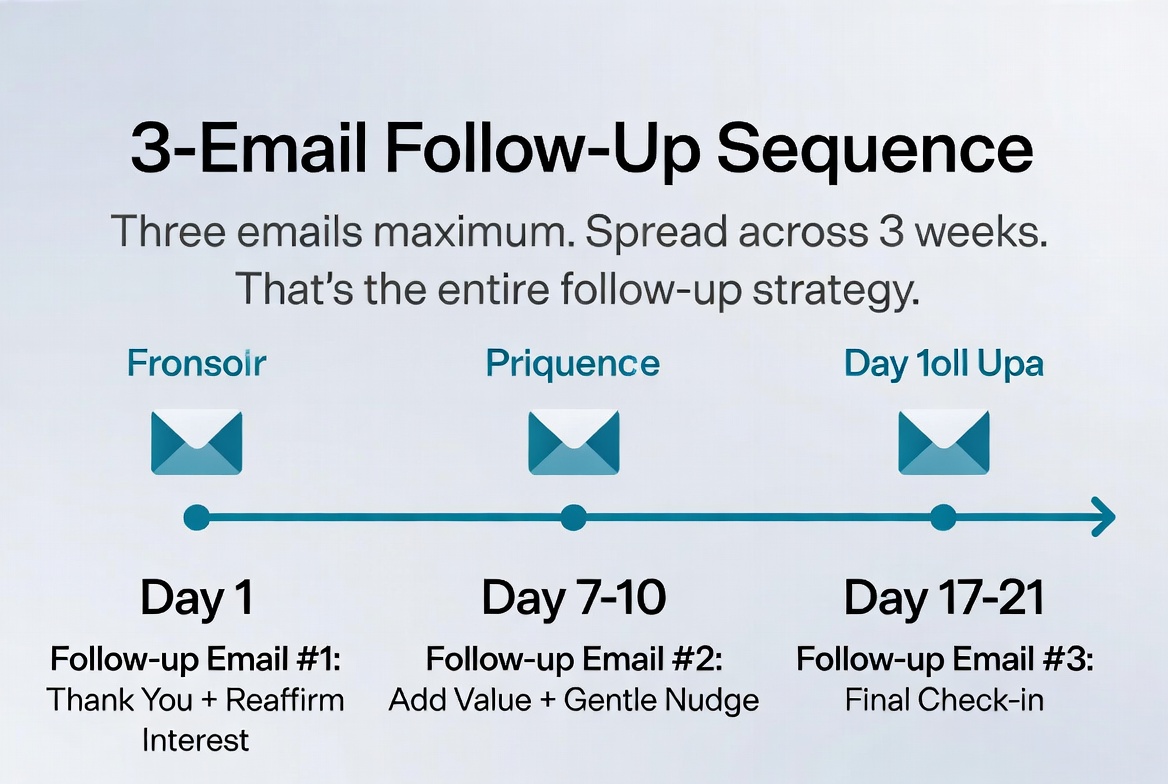
The Complete Follow-Up Timeline
Here's the whole sequence in one view so you can plan it:
Day 1 (morning after interview): Thank-you email. Specific, personal, under 100 words.
Days 2-7: Wait. Keep applying elsewhere. Prepare for a potential next round. Do not email again.
Day 7-10 (or when their stated timeline passes): Second follow-up. Brief check-in. Express continued interest. Under 50 words.
Days 10-20: Wait again. Continue job searching actively.
Day 17-21: Final follow-up. Give them an easy out. Express gratitude regardless. Under 60 words.
After Day 21: Move on mentally. If they come back later, great. If not, you handled it professionally and you have nothing to regret.
Three emails maximum. Spread across 3 weeks. That's the entire follow-up strategy.
The 5 Follow-Up Mistakes That Make Recruiters Cringe
I've seen all of these. Some of them I've done myself early in my career. Every single one hurts your chances.
1. Following up the same day as the interview
Sending a thank-you email 30 minutes after walking out looks desperate, not eager. The interviewer is probably still in back-to-back meetings and won't read it until the next day anyway. Wait until the next morning. The one exception: if the interviewer specifically said "shoot me an email with that portfolio link we discussed" — then send that specific thing immediately because they asked for it.
2. Writing a novel
Your follow-up email is not a second cover letter. It's not a place to add points you forgot to mention in the interview. It's not an essay about how much you want the job. Keep it under 100 words. If you couldn't say it in a 30-second voicemail, it's too long for a follow-up email.
3. Following up through multiple channels simultaneously
Email AND LinkedIn message AND a text AND calling the office AND commenting on their LinkedIn post. Don't do this. Pick one channel — email — and use only that. Following up across multiple channels doesn't show persistence. It shows an inability to respect boundaries. And it genuinely freaks people out.
4. Passive-aggressive guilt language
"I haven't heard back from you..." "As I mentioned in my previous email..." "I'm disappointed I haven't received a response..." All of these put the interviewer on the defensive. Even if you're frustrated — and the frustration is valid — guilt language never gets a positive response. Keep every message warm and assumption-free. They might be dealing with a hiring freeze, a budget delay, or a personal emergency you know nothing about.
5. Continuing to email after the third follow-up
Three messages is the limit. Three. After the thank-you email and two follow-ups, you stop. A fourth email doesn't convey persistence — it conveys that you don't understand professional norms. If they want to reach you, they will. Your job is to be graceful, not relentless.
⚠️
There is no scenario where a 4th, 5th, or 6th follow-up email gets you hired. If three well-crafted professional messages didn't get a response, a fourth one won't either. It will, however, ensure that if the recruiter does think of you for a future role, they'll remember you as the person who couldn't take a hint. Protect your reputation. Three and done.
What Actually Determines Whether You Get the Job
I want to end with some perspective that might reduce your follow-up anxiety. The follow-up email is not what determines whether you get hired. The interview is. The follow-up is a courtesy that keeps you top of mind and demonstrates professionalism. A great follow-up won't save a bad interview. And a missing follow-up rarely kills a candidacy that was otherwise strong.
The real leverage point is the interview itself. If you nail the interview, the follow-up is a cherry on top. If you fumble the interview, no follow-up email can rescue it. Which means the highest-return investment of your time isn't perfecting your follow-up wording — it's preparing for the interview in the first place.
If you haven't already, spend 30 minutes before your next interview practicing with an AI interview simulator. Run through the 10 most common interview questions out loud and get feedback on your answers. The candidates who practice beforehand don't just interview better — they feel better afterward because they know they prepared. And when you feel confident about how the interview went, the follow-up anxiety drops dramatically because you're not second-guessing every answer.
Nail the interview so the follow-up is just a formality
Practice with GigForge's AI interview simulator. Choose your target role, answer questions by speaking, and get scored on communication, technical knowledge, and problem-solving. Feedback and model answers included.
The follow-up matters. But what matters more is what happens before it. Prepare well. Interview with confidence. Send a professional, specific, short follow-up within 24 hours. Then go apply to more jobs. The right opportunity responds. The wrong ones don't. And both of those outcomes are fine.
Already past the follow-up stage? Make sure your resume is getting you to interviews in the first place.
Check your resume's ATS compatibility score against any job description. See what's blocking your applications and fix it in minutes.