How to Build a Hiring Process From Scratch for a Small Team | GigForge
Organisations
How to Build a Hiring Process From Scratch for a Small Team
You don't have an HR department. You don't have a recruiter. You barely have time to do your actual job, let alone screen 200 CVs. Here's the exact hiring process that works for teams of 1-20 people.
By Brabyns Yabwetsa20 May 202614 min read
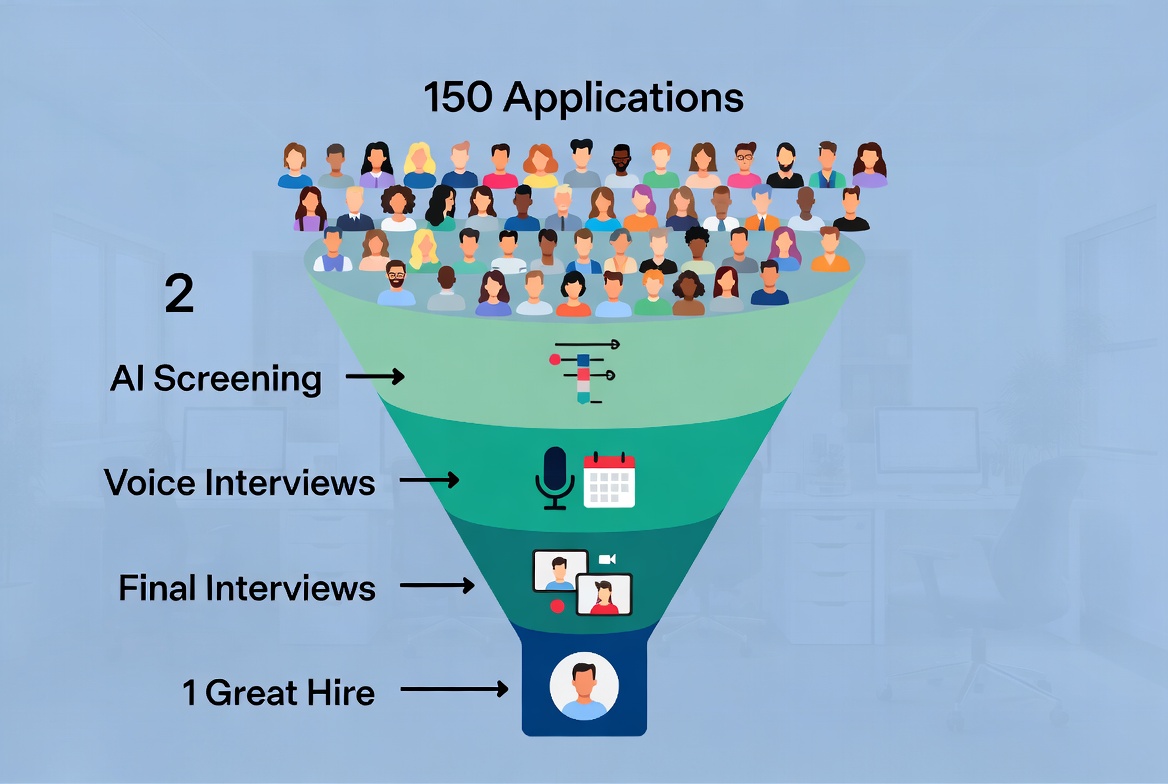
Let me describe a situation I've watched play out dozens of times. A founder or team lead realises they desperately need to hire someone. They write a job post in 20 minutes, share it on LinkedIn, and within a week they have 150 applications sitting in their inbox. Now they're paralysed. They don't have an HR person. They don't have a recruiter. They barely have time to do their actual job. So the applications sit there. And sit there. And three weeks later they're still "getting to it" while the team burns out from being understaffed.
Sound familiar? If you're running a small team — whether that's a 3-person startup, a 15-person agency, or a growing company that just hasn't built an HR function yet — hiring feels like this impossible side quest that pulls you away from everything else.
But here's what I've learned from building GigForge and watching hundreds of small teams hire: the companies that hire well don't have bigger teams or bigger budgets. They have a simple process they follow every time. And that process is not complicated. You can set it up in an afternoon and use it for every hire going forward.
ℹ️
I built GigForge as basically a one-person team for the first several months. When I needed to bring on help — even freelance or contract help — I had to figure out how to evaluate people without spending my entire week on it. Everything in this article comes from what I learned doing that, plus what I've seen work for small teams using our platform.
Why Small Teams Get Hiring Wrong
Before I give you the process, let me explain why small teams specifically struggle with hiring. It's not because you're inexperienced or disorganised. It's because the default "advice" about hiring is designed for companies with dedicated HR departments, and it simply doesn't translate.
You don't have time for a 6-week hiring cycle
Large companies can afford to post a role, wait two weeks for applications, screen for a week, do three rounds of interviews over two more weeks, and make an offer. That's 6-8 weeks. For a small team, every week without that hire means someone on the existing team is doing two jobs. You need to move fast — but not so fast that you make the wrong hire. The real cost of a bad hire is devastating for any company, but for a small team it can genuinely threaten the business. I wrote about this in detail — the real cost of a bad hire runs well beyond just salary when your team is small enough that one person represents 20% of your workforce.
You're the interviewer AND the decision-maker AND the manager
In a large company, different people handle each stage. A recruiter screens. A hiring manager interviews. A panel makes the decision. HR handles the offer. In a small team, you do all of it. Which means every minute you spend on hiring is a minute you're not spending on your product, your customers, or your strategy. The process needs to be ruthlessly efficient.
Your gut feeling is louder when the team is small
When you're hiring person number 4 or 5, the stakes feel enormous. This person will sit next to you every day. They'll shape the culture. They'll interact with your customers. So you rely heavily on gut feeling — "do I like this person? Would I enjoy working with them?" And gut feeling, frankly, is where most bad hiring decisions come from. Not because your instincts are bad, but because a 45-minute conversation is not enough data to predict how someone will perform over 12 months.
When your team is 5 people, every single hire changes the entire company.
The 6-Step Hiring Process for Small Teams
This is the process. It works for hiring developers, marketers, designers, salespeople, operations staff — any role. It's designed to be fast (under 2 weeks from posting to offer), structured (decisions based on evidence, not vibes), and realistic (you can run it while still doing your actual job).
Step 1: Write a job description that filters for you (45 minutes)
Most job descriptions are wishlists. "We're looking for a rockstar developer with 5+ years of experience in React, Node, Python, Go, AWS, Docker, Kubernetes, who is also a great communicator and team player." That's not a job description. That's a fantasy. And it attracts hundreds of applications from people who match some of it, none of it, or all of it — giving you no way to filter.
A good job description does three things. First, it describes the actual work — not the title, not the department, but what this person will do in their first 90 days. "You will rebuild our checkout flow, reduce page load time by 50%, and integrate our payment system with a new provider." That is specific enough that only people who can actually do this work will apply.
Second, it separates requirements from nice-to-haves. List 3-5 absolute requirements — the things a candidate must have or they cannot do the job. Then list 2-3 nice-to-haves that would be bonuses. This distinction matters because it gives you clear pass/fail criteria for screening.
Third, it states what you offer honestly. Salary range, remote or in-office, team size, stage of company. Being upfront about these things filters out candidates who wouldn't accept the offer anyway, saving both sides time.
💡
Write your job description as if you're explaining the role to a friend over coffee. If you wouldn't say "we need a self-motivated synergy-driven team player" out loud to a real person, don't write it in the job post. Speak like a human. The best candidates are reading 20 job posts a day and they can smell corporate filler from a mile away.
Step 2: Post it in the right places (30 minutes)
You don't need to be on every job board. You need to be on the ones where your candidates actually look. For tech roles: LinkedIn, your company website, and one or two niche boards (like RemoteOK for remote roles, or AngelList for startup roles). For non-tech roles: LinkedIn, Indeed, and your local professional networks.
Don't underestimate the power of your own network. Share the role on your personal LinkedIn with a note about why you're hiring and what the role involves. Posts from real people consistently outperform official company job listings in terms of engagement and quality of applicants. Your network knows people you'd never find on a job board.
GigForge's job search aggregator pulls listings from 17+ platforms including LinkedIn, Indeed, Upwork, and Fiverr into one dashboard. If you're also hiring freelancers or contract workers, posting across multiple platforms increases your reach without multiplying your workload.
Step 3: Screen applications with criteria, not feelings (1-2 hours)
This is where most small teams fall apart. Applications arrive and the founder starts reading them one by one, top to bottom, making gut decisions. By application number 30, they're skimming. By 50, they're looking at employer names and university brands instead of actual qualifications. By 100, they're so overwhelmed they stop reading entirely.
The fix is to screen with a scorecard, not with your gut. Before you open a single application, write down your 3-5 requirements from Step 1. Then score each application against those requirements. Does this person have the required skill? Yes or no. Do they have the minimum experience? Yes or no. Did they answer the screening questions thoughtfully? Rate 1-3.
This turns screening from a subjective "do I like this resume" exercise into an objective "does this person meet the criteria" process. It takes the same amount of time but produces dramatically better shortlists because every application is evaluated against the same standard.
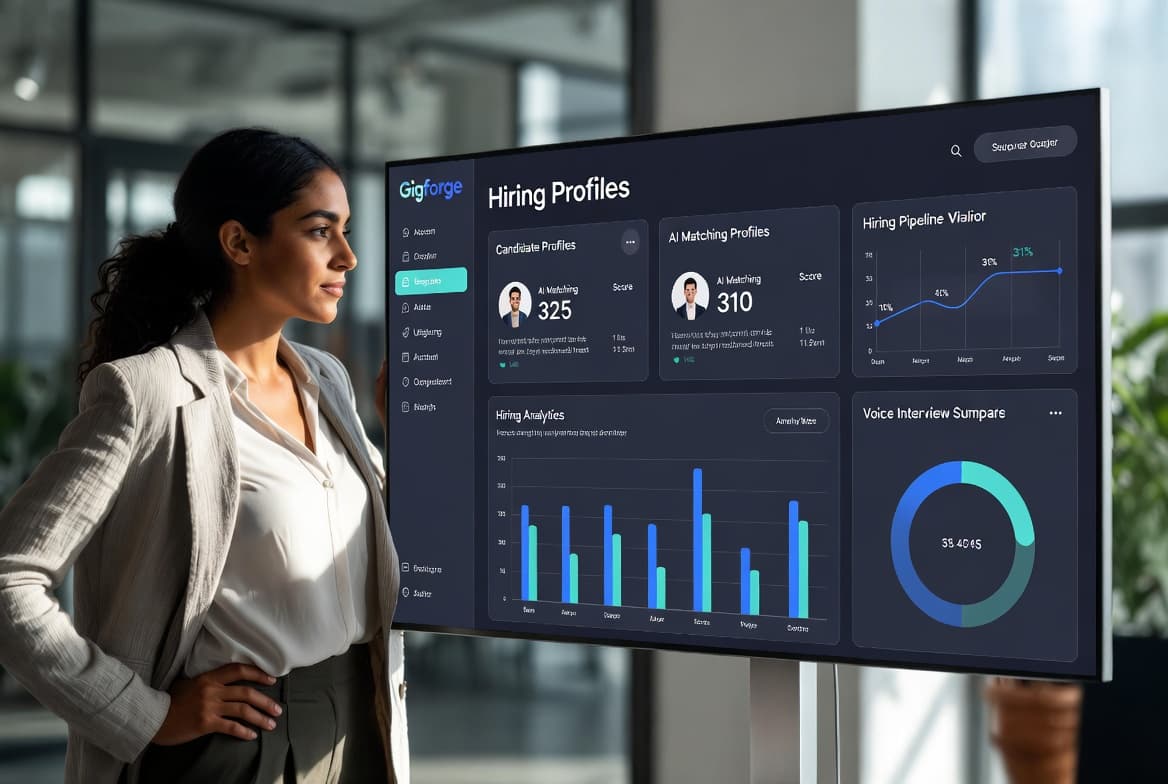
Now here's where I'll be direct about something. If you're getting more than 50 applications per role — which is common even for small companies in 2026 — doing this manually still takes 5-10 hours. That's an entire workday you don't have. AI-powered CV screening does this entire step automatically. You define your criteria, and the AI reads every CV, scores each applicant against those criteria, and gives you a ranked shortlist. I know I'm biased because I built one of these tools, but the time savings are real. What takes a human 8 hours takes AI about 2 minutes. And unlike a tired human skimming at 11pm, the AI evaluates application number 200 with the same attention as application number 1.
Screen 200 applications in 2 minutes
Define your criteria and let GigForge's AI read every CV, score each applicant, and deliver a ranked shortlist. You skip straight to the candidates worth meeting.
Step 4: Do a structured voice screen, not a casual chat (30 min per candidate)
You've got your shortlist — let's say 10-15 candidates who scored well on the criteria. The natural instinct is to jump straight to full interviews. Don't. Full interviews are your most expensive investment — your time, their time, your team's time. Protect that investment by adding a quick voice screen first.
A voice screen is a 10-15 minute structured conversation that answers three simple questions. Can this person communicate clearly? Do they understand what the role actually involves? Is there anything that wasn't obvious from their CV that would be a dealbreaker?
I want to emphasise the word "structured." This is not a casual chat where you ask "so tell me about yourself" and make a decision based on whether you liked the conversation. You ask the same 3-4 questions to every candidate, take notes on each answer, and compare afterward. Structure removes the bias. Bias is what causes bad hires.
Now — doing 10-15 of these voice screens yourself takes 3-4 hours minimum, plus scheduling time. If your time is genuinely that limited (and if you're running a small team, it is), this is where AI voice interviews become a real option. The AI conducts a spoken interview with each candidate, asks role-specific questions, transcribes everything, and delivers a detailed report with scores and a recommendation. I wrote a full breakdown of how AI voice interviews work — the short version is that your candidates speak to an AI interviewer, and you receive a report that tells you who's worth a face-to-face conversation.
Step 5: Interview only the top 3-5 candidates (1-2 hours each)
By this point, you've filtered 150 applications down to 3-5 people who have passed a CV screen AND a voice screen. These are not random candidates. These are people who have demonstrably met your criteria, communicated their experience clearly, and shown genuine understanding of the role.
Now — and only now — invest your full interview time. This is where your gut feeling actually becomes useful. You've already established that these candidates can do the job (the data told you that). The interview is for the things data can't tell you: Do you trust this person? Would you enjoy working with them? Do they ask good questions? Are they genuinely excited about this role, or is it just another application?
Keep the interview structured even at this stage. Ask every candidate the same core questions so you can compare apples to apples afterward. But leave room for the conversation to go naturally — the best interviews feel like interesting work conversations, not interrogations.
⚠️
The most common mistake at this stage: falling in love with interview performance instead of evaluating job fit. Some people are brilliant interviewers and average workers. Others are awkward in interviews but exceptional at the actual work. Your screening data (CV scores, voice screen reports) protects you from being swayed by charisma alone. Use both signals — the data AND the conversation — when making your decision.
Step 6: Make the offer quickly (same day if possible)
Small teams have one advantage over large companies: speed. A corporate hiring process takes 4-6 weeks. You can go from interview to offer in 24 hours. Use that speed. The best candidates are interviewing at multiple companies. Every day between your interview and your offer is a day they might accept somewhere else.
When you find the right person, call them the same day or the next morning. Tell them directly: "We'd like to offer you the role. Here's the salary, here's the start date, here's what the first month looks like." Be specific. Be enthusiastic. Good candidates want to join teams where they feel wanted, not teams where they waited two weeks for a form email.
If you need to check references or do a background verification, do it in parallel — don't make the candidate wait in silence while you complete internal processes. Silence after a good interview feels exactly like the silence after submitting an application. And you know how that feels — every job seeker who has applied to 50 jobs and heard nothing can tell you.
The right process turns 150 applications into 1 great hire in under 2 weeks.
The Complete Hiring Stack for a Small Team (Under $100/month)
You don't need Greenhouse. You don't need Workable. You don't need a $500/month ATS that was built for companies with 500 employees. Here's what a small team actually needs:
To post the job and receive applications
Use GigForge's job posting system or post directly on LinkedIn and Indeed. Your company career page is a bonus but not required at this stage. What matters is that applications flow into one place, not scattered across your email, LinkedIn messages, and job board inboxes.
To screen applications
If you're getting under 30 applications: a scoring spreadsheet works. Create columns for your 3-5 criteria, score each applicant, sort by total score. If you're getting over 30 applications: AI-powered CV screening saves you literal hours. The AI reads every resume against your criteria and gives you a ranked list. GigForge's free plan includes AI screening for up to 2 active jobs — that's enough for most small teams.
To conduct voice screens
If you have the time: do 10-15 minute structured calls yourself using a consistent question list. If you don't: AI voice interviews handle this automatically. Each candidate gets a link, answers role-specific questions by speaking to an AI interviewer, and you receive a detailed report. Either approach works — the key is that the voice screen happens before you invest full interview time.
To interview and decide
You. A quiet room. A consistent question list. A notepad. That's the entire interview stack for a small team. No panel interviews. No take-home assignments that take candidates 6 hours. No five-round processes. One structured interview with the top 3-5 candidates. Make a decision based on screening data plus interview impression. Move fast.
💡
When I hire for GigForge, the entire process from posting to offer takes about 10 days. AI screens the applications on day 1-2. AI voice interviews happen on day 3-5. I personally interview 3-4 people on day 6-8. Offer goes out on day 9-10. Total time I spend personally? About 6 hours. The AI handles everything else.
Your entire hiring process — one platform
Post jobs, screen candidates with AI, conduct AI voice interviews, and review detailed reports with scores and recommendations. Built for teams that don't have time to waste.
I want to end with something that small team founders don't hear enough. Hiring is not a distraction from building your company. Hiring IS building your company. Every person you add to a 5-person team changes 20% of the entire organisation. Get it right and you unlock capacity you didn't have. Get it wrong and you spend 6 months managing a problem instead of building a product.
The process I described takes about 10 days and costs under $100 in tooling. Compare that to the cost of a bad hire — which I laid out in detail in our article on the real cost of a bad hire — and the return on investment is impossible to ignore.
You don't need an HR department. You don't need a recruiter. You need a clear process, consistent criteria, and the discipline to evaluate with evidence instead of vibes. The tools exist to automate the mechanical parts. The human judgement — the part that actually requires you — is a 6-hour investment spread over a week.
That's the hiring process for a small team. Simple. Structured. Fast. And it works every single time.