AI Hiring Tools Compared: What Actually Works in 2026 | GigForge
Organisations
AI Hiring Tools Compared: What Actually Works in 2026
Every hiring tool claims to use AI. Most of them just automated a job posting form and called it innovation. Here's an honest breakdown of what AI hiring tools actually do in 2026, what's real, what's marketing, and what's worth paying for.
By Brabyns Yabwetsa13 June 202615 min read
Every recruitment tool on the market now has "AI-powered" somewhere in its marketing. Every single one. It's on landing pages, in demo videos, across LinkedIn ads — AI this, AI that, AI everything. And I get it. AI is the word that gets clicks, gets demos booked, and gets budgets approved.
But here's what nobody in the recruitment industry wants to say out loud: most of these tools are not doing what you think they're doing. The word "AI" has become so diluted in hiring tech that it can mean anything from a genuinely intelligent system that reads and evaluates resumes to a basic keyword filter with a fancy interface. Both get called "AI-powered." Both charge premium prices. One actually works. The other is a dressed-up search bar.
I'm going to be blunt in this article because I think hiring managers and HR teams deserve honesty, not marketing. I build an AI hiring tool — GigForge — so yes, I have a perspective and a bias. I'll be upfront about that. But I also spent months researching every major tool in this space before building ours, and what I found was genuinely surprising. So let me share what I learned.
ℹ️
Before I wrote a single line of code for GigForge, I tested or demoed over a dozen AI hiring tools. I wanted to understand what existed, what worked, and where the gaps were. Some tools genuinely impressed me. Most didn't. The gap between what's advertised and what's delivered in AI recruitment is wider than in almost any other software category I've seen. This article is my honest assessment based on what I found.
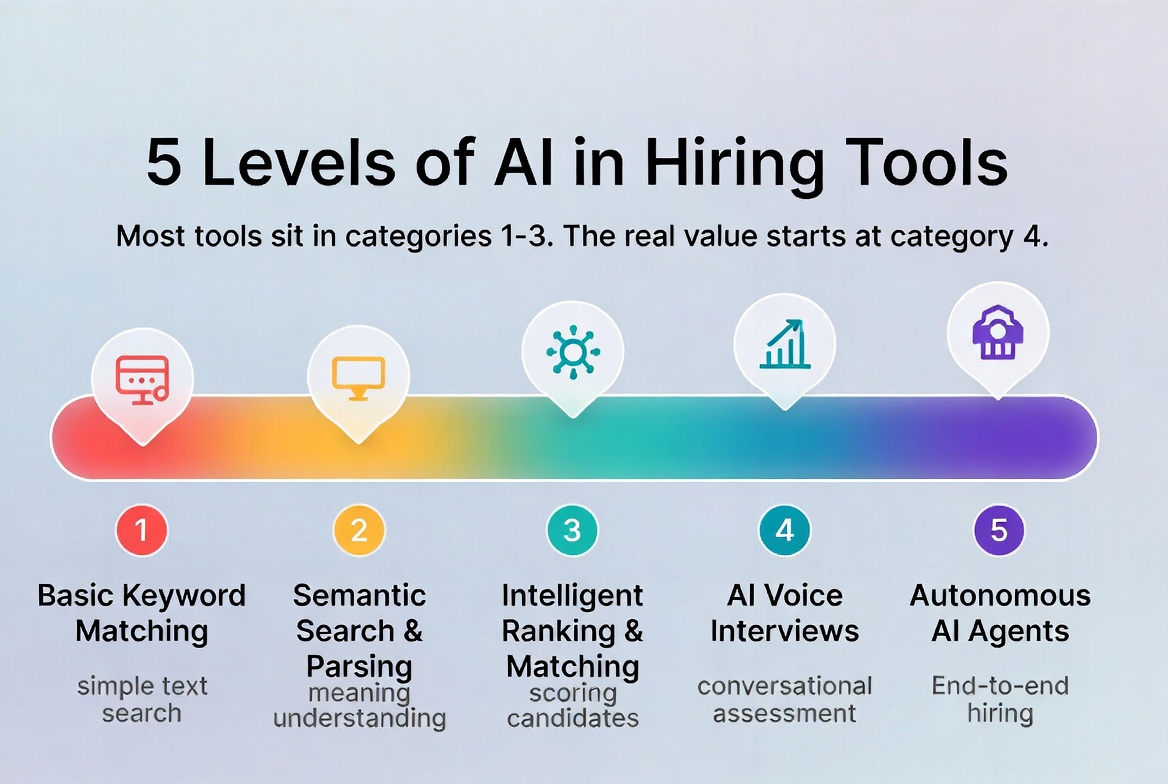
The 5 Categories of "AI" in Hiring Tools
Not all AI in hiring is the same. Before comparing specific tools, you need to understand the spectrum — because some things called AI are genuinely intelligent, and some are basic automation wearing a lab coat.
Category 1: Keyword matching dressed up as AI
This is the most common and the most misleading. The tool takes the job description, extracts keywords, then searches resumes for those exact keywords and gives a "match percentage." That's it. That's the entire AI. It's the same technology that's existed in ATS systems since 2005, now wrapped in a modern interface with the word "AI" on the marketing page.
How to spot it: If the tool can't tell the difference between "managed projects" and "project management" — if it needs exact phrase matches to score a candidate — it's keyword matching, not AI. Ask the vendor during a demo: "If a resume says 'built frontend interfaces' and the job post says 'React developer,' will your AI connect those?" If the answer involves workarounds rather than "yes, automatically" — you're looking at keyword matching.
Category 2: Automated job posting and distribution
Some tools call themselves AI hiring platforms but their primary feature is posting your job to multiple boards simultaneously. LinkedIn, Indeed, Glassdoor — one click, multiple postings. That's useful. That saves time. But it's automation, not intelligence. The AI isn't making any decisions about candidates. It's just distributing a listing to more places.
This solves a real problem — getting your job in front of more candidates. But it doesn't solve the ACTUAL bottleneck in hiring, which is what happens after 200 people apply. Posting faster to more boards often makes the bottleneck worse because now you have 400 applications instead of 200.
Category 3: Resume parsing and data extraction
This is genuine AI, but it's table-stakes technology in 2026 — not a differentiator. These tools use natural language processing to read a resume and extract structured data: name, email, work history, education, skills. Good parsing handles different formats, layouts, and even languages. It's necessary infrastructure, but it doesn't evaluate candidates — it just organises their information into a database.
Every serious ATS has this. It's not a feature to pay a premium for. If a tool's main AI claim is "we automatically parse resumes" — that's like a car company advertising that their vehicle has wheels.
Category 4: AI-powered candidate evaluation
Now we're getting into genuinely useful territory. These tools go beyond parsing and keyword matching — they actually evaluate candidates. The AI reads the full resume, understands context (not just keywords), considers the relationship between different experiences, and produces an assessment that a human recruiter would broadly agree with.
The key difference from keyword matching: these systems can recognise that a candidate who spent 3 years at a high-growth startup managing a small team might be more relevant for a startup role than someone with 10 years at a large corporation — even if the corporate candidate has more exact keyword matches. They understand context, not just strings.
This is the category where real value starts. If a tool can score candidates in a way that genuinely correlates with how a skilled recruiter would rank them — saving the recruiter from reading 200 resumes to find the same top 10 — that's worth paying for.
Most tools sit in categories 1-3. The real value starts at category 4.
Category 5: AI-conducted interviews
This is the newest category and the most transformative. Instead of just evaluating a resume, the AI actually speaks with the candidate. A real voice conversation — the AI asks role-specific questions, the candidate answers verbally, and the system produces a detailed evaluation with transcript, scores across multiple dimensions, and a hiring recommendation.
This replaces the most time-consuming part of hiring: the phone screen. That 15-minute call with 15 candidates that takes the recruiter an entire week? AI does all 15 calls simultaneously and delivers scored reports. The recruiter reads the reports and decides who earns a full interview — investing their time only in candidates who have already been evaluated through both CV screening and a spoken conversation.
I'll be transparent — this is the category GigForge operates in. We do both Category 4 (AI CV evaluation) and Category 5 (AI voice interviews). I built it because I genuinely believe the phone screen is the biggest waste of time in the entire hiring process, and AI in 2026 is finally good enough to handle it properly. But I also know this category is new and not every implementation is good. More on that below.
What to Actually Look For When Evaluating AI Hiring Tools
Forget the marketing. Forget the demo with pre-loaded perfect data. Here are the specific questions to ask — and the answers that separate genuinely useful tools from expensive decorations.
Question 1: "Does your AI understand context or just match keywords?"
Ask the vendor to show you how the system handles a resume that uses different terminology than the job description. If you have to manually create keyword lists or synonym dictionaries for the AI to work properly, it's keyword matching with extra steps. A genuinely intelligent system handles this automatically because it understands language, not just text patterns.
Question 2: "Can I see the AI's reasoning, not just its score?"
A number without explanation is useless. If the tool says "this candidate scored 78" but can't tell you WHY — what strengths it identified, what concerns it found, what skills matched and which were missing — then you can't trust the score. You'll end up second-guessing the AI and reading all the resumes anyway, which defeats the entire purpose.
Good AI evaluation tools show you the full reasoning: here are the skills that matched, here are the gaps, here are the strengths, here are the concerns, here's a written assessment explaining the overall score. You should be able to read the AI's report and think "yes, that's roughly what I would have concluded if I'd spent 10 minutes reading this resume."
Question 3: "What happens between the CV screen and the interview?"
This is the question that exposes the biggest gap in most AI hiring tools. They screen the CVs — great. Then they hand you a shortlist and say "now go interview these 15 people." You've saved time on screening. But you haven't saved time on the actual bottleneck — the phone calls.
The best tools fill this gap. Between the CV screen and your full interview, there should be an additional evaluation layer that reduces your shortlist from 15 to 3-5 without requiring your time. AI voice interviews do this. Asynchronous video interviews do it partially. Skills assessments do it for technical roles. Ask what happens between screen and interview — because that's where the real time savings live.
Question 4: "What does the candidate experience look like?"
This matters more than most hiring teams realise. If your AI tool sends candidates a clunky, confusing, or robotic experience, you'll lose good candidates before you evaluate them. They'll drop out, leave negative reviews on Glassdoor, or just ghost the process.
Ask to go through the process yourself as a candidate. Apply for a test job. Take the AI interview if there is one. See what emails are sent. See what the interface looks like on a phone. If you wouldn't want to go through it yourself, your candidates won't want to either.
💡
The best test of any AI hiring tool: apply for a test job yourself and go through the full candidate experience. If the AI interview feels awkward, the emails are confusing, or the interface is clunky on mobile — that's what every candidate you send through it will experience. Your hiring process is your first impression as an employer. Don't let a bad tool make it for you.
Question 5: "What's the actual cost per hire?"
Pricing in recruitment tools is deliberately confusing. Monthly subscriptions, per-seat pricing, per-job pricing, per-interview pricing, usage caps, overage fees. Before you commit, calculate the actual cost for your typical hiring scenario.
Example: If you hire 3 people per quarter and each role gets 100 applications and 10 interviews, what's the total annual cost? Compare that across tools. Some tools that look cheap per month become expensive at volume. Others that look expensive have pricing that scales efficiently.
For context, with GigForge the total cost to screen and AI-interview one candidate is roughly $1.21 — that covers AI CV screening, interview question generation, a 15-minute AI voice interview, and the full evaluation report. For a role with 100 applicants where you interview 10, the total AI cost is about $45. Compare that to a recruiter spending 20 hours at $40/hour doing the same work manually — $800 in labour cost. The maths isn't close.
$1.21
Total AI cost to screen AND interview one candidate on GigForge
What Genuinely Works in 2026
After testing and researching this space extensively, here's my honest assessment of what's actually worth using.
AI CV screening with transparent scoring — works
When done well — meaning the AI reads contextually, not just keyword-matching — AI CV screening genuinely saves hiring teams 80% of their screening time while producing shortlists that are as good or better than manual review. The key is transparency. You need to see why each candidate scored the way they did so you can trust the system and calibrate it to your standards. Opaque scores that you can't explain to your team are worthless.
AI voice interviews — works (when the experience is good)
AI voice interviews are the single biggest time saver in recruitment right now. They replace 15-20 hours of phone screens per role with AI-conducted conversations that produce detailed, comparable reports. But the candidate experience matters enormously. The AI interviewer needs to sound natural, handle unexpected responses gracefully, and feel like a real conversation — not a robotic Q&A. Bad implementations make candidates feel like they're talking to a broken chatbot, and they'll drop out or badmouth your company
When I built GigForge's AI voice interview system, I tested every competitor I could find. The difference between a good AI interviewer and a bad one is like the difference between talking to a thoughtful person and talking to an automated phone menu. Both technically "interview" you. Only one makes you feel heard. I wrote a detailed breakdown of how AI voice interviews work if you want to understand the technology behind it.
AI-powered job distribution — works but isn't enough
Posting to multiple platforms from one dashboard saves administrative time. It's useful. But it doesn't solve the actual hiring bottleneck. If anything, it makes the screening problem bigger by increasing application volume. Use it as part of your stack, not as the whole solution.
AI resume parsing — works but it's not a differentiator
Every modern ATS parses resumes. It's infrastructure, not intelligence. Don't pay a premium specifically for this feature. Expect it to be included in whatever tool you choose.
"AI-powered" culture fit scoring — doesn't work (and is risky)
Some tools claim to assess "culture fit" or "personality" from resume text or video responses. Be extremely cautious. Culture fit is inherently subjective, and automating subjective judgements with AI creates bias, not objectivity. If a tool claims it can tell you whether a candidate will fit your culture from their resume, that tool is either overselling or building bias into your process. Stick to AI for what it's good at — evaluating skills, experience, and structured responses. Leave culture assessment to the humans who actually define your culture.
⚠️
Any AI tool that claims to assess "personality" or "culture fit" from text or video should be approached with serious caution. These claims rarely hold up to scrutiny and can introduce systematic bias into your hiring process. In several jurisdictions, AI-based personality assessment in hiring is facing legal challenges. Use AI for skills and experience evaluation. Use humans for culture and personality assessment.
How to Choose the Right Tool for Your Team
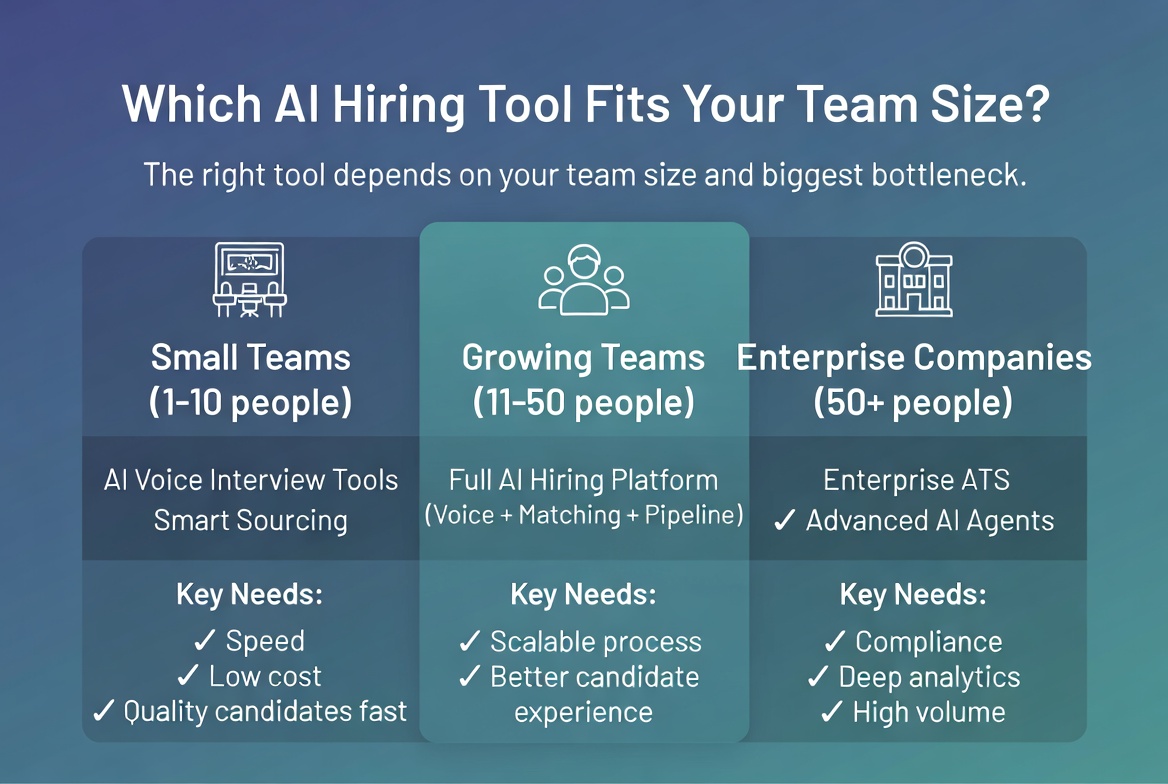
The right tool depends on your size, your volume, and your biggest bottleneck.
If you're a small team (1-20 people, hiring 1-5 roles per quarter)
You don't need an enterprise ATS. You need something fast, affordable, and simple. Your bottleneck is time — you don't have a recruiter, so every hour spent screening is an hour away from building your product. Look for a tool that combines CV screening and voice interviews so you only interview candidates who have been pre-evaluated twice. GigForge's free plan includes AI screening for 2 active jobs — that covers most small teams. I also wrote a complete guide to building a hiring process from scratch for a small team that covers the full workflow beyond just tooling.
If you're a growing team (20-100 people, hiring regularly)
You need a system that scales and supports collaboration. Multiple people reviewing candidates, structured scorecards, interview scheduling, and centralized candidate data. At this size, the cost of bad hires becomes company-threatening, so the ROI on proper screening tools is highest. The real cost of a bad hire at this stage — when one person represents 5-10% of your company — is staggering.
If you're enterprise (100+ people, dedicated HR team)
You probably already have an ATS (Greenhouse, Lever, Workday). The question is whether to add AI evaluation on top of it. Look for tools that integrate with your existing ATS rather than replacing it. AI voice interviews as an add-on layer — plugging into your existing workflow to replace phone screens — provide the highest ROI without disrupting your established process.
The right tool depends on your team size and biggest bottleneck.
The Honest Truth About AI in Hiring
AI is not going to replace recruiters. I say this as someone who builds AI recruitment tools. The technology is excellent at reading resumes, matching skills, conducting structured first-round conversations, and producing consistent evaluations. It is terrible at judging character, assessing motivation, reading between the lines, and making the final call on whether someone will thrive in your specific team.
The best hiring processes in 2026 use AI for the mechanical evaluation — the parts that are repetitive, time-consuming, and prone to human fatigue and bias — and reserve human judgement for the decisions that actually require a human. Read 200 resumes? Let AI do it. Conduct 15 phone screens? Let AI do it. Decide who joins your team? That's your call. Always.
The tools that understand this distinction are worth investing in. The ones that promise AI will "hire for you" are selling something that doesn't exist and shouldn't. Your team is too important for a machine to choose.
If you're evaluating AI hiring tools right now, start by being honest about your bottleneck. Is it getting applications? AI job distribution helps. Is it screening applications? AI CV evaluation helps. Is it phone screens eating your week? AI voice interviews help. Match the tool to the problem. Ignore the marketing. And always — always — test the candidate experience yourself before you send a single real applicant through it.
See what AI hiring actually looks like
Post a job, set your criteria, and watch GigForge's AI screen every applicant and interview your shortlist. Detailed reports with scores, transcripts, and recommendations. Free to start — no credit card required.