How to Hire Your First Employee (A Founder's Step-by-Step Guide)
You've been doing everything yourself. Now it's time to hire your first employee — and you have no HR department, no recruiter, and no idea where to start. Here's the step-by-step guide from someone who figured it out the hard way.
By Brabyns Yabwetsa3 June 202619 min read
There's a moment every founder hits. You've been running everything alone — building the product, talking to customers, handling marketing, fixing bugs at midnight, answering support emails at 6am. And one morning you wake up and realise the thing that's holding your company back is no longer a product problem or a market problem. It's a you problem. There's only one of you. And one of you isn't enough anymore.
That's the moment you need to hire your first employee. And it's one of the most terrifying decisions you'll make as a founder. Not because hiring is complicated — it's actually straightforward once you know the steps. It's terrifying because this person will change everything. They'll touch your product. They'll talk to your customers. They'll represent your company when you're not in the room. And if you get it wrong, you don't just lose money. You lose months of momentum that you can't get back.
I'm going to walk you through the entire process. Not the HR textbook version — the founder version. The one where you don't have a recruiting team, you don't have an employee handbook, and you need someone yesterday but you also can't afford to hire the wrong person.
ℹ️
When I needed to bring on my first help for GigForge, I had zero experience hiring. I didn't know how to write a job description that would attract the right people. I didn't know how to evaluate candidates objectively instead of just going with whoever I vibed with. I made mistakes. Some of them were expensive. Everything in this guide is what I wish someone had told me before I started — it would have saved me a lot of pain and at least one very awkward 'this isn't working out' conversation.
Before You Hire: The Questions You Need to Answer First
The biggest mistake founders make isn't hiring the wrong person. It's hiring before they're ready to hire. Before you write a single job description, sit down and answer these four questions honestly.
Question 1: What exactly will this person do in their first 30 days?
Not "help with marketing" or "do development stuff." Specific, concrete deliverables. "Set up our email marketing system, create 3 automated sequences, and write the copy for our onboarding emails." That level of specificity. If you can't describe what they'll do in their first month, you don't actually know what you're hiring for — and you'll end up with someone sitting at a desk waiting for direction you don't have time to give.
Write down 5-7 specific tasks or projects for their first 30 days. If you can't fill the list, you might not need a full-time employee yet. You might need a freelancer or contractor for a specific project.
Question 2: Can you actually afford this hire for at least 6 months?
Your first employee isn't productive on day one. There's a ramp-up period — learning your systems, understanding your product, figuring out how you work. Realistically, they won't be fully productive until month 2-3. If you can only afford to pay them for 3 months and they need 2 months to ramp up, you're getting 1 month of real output before the money runs out.
Calculate the total cost: salary plus any benefits, equipment, software licenses, and your own time spent training and managing them. Multiply that monthly figure by 6. If you don't have that amount available — either in revenue, savings, or funding — you're not ready for a full-time hire yet. The real cost of a bad hire is devastating at any company size, but when your entire team is two people, one wrong hire can genuinely sink the business.
Question 3: What skills does this person need that you don't have?
Your first hire should fill a gap, not duplicate your strengths. If you're a developer who can't sell, hire someone with sales and marketing skills. If you're a marketer who can't build, hire a developer. If you're decent at everything but drowning in volume, hire someone who can take over the most time-consuming operational tasks.
The worst first hire is a clone of yourself. Two people who think the same way and have the same skills don't make a team — they make a bottleneck in two chairs. Hire for what you're missing, not what you're comfortable with.
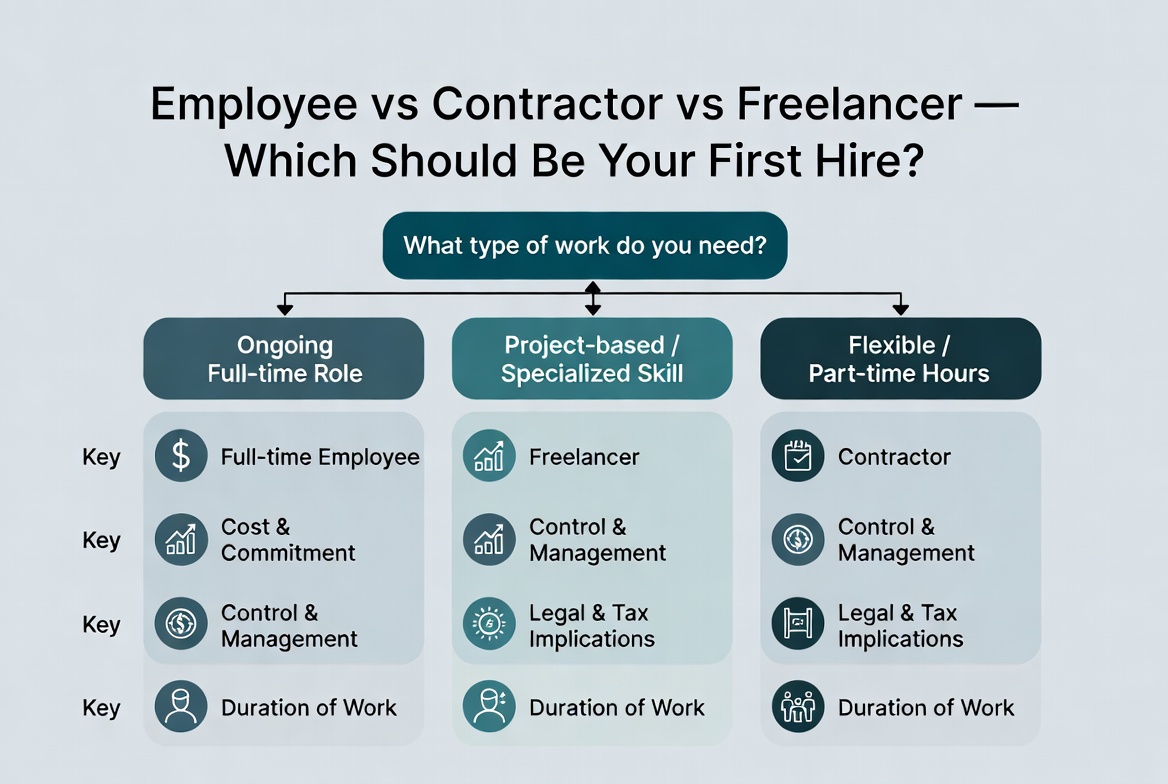
Question 4: Employee, contractor, or freelancer?
This decision has legal and financial implications that vary by country, so I won't pretend there's one universal answer. But here's the general thinking.
Hire a full-time employee when: the work is ongoing (not project-based), you need someone embedded in your team daily, and you want loyalty and cultural investment. Hire a contractor or freelancer when: the work is project-based, you need specific expertise for a defined period, or you're not ready for the commitment and cost of a full-time hire.
Many founders start with contractors for their first 1-2 hires, then convert the best ones to full-time once the revenue supports it. That's a perfectly valid approach and it reduces your risk.
Not every hire needs to be full-time. Match the work type to the employment type.
Step 1: Write a Job Description That Attracts the Right People (1 Hour)
Most job descriptions are terrible. They read like legal documents written by a committee. "We are seeking a highly motivated self-starter with excellent communication skills and a passion for innovation." What does that even mean? Who reads that and thinks "yes, that's specifically me"?
Your job description needs to do three things. Describe the actual work. Separate the must-haves from the nice-to-haves. And be honest about what you offer.
Describe the actual work
Start with this sentence: "In your first 90 days, you will..." and list 5-7 specific things they'll actually do. Not responsibilities — deliverables. Not "manage social media" — "build our social media presence from zero, creating and posting 5 times per week across LinkedIn, Twitter, and Instagram, and growing our following to 1,000 within 3 months."
This specificity does two things. It attracts candidates who can actually do this work because they recognise the tasks. And it repels candidates who can't — saving you from screening people who would have been obvious mismatches.
Separate must-haves from nice-to-haves
List 3-5 absolute requirements. These are dealbreakers — without these skills, the person cannot do the job. Then list 2-3 nice-to-haves that would be bonuses but aren't essential. This distinction matters because it becomes your screening criteria later. A candidate who has all 5 must-haves but no nice-to-haves is a strong candidate. A candidate who has 3 nice-to-haves but is missing 2 must-haves is not.
Be honest about what you offer
Salary range. Remote or in-office. Stage of company. Team size (currently: just you). Growth potential. What's exciting and what's hard. Founders who are transparent in job descriptions get fewer applicants but better ones. The people who apply knowing the salary, knowing it's a 2-person company, knowing it'll be chaotic — those people are self-selecting for the reality of your situation. That's exactly who you want.
💡
Write your job description as if you're explaining the role to a friend at a coffee shop. If you wouldn't say "we're seeking a synergy-driven individual to leverage cross-functional paradigms" out loud to a real person, don't write it in the job post. The best candidates are reading 20 job descriptions a day and they can spot corporate filler instantly. Speak like a founder. The right people will respond to that.
Step 2: Post It Where Your Candidates Actually Are (30 Minutes)
You don't need to be on every job board. You need to be on 2-3 where your specific candidates look.
For tech roles: LinkedIn, your personal network, and one niche board (AngelList/Wellfound for startup roles, RemoteOK for remote roles, or local tech community boards).
For non-tech roles: LinkedIn, Indeed, and your personal network.
For freelancers or contractors: Upwork, Fiverr, or direct outreach on LinkedIn.
The most underrated channel: your own LinkedIn post. Not from the company page — from your personal profile. Write a post explaining what you're building, why you're hiring, and what the role involves. Personal posts from founders consistently outperform company job listings in both reach and quality of applicants. People want to work with founders they can see and relate to, not faceless companies.
If you want to cast a wider net without spending hours posting to individual boards, GigForge's job search aggregator connects with 17+ platforms including LinkedIn, Indeed, Upwork, and Fiverr. Candidates searching across those platforms can discover your role from a single posting.
Step 3: Screen Applications With a Scorecard, Not Your Gut (2-3 Hours or 2 Minutes)
Applications start coming in. This is where most solo founders fall apart.
The pattern is always the same. You open the first 10 CVs with energy and attention. By CV 30, you're skimming. By CV 50, you're looking at university names and employer brands as shortcuts. By CV 100, you've stopped reading entirely and the applications sit unopened while you tell yourself you'll "get to them this weekend."
The fix is a scorecard. Before you open a single application, create a simple spreadsheet with columns for each of your 3-5 must-have requirements. Then score every application against those requirements. Meets the requirement: 1. Doesn't meet it: 0. Partially meets it: 0.5. Add up the scores. Sort by total. Your shortlist writes itself.
This takes discipline. It also takes time — about 3 minutes per application if you're thorough. For 100 applications, that's 5 hours. As a founder, you probably don't have 5 hours to spare.
This is where I'll tell you what I tell every founder who uses GigForge. AI-powered CV screening does this exact scorecard process automatically. You define your criteria and weights — "React.js experience is 40%, startup experience is 25%, communication skills are 20%, and design sense is 15%" — and the AI reads every single CV, scores it against those criteria, and gives you a ranked list. The AI evaluates application number 100 with the same attention as application number 1. It takes about 2 minutes regardless of how many applications you receive.
I'm biased because I built this tool. But the maths isn't biased. 5 hours of your time versus 2 minutes. For a solo founder, that's the difference between screening becoming a week-long project and screening being done before your morning coffee gets cold.
Screen every application in 2 minutes
Define your criteria and let GigForge's AI read every CV, score each applicant, and deliver a ranked shortlist. Built for founders who don't have 5 hours to read 100 resumes.
Step 4: Interview With Structure, Not Vibes (2-3 Hours Total)
You've got your shortlist — let's say 5-8 candidates who scored well on the criteria. Now you need to actually talk to them.
Here's the founder trap. Because this is your company, your baby, the thing you built from nothing — the interview feels incredibly personal. You're not just evaluating a candidate. You're evaluating a potential partner, a person who'll sit next to you every day, someone who'll shape the future of something you care deeply about. That emotional weight makes you rely heavily on "do I like this person?" and "would I enjoy working with them?"
Those feelings matter. But they're not enough. The question isn't "do I like them?" The question is "can they do the work I need done?" Likability and competence are two different things. Some of the best employees I've ever seen are people who were slightly awkward in interviews but absolutely brilliant at the work. And some of the most charming interviewers I've met turned out to be mediocre at the actual job.
The 5 questions to ask every candidate
Ask the same core questions to every candidate so you can compare answers fairly. Here are 5 that work for almost any first hire:
"What did you actually do in your last role — not your title, but the specific work you did day to day?" — This separates people who did the work from people who were in the room while work happened.
"Tell me about a project that didn't go as planned. What happened and what did you do?" — This reveals how they handle adversity, whether they take responsibility, and how they solve problems under pressure.
"What would you do in your first 30 days here?" — This tells you whether they understood the role, whether they're proactive, and whether their expectations match your reality.
"What's something you're not great at?" — This tests self-awareness and honesty. The best answer is a real weakness with a real plan to manage it.
"What questions do you have for me?" — Their questions reveal what they actually care about. If they ask about the product, the customers, and the challenges — that's someone who's thinking about the work. If they only ask about perks and working hours, they're thinking about the job, not the mission.
If you want detailed guidance on handling these conversations, I wrote a complete breakdown of the 10 most common interview questions and how to answer them — it's written from the candidate's perspective but it'll help you understand what a strong answer looks like versus a weak one.
Consider adding a voice screen before the full interview
If your shortlist is longer than 5 candidates, add a 15-minute voice screen before the full interview. This isn't a deep conversation — it's a quick filter. Can they communicate clearly? Do they understand what the role involves? Is there anything their CV didn't reveal that would be a dealbreaker?
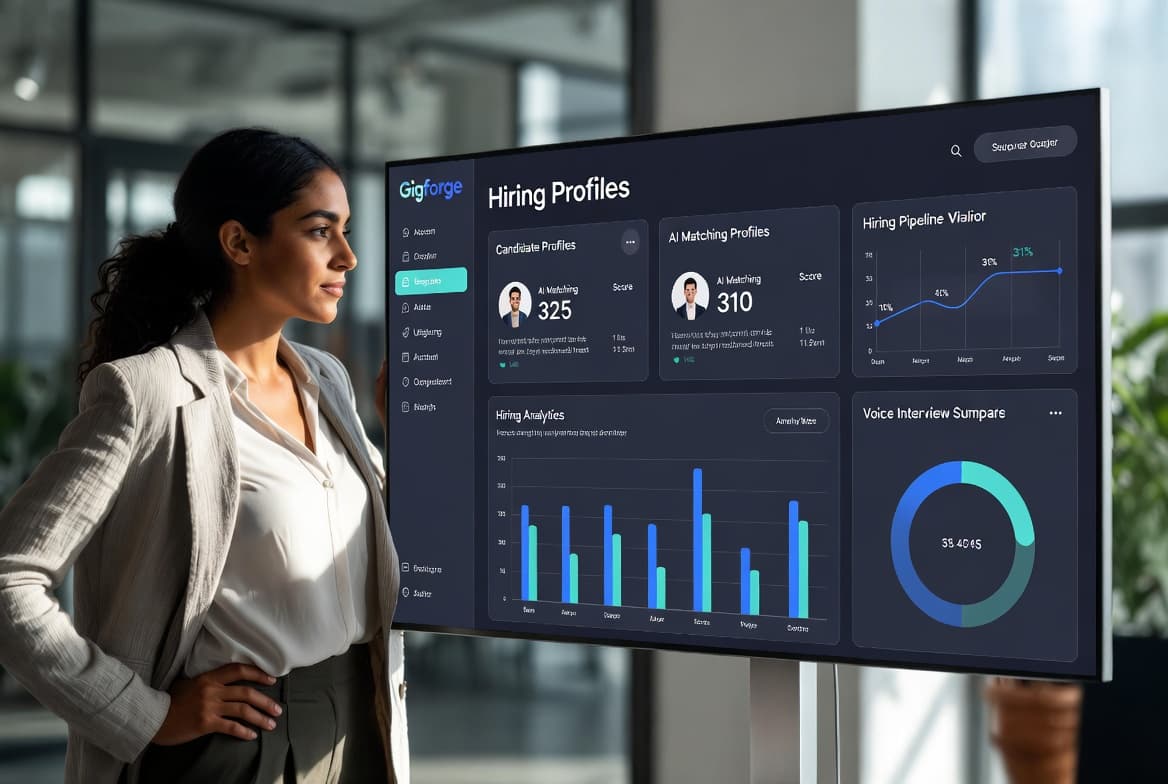
GigForge's AI voice interviews do this automatically. Each shortlisted candidate receives a link, answers role-specific questions by speaking to an AI interviewer, and you receive a report with scores across communication, technical knowledge, experience relevance, and problem-solving. You read the reports over coffee and decide who gets a full interview with you. It's the step that turns 10 potential interviews into 3 focused ones.
I know. You're excited. You found someone great. You want to make the offer RIGHT NOW before they accept somewhere else. But spend 30 minutes checking references first. One phone call to a previous employer has saved more founders from bad hires than any other screening method.
Call the reference and ask two questions. "What was [candidate] like to work with day to day?" and "Would you hire them again?" The first question gives you texture. The second gives you the truth. A hesitation before "yes" tells you more than 10 minutes of positive descriptions.
If the candidate can't provide references — or all their references are personal contacts rather than professional ones — that's a yellow flag. Not necessarily a dealbreaker, but worth noting and discussing directly with the candidate.
Step 6: Make the Offer Fast and Clear (Same Day)
You've found your person. Don't wait. The best candidates are interviewing at multiple companies and the first good offer usually wins.
Call them — don't email this. Say: "We'd like to offer you the role. The salary is [amount], the start date is [date], and here's what the first month will look like." Be specific. Be enthusiastic. Good people want to join teams where they feel genuinely wanted.
Follow the call with a written offer letter that includes: job title, salary, start date, working hours, location (or remote terms), reporting structure (they report to you), probation period if applicable, and any benefits.
Give them 3-5 business days to decide. Don't pressure for an immediate answer — that creates buyer's remorse. But also don't give them two weeks — that signals you're not urgent about filling the role and allows time for competing offers to arrive.
⚠️
Do NOT skip the written offer letter and employment contract. Even if you're a 2-person startup and everything feels casual and friendly right now, you need the legal basics in writing. Employment terms, salary, notice period, IP ownership (especially important if they'll be building your product), and confidentiality. Get a basic employment contract template for your country and customise it. An hour with a lawyer now prevents a nightmare later. This isn't optional — it's the foundation of a professional employer relationship from day one.
Step 7: Onboard Like You Care (First 2 Weeks)
Congratulations. You have an employee. Now don't waste the hire by throwing them into the deep end without support.
The first two weeks set the tone for everything that follows. A structured onboarding — even a simple one — makes new employees productive faster and makes them stay longer. An unstructured "figure it out" approach makes them confused, anxious, and wondering if they made the wrong choice.
For a small team, onboarding doesn't need to be elaborate. Here's the minimum:
Day 1: Set up their equipment, accounts, and access. Walk them through the product or service. Explain how the team communicates (Slack, email, WhatsApp — whatever you use). Buy them lunch. Make them feel welcome.
Week 1: Give them one small, completable project. Something they can finish and deliver so they feel the satisfaction of contributing. Meanwhile, spend 30 minutes each morning answering their questions and giving context. This 30-minute daily investment pays back exponentially.
Week 2: Give them ownership of a real deliverable from their 30-day list. Check in midweek. Give honest feedback on their first project. Ask what they need from you to be effective. Listen to the answer.
After week 2, move to weekly check-ins. The heavy onboarding is done. They should be ramping up on real work with enough context to be increasingly independent.
The 5 First-Hire Mistakes That Cost Founders the Most
I've seen these patterns repeat across dozens of small companies. Each one is avoidable if you know to watch for it.
1. Hiring a friend because it feels safe
I understand the impulse. Hiring is scary and a friend feels like a safe bet because you already trust them. But friendship and professional competence are completely separate qualities. If the friend underperforms, you now have both a business problem and a friendship problem. If you have to fire them, you lose both. Hire based on skills and fit. If a friend genuinely IS the best candidate through an objective evaluation, great. But don't skip the evaluation because they're a friend.
2. Not defining the role clearly enough
"I just need someone to help out" is not a job description. Without clarity on what this person will DO, they'll spend their first month asking you what to work on — which means you spend your time directing them instead of doing your own work. You haven't saved time. You've added management overhead without clear output.
3. Offering too little money and getting what you pay for
If you pay below market rate, you attract candidates who can't get hired elsewhere at market rate. There's usually a reason for that. Pay fairly — even if it stretches your budget. The cost of underpaying and getting a mediocre hire is much higher than the cost of paying market rate for someone who actually delivers.
4. Hiring too fast out of desperation
The team is drowning. Everything is on fire. You need someone YESTERDAY. So you hire the first person who seems decent without proper screening. Three months later they're underperforming and you're back to doing everything yourself PLUS managing a problem employee. The urgency is real but the solution is process, not speed. A structured hiring process with AI screening can move fast AND be rigorous — I built a complete guide to building a hiring process from scratch for a small team that covers this in detail.
5. Not having a trial period
Always include a probation or trial period — typically 1-3 months depending on your local employment laws. This gives both sides an explicit evaluation window. If it's not working, the trial period makes it straightforward to part ways without the complexity of a full termination. Be upfront about this from the beginning. Good candidates aren't threatened by a trial period — they're confident they'll prove themselves.
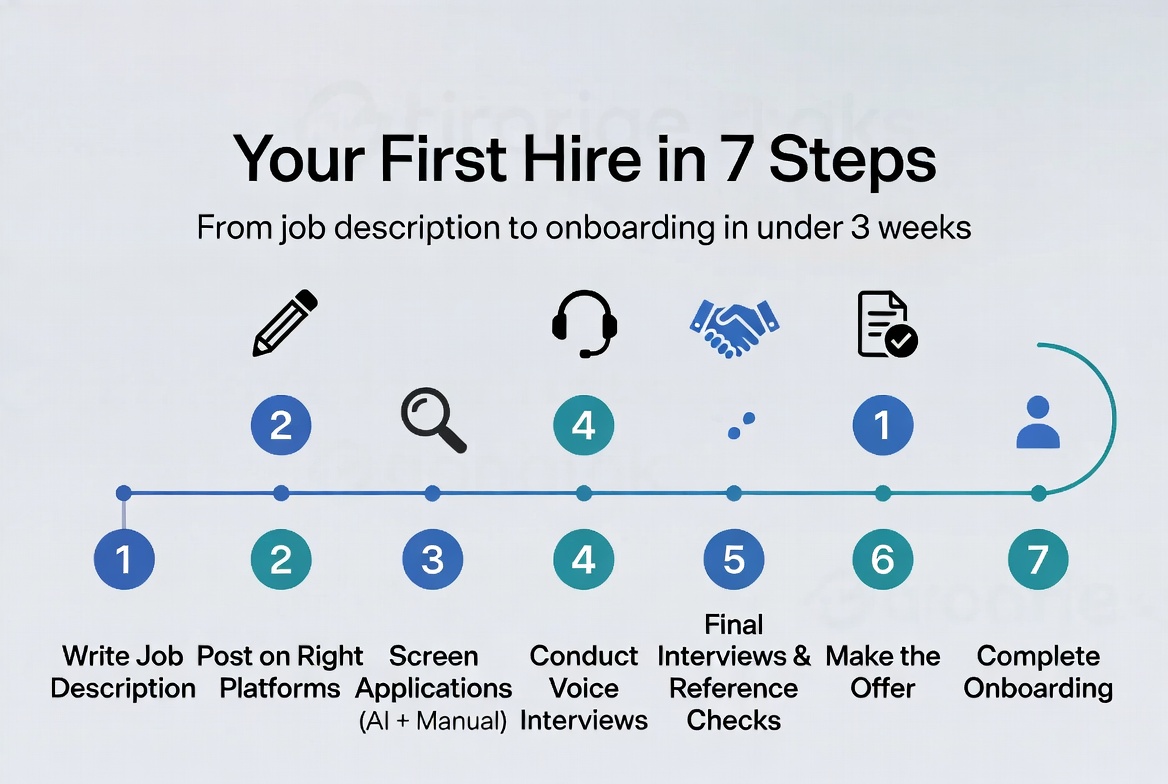
Your first hire in 7 steps. From job description to onboarding in under 3 weeks.
Your First Hire Changes Everything
I want to end with something that doesn't get said enough in hiring guides. Your first hire isn't just a staffing decision. It's the moment your company stops being a solo project and becomes a real team. That shift changes you as a founder. You'll learn how to delegate — and discover it's harder than doing the work yourself. You'll learn how to communicate expectations — and realise you've been keeping half the context in your head. You'll learn how to give feedback — and find out it's the most important skill nobody taught you.
It's messy. It's uncomfortable. And it's the single most important growth step your company will take.
Do it right. Define the role clearly. Screen with criteria, not feelings. Interview with structure, not vibes. Check references. Make the offer fast. Onboard like you care. And if the whole process feels overwhelming, remember — you don't need an HR department to hire well. You need a clear process and the right tools. GigForge gives you both.
Your entire first hire — one platform
Post the job, define your criteria, let AI screen every applicant and interview your shortlist. Review detailed reports with scores and recommendations. Built for founders who are hiring for the first time.