How to Reduce Time to Hire: A Practical Guide for Growing Teams | GigForge
Organisations
How to Reduce Time to Hire: A Practical Guide for Growing Teams
The average company takes 42 days to fill a role. The best companies do it in 10. The difference isn't budget or headcount — it's knowing which steps to keep, which to automate, and which to kill entirely.
By Brabyns Yabwetsa17 June 202610 min read
I'm going to show you exactly where your hiring time is going and how to cut it in half. Not with some enterprise HR transformation project. Not with a six-figure recruitment platform. With specific changes to your process that a 10-50 person team can implement this week.
But first, let's be honest about why time-to-hire matters beyond the obvious "we need someone." Every week a role stays unfilled, your existing team absorbs extra work. Productivity drops. Morale erodes. Your best people — the ones carrying the extra load — start wondering if this is just how it's going to be. And the candidates you're evaluating? The good ones don't wait around. They accept the first strong offer they receive. Your slow process is literally filtering for candidates who have no other options. Think about what that means for the quality of your eventual hire.
ℹ️
When I'm hiring for GigForge, my target is 10 days from posting to offer. That sounds aggressive but it's completely achievable with the right process. The secret isn't working faster — it's eliminating the steps that eat time without adding value. Most of the time in a traditional hiring process is wasted on manual screening and phone calls, not on actual decision-making.
Where Your Time Actually Goes
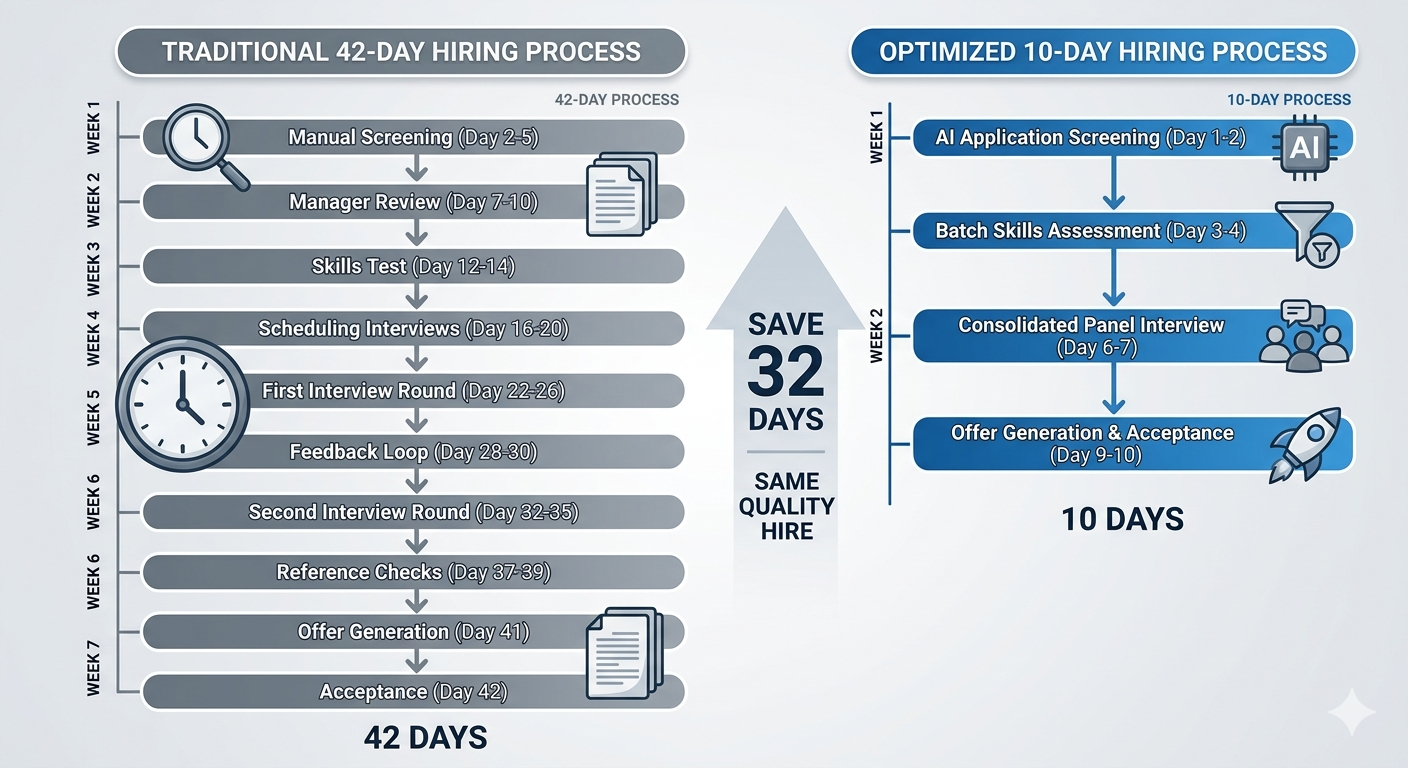
The average time-to-hire across industries is 42 days. But that number hides where the time actually disappears. Let's break it down
Days 1-5: Job goes live. Applications trickle in. You're waiting. Nothing to optimise here — candidates need time to find and apply to your listing.
Days 5-15: Applications pile up. You're "going to review them this weekend." Then next weekend. Then the weekend after that. This is procrastination disguised as busyness, and it's the first place most companies lose time. Those 200 CVs feel overwhelming so they sit in an inbox while your team remains understaffed.
Days 15-25: You finally screen the CVs. It takes 10-20 hours. You shortlist 15 people. Now you need to schedule phone screens with all 15. The scheduling back-and-forth with 15 candidates across different timezones takes another 3-5 days by itself.
Days 25-35: Phone screens. 15 candidates × 15-20 minutes each. Plus prep time, note-taking, and debriefing after each one. That's another 8-10 hours of your time, spread across 1-2 weeks because you can only fit so many calls between your actual job responsibilities.
Days 35-42: Full interviews with the final 3-5 candidates. Decision-making meetings. Reference checks. Offer negotiation. This is the part that should take the most time — and ironically, it's usually the fastest stage because by now everyone's urgent.
See the pattern? The actual decision-making (interviews + offer) takes about 7-10 days. The screening and phone calls take 20-30 days. That's where the fat is.
42 days
Average time to hire. 70% of that is spent on screening and phone calls — not interviews or decision
The 5 Changes That Cut Time-to-Hire in Half
1. Screen CVs the day applications hit 50 — not when the posting expires
Most companies wait until the application deadline passes, then screen everyone at once. This means strong early applicants wait 2-3 weeks just for you to read their CV. Many of them accept other offers during that wait.
Instead: set a trigger. When you have 50 applications, screen them. Shortlist the strong ones immediately. Start voice screens with those candidates while more applications continue arriving. Process in batches rather than one massive pile. This alone can save 7-10 days.
2. Replace the phone screen with a structured voice evaluation
The traditional phone screen is the single biggest time waste in hiring. You spend 15-20 minutes per candidate asking the same 3-4 questions, taking notes, and making a judgement call based on a short conversation you'll barely remember two days later.
The fix: structure the voice screen so every candidate answers the same questions, gets evaluated on the same criteria, and the results are comparable. This can be done by you — with a consistent question list and scoring rubric — or by an AI voice interview system that conducts the conversation automatically and delivers a scored report.
Either way, the key is structure. An unstructured phone chat where you "get a feel for the person" is not a screening method. It's a coin flip dressed up as professional judgement.
With AI voice interviews, the maths is dramatic. Instead of 8-10 hours of phone calls across 2 weeks, every candidate completes their interview on their own time within 2-3 days, and you receive scored reports for all of them simultaneously. The AI evaluates communication, technical knowledge, experience relevance, and problem-solving — the same dimensions you'd assess manually, but consistently across every candidate.
3. Evaluate candidates against criteria, not against each other
Comparative evaluation — "is Candidate A better than Candidate B?" — forces you to wait until you've seen everyone before making a decision. That adds days or weeks to your process.
Criteria-based evaluation — "does this candidate meet our threshold?" — lets you make decisions as soon as each candidate is assessed. If someone scores 90 out of 100 on your criteria in the first batch, you don't need to wait for 50 more candidates to confirm they're strong. Move them to the interview stage immediately.
This requires defining your scoring criteria upfront, which I covered in detail in how to build a hiring process from scratch for a small team. The short version: list 3-5 requirements, weight them, and score every candidate against them. Anyone above your threshold moves forward. Anyone below doesn't. No waiting. No comparing.
4. Run interview stages in parallel, not sequence
Most companies run hiring as a sequential pipeline: screen → phone → interview → panel → offer. Each stage waits for the previous one to finish for all candidates. This is where weeks disappear.
Instead, overlap stages. While you're still screening batch 2 of applications, start voice screens with batch 1's shortlist. While voice screen results come in, start interviewing the top candidates from batch 1. The hiring process should be a flowing pipeline, not a series of gates where everyone waits at each one.
The risk people worry about: "What if I start interviewing someone from batch 1 and a stronger candidate appears in batch 3?" That can happen. But the cost of missing a great candidate from batch 1 because you were waiting for batch 3 is usually much higher. Speed and quality aren't opposing forces — they're aligned, because the best candidates don't wait.
5. Make the offer the same day as the final interview
This is where most growing teams have a genuine advantage over larger companies. A corporation needs 2-3 weeks for approvals, budget confirmations, and HR processing. You can call the candidate the same evening and say "we'd like to offer you the role."
Use that speed. The candidate just finished an interview where they were excited about your company, your team, and the work. Their enthusiasm is highest right now. Every day that passes between the interview and the offer, that enthusiasm fades — and competing offers arrive.
If you need to check references, do it in parallel. Call references the same day as the final interview. Have the offer letter template ready before the interview starts. Prep the compensation package in advance. When the interview ends and you know this is the person, move immediately.
Same quality hire. 32 fewer days. The difference is process, not luck.
The 10-Day Hiring Timeline
Here's what the compressed process looks like when you implement all five changes:
Days 1-3: Job posted. Applications arriving. You're not waiting — you set a batch trigger at 50 applications.
Day 3-4: First batch of 50+ applications screened. Either manually with a scorecard (3-4 hours) or with AI-powered CV screening (2 minutes). Top 10-15 candidates identified.
Days 4-6: Voice evaluations. Either structured calls you conduct with a consistent question list, or AI voice interviews that candidates complete on their own schedule. Reports delivered.
Days 6-8: Full interviews with the top 3-5 candidates. You're interviewing people who have passed two rounds of evidence-based evaluation. These aren't random candidates — these are proven contenders.
Day 8-9: Reference checks (in parallel with final decision-making).
Day 9-10: Offer extended. Candidate accepts.
Total time: 10 days. Total time YOU personally spent: approximately 6-8 hours. Compare that to the traditional 42-day process where you personally spend 25-35 hours.
💡
The most counterintuitive part of reducing time-to-hire: it actually IMPROVES quality. Slow processes lose the best candidates (they accept elsewhere), introduce fatigue bias (your 150th CV review isn't as good as your 1st), and create decision paralysis (too many candidates, too much data, too little clarity). A fast, structured process keeps the best candidates engaged and forces clear, criteria-based decisions.
What AI Actually Changes (And What It Doesn't)
I want to be specific about where AI helps in this process and where it doesn't, because there's a lot of vague "AI will transform hiring!" content out there that doesn't tell you anything useful.
AI screening replaces the 10-20 hours of manual CV reading. It reads every application, scores it against your criteria, and delivers a ranked shortlist. This is real, measurable time savings. It's the single most impactful automation in the hiring process because CV screening is the largest time block and the least intellectually demanding — it doesn't require human judgement, it requires pattern matching at scale.
AI voice interviews replace the 8-10 hours of phone screens. The AI conducts a structured conversation, evaluates responses, and delivers scored reports. Again, real time savings on a task that's repetitive and follows a consistent format. I went deep on how this technology works in my breakdown of AI hiring tools and what actually delivers results versus what's just marketing.
What AI doesn't replace: the final interview, the culture assessment, the gut check on whether this person will thrive on your team. Those decisions require human judgement and human connection. AI handles the screening funnel. You handle the decision.
The real cost of a bad hire at a growing company — where one person might represent 5-10% of your team — makes this investment in process worth every minute. Getting the hire wrong doesn't just cost money; it costs months of momentum you can't get back.
Cut your screening time from 10 hours to 2 minutes
Post a job, define your criteria, and GigForge's AI screens every CV and interviews your shortlist. You get ranked candidates with detailed reports. From 42 days to 10.
You don't need to overhaul your entire hiring process at once. Pick one change from this article and implement it for your next role. If I had to pick one, it'd be number 1: stop waiting for the posting to expire. Screen in batches. Move strong candidates forward immediately. That single change probably saves you 7-10 days on its own.
Then for the next role after that, add structured voice screens. Then criteria-based scoring. Each hire gets faster, better, and less painful. By your third or fourth hire using this process, 10 days will feel normal and you'll wonder how you ever tolerated a 42-day cycle.
Need the full hiring process guide?
If you're building a hiring process for the first time, start here. Step-by-step guide for teams without an HR department.